Ten Years Running with The Doctor

On this day ten years ago, the newest iteration of Doctor Who launched.  Difficult to believe that much time has passed, but I suppose you feel that way about almost everything after a while.  Like so much great television, the adventures of the Doctor have become a great point of connection for me and others, whether its family or friends or students.  The folks at aintitcool.com rounded up a few of the celebratory YouTube clips that have been made in honor of the occasion.  Two of them are definitely worth sharing.  The first, just below, is an amazing fan piece.  Wonderful visuals, as in “I wonder how they did that.”


And if the flash and bang of the series is more to your liking, here’s another great compilation of things.


Ten years and still running.  Splendid!

Posted in Internet, Television | Tagged | Leave a comment

Back to the Island: All of This Matters

As I quickly put together the previous post on the origins of LOST, I remembered that I never quite finished my look back at the show while watching it again last year.  In fact, I think I got up to season two and and stopped, which is a shame because the show has many amazing moments.  So, in honor of today’s earlier post, I thought I’d drop in two last clips from the show.  The first, from season two, exemplifies two of the show’s greatest strengths: the power of reunion and the beauty of a Michael Giacchino score.  The scene crescendoes with Sun and Jin before turning its attention to something sadder.  The score catches all of it perfectly.  In my mind, these two things together are also a big part of why the series ending worked so well for me.


The second clip is one that helped sell me on the series finale.  Even a cursory glance at the “document” I pointed to earlier today tells you that the show could have gone in a million different directions, almost at once.  The more science fiction elements like time travel and sentient smoke monsters and donkey wheels entered the picture, the less certain you were of what ultimately mattered.  And so this brief exchange between Jack and Desmond in the final has become the quote I think of almost as much as I go back to “live together or die alone.”


Thanks for indulging one more look at a show that many viewers have moved on from.  In light of news concerning reboots and continuations of shows like The X-Files and Heroes, one cannot help but wonder when LOST will be brought back around.  As much as I love the show, I hope it’s not for a good, long while.

Posted in Internet, Music, Television | Tagged | Leave a comment

A Last Word on the First Words of LOST

A Page from LOST

Front page of the minutes from a LOST storyboarding meeting in February, 2004.

In a bit I’m going to ask you to click a link, get some comfort food to sip or snack on, and then sit back for a wonderfully interesting read on the “secret origins” of LOST.

For many, the origins of LOST have been the stuff of myth and legend.  Who was the series full-fledged creator?  When did the staff know what the nature of the island?  What were we to make of tidbits of knowledge like the fact that Jack, the surgeon and show’s through-line character, was intended to die in the pilot episode?  One of the major forces behind the first two seasons of the show, Javier Grillo-Marxuach, just posted his best recollection of those early days, and it is a brilliant thing to read.

I say this as someone who was ultimately pleased with the way the show ended and who feels like the show holds up better the second time around ( I surprisingly accomplished that feat last year in honor of the tenth anniversary of the show’s debut).  So I’m at the place where I can enjoy taking a critical eye to the work and appreciate the creative process.

Let me warn you, the article is a doozy: long and winding, just like the series.  Lots of talk about things pre-pilot and post-pilot episode.  Lots of things that you might find as frustrating as some of your least favorite moments from the show itself (like was Walt really some kind of psychic?).  But it could be the best things you’ll read all week (and there are lots of great things out there to read).

So grad some goodies to eat or drink, settle into a nice seat, and click here for an amazing read.

Tip o’ the hat to Andy Greenwald’s Twitter feed.  He pointed this out yesterday.  Greenwald writes about television regularly for grantland.com.

Posted in Internet, Television | Leave a comment

Life as It Buffers

YouTube screenFrom Tom McCarthy’s Satin Island (upon seeing the dreaded swirling circle on his computer screen):

But on this thought’s outer reaches lay a much less reassuring counter-thought: what if it were just a circle spinning on my screen, and nothing else?   What if the supply-chain, its great bounty, had dried up, or been cut off, or never been connected in the first place?  Each time that I allowed this possibility to take hold of my mind, the sense of bliss gave over to a kind of dread.  If it was a video-file that I was trying to watch, then at the bottom of the screen there’d be that line, that bar that slowly fills itself in– twice: once in bold red and, at the same time, running ahead of that, in fainter grey; the fainter section, of course, has to remain in advance of the bold section, and of the cursor showing which part of the video you’re actually watching at a given moment; if the cursor and red section catch up, then buffering sets in again.  Staring at this bar, losing myself in it just as with the circle, I was granted a small revelation: it dawned on me that what I was actually watching was nothing less than the skeleton, laid bare, of time or memory itself.  Not our computers’ time and memory, but our own.  This was its structure.  We require existence to stay ahead, if only by a nose, of our consciousness of experience– if for no other reason than that the latter needs to make sense of the former, to (as Peyman would say) narrate it both to others and ourselves, and, for this purpose, has to be fed with a constant, unsorted supply of fresh sensations and events.  But when the narrating cursor catches right up with the rendering one, when occurrences and situations don’t replenish themselves quickly enough for the awareness they sustain, when, no matter how fast they regenerate, they’re instantly devoured by a mouth too voracious to let anything gather or accrue unconsumed before it, then we find ourselves jammed, stuck in limbo: we can enjoy neither experience nor consciousness of it.  Everything becomes buffering, and buffering becomes everything.

Posted in Commonplace Book | Leave a comment

The Tribe is Us

Anthropology 101When Tom McCarthy’s essay about “fiction in the age of data saturation” posted earlier this month on The Guardian website, a number of writers picked up on the image of James Joyce working for Google:

If there is an individual alive in 2015 with the genius and vision of James Joyce, they’re probably working for Google, and if there isn’t, it doesn’t matter since the operations of that genius and vision are being developed and performed collectively by operators on the payroll of that company, or of one like it.

There’s more going on in the essay, though, than just a thought-provoking image of literary corporate absconsion.  Throughout the essay, McCarthy draws connections between the ethnographer/anthropologist (like Claude Levi-Strauss) and the novelist (thus James Joyce).  For McCarthy, the anthropologist is  “the writer stripped down to the bare structural essentials.  You look at the world around and you report on it.  That’s it.”  And so the conclusive book of the anthropologist equals the novel that might capture the spirit of an age.  Now, though, the task of telling the story of a people is falling into corporate hands, as organizations hire their own anthropologists, “deploying ethnographic knowledge to help [them] achieve deeper penetration of their markets, to advise cities how to brand and rebrand themselves, and governments how better to narrate their policy agendas.”

From the paragraph where James Joyce was mentioned:

That last term – narrate – should bring this whole discussion back to the point it never really left. As for the world of anthropology, so for the world of literature. It is not just that people with degrees in English generally go to work for corporations (which of course they do); the point is that the company, in its most cutting-edge incarnation, has become the arena in which narratives and fictions, metaphors and metonymies and symbol networks at their most dynamic and incisive are being generated, worked through and transformed. While “official” fiction has retreated into comforting nostalgia about kings and queens, or supposed tales of the contemporary rendered in an equally nostalgic mode of unexamined realism, it is funky architecture firms, digital media companies and brand consultancies that have assumed the mantle of the cultural avant garde. It is they who, now, seem to be performing writers’ essential task of working through the fragmentations of old orders of experience and representation, and coming up with radical new forms to chart and manage new, emergent ones.

While fiction writers are in a particularly precarious boat (surrounded by way too much data to process), the same is true for the average citizen on 21st century Planet Earth.  Everyone’s got a story to tell, and they’re telling it all the time through multiple platforms.  And the powers behind those platforms are soaking it up. In turn, we are having our stories tweaked and told back to us as marketing.  We are providing the fodder for others to be our anthropologists.  As McCarthy says early in his essay, “the tribe is us.”

If you get a chance, read the essay.  It’s a good challenge.  McCarthy talks a good bit about particular authors and anthropologists.  The piece is also a good introduction to what you will find if you read Satin Island.  Both remind us that we have turned digital technology into (perhaps) our final story-telling apparatus and that we have made it that way by giving it so much information about us.  The story of our lives, indeed.

Posted in Books, Internet | Leave a comment

In But Not Of, Teaching and Learning Edition

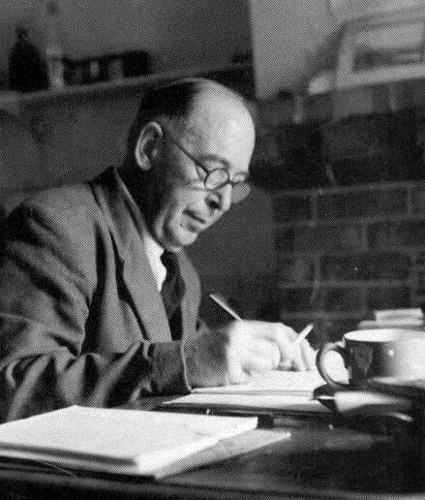
C. S. Lewis WritingReading Alan Jacobs’ biography of C. S. Lewis, I couldn’t help but imagine what it must have been like to listen to the man lecture.  Then I couldn’t help but remember how far most academic institutions have moved from a lecture environment.  Times change, or time changes things.  I feel it a bit myself every year when I find myself caring less about understanding the pop culture references (or lack thereof, oddly enough) of my students.  For writers like Lewis and Tolkien, the divide was much greater.  Lewis tried to acknowledge this in his first lecture at Cambridge.  From that lecture by Lewis, quoted in The Narnian:

I myself belong far more to that Old Western order than to yours.  I am going to claim that this, which in one way is a disqualification for my task, is yet in another a qualification.  The disqualification is obvious.  You don’t want to be lectured on Neanderthal Man by a Neanderthaler, still less on dinosaurs by a dinosaur.  And yet, is that the whole story?  If a live dinosaur dragged its slow length into the laboratory, would we not all look back as we fled?  What a chance to know at last how it really moved and looked and smelled and what noises it made?  And if the Neanderthaler could talk, then, though his lecturing technique might leave much to be desired, should we not almost certainly learn from him some things about him which the best modern anthropologist could never have told us?  He would tell us without knowing he was telling.  One thing to know: I would give a great deal to hear any ancient Athenian, even a stupid one, talking about Greek tragedy.  He would know in his bones so much that we seek in vain.  At any moment some chance phrase might, unknown to him, show us where modern scholarship had been on the wrong track for years.  Ladies and gentlemen, I stand before you somewhat as that Athenian might stand.  I read as a native texts that you must read as foreigners. . . .  It is my settled conviction that in order to read Old Western literature aright you must suspend most of the responses and unlearn most of the habits you have acquired in reading modern literature,  And because this is the judgement of a native, I claim that, even if the defence of my conviction is weak, the fact of my conviction is a historical datum to which you should give full weight.  That way, where I fail as a critic, I may yet be useful as a specimen.  I would even dare to go further.  Speaking not only for myself but for all other Old Western men whom you may meet, I would say, use your specimens while you can.  There are not going to be many more dinosaurs.

Posted in Books, Commonplace Book, Teaching | Tagged | Leave a comment

Goodbye, Glee

Somewhere in the transition between the first and second hour of Glee‘s two-hour finale I had a C. S. Lewis thought, a thought that was confirmed when the show’s second hour started with Will Schuester’s high school glee club coach reminding them that glee club wasn’t about winning something like nationals.  In the end, the coach said, glee club was about “being open to joy.”  That’s something that Lewis understood for most of his life.  And while most of what I saw from my time watching Glee wasn’t about joy, it still had its moments.

Like most viewers of the show, I started losing interest in the show during season two and mostly lost track of things throughout season three.  The show’s weaknesses were evident almost from the start, as this article from Vox asserts confidently.  But when I heard that the show was in its final, shortened season a few weeks ago, I thought I’d pay it the respect that I must admit it deserves.  Let’s face it, Glee holds a particularly weighty place, a particular moment, in our accelerated culture (remember when its covers of old songs topped the iTunes chart along with American Idol?  yeah.  You don’t see that happening anymore on either account).  The show was much like I left it: muddled, misdirected, and scattershot.  Its political agenda was stronger than ever.  And it had eschewed attempts at making the show about any new cast of characters (though the final set of new students wasn’t all that bad).  But the promise of an actual ending is always a draw for those of us who love story.

The finale was more Parks and Recreation than How I Met Your Mother or Lost: it gave long-time viewers what they most wanted.  The evening’s first episode was a flashback recounting how many of the first cast actually met.  It rightfully ended with “Don’t Stop Believing” from the pilot episode.  The second episode of the night was a flash-forward to how most of the original cast turned out, and things turned out well for pretty much everyone.  Everyone got a moment to shine.  After it all, it was a world of piano-band-back-up-choir on demand and the use of slightly awkward songs to convey particular emotions regardless of said awkward content.  How could that world end sadly?

It will be interesting to see how the show is remembered in the long run.  Like the author of the Vox article suggests, “The general consensus is that Glee‘s best season was its 22-episode first season, which is true. But I would go further than that. The best “season” of Glee is actually its first 13 episodes, produced in one chunk, before the last nine episodes of season one were produced later.”  Season two definitely had some good moments (I grow more and more fond of the “Grilled Cheesus” episode each time I watch it).  Still, as the article suggests, it was a show where “sacrifice was only illusory at best.”  If nothing else, it will remind us of just how good singing can be and how, regardless of the moment, maybe we can find some way to be open to joy, even if its seems illusive in a 44-minute network dramedy.

Posted in Internet, Music, Television | Leave a comment

Barry Allen: Time Lord

This week’s episode of The Flash was a doozy.  Over the course of two or three scenes, it moved the story of Barry Allen forward dramatically.  Cisco shot.  A tsunami poised to smash Central City.  Barry and Iris making peace with their feelings.  And the solution to that pending tsunami?  Run back and forth fast enough to stop it from hitting shore.  How fast?  Fast enough for Barry to make his first (and accidental) trip through time.  How far back?  To earlier in the episode.  And what a brilliant episode it was.

Time travel, as any fan of Doctor Who can attest, is a funny thing.  “Time can be rewritten” is a familiar refrain to fans of the Doctor.  Now we get to see if the same is true for the Flash.  I’m hoping that time travel doesn’t become a constant in Allen’s adventures.  I also hope it doesn’t become the easy way out for the writers, a way to have the cake and eat it, too.  Time reboots ultimately become plot cop-outs if they aren’t used wisely.  I think Barry will feel the weight of what he experienced but no one can remember much more heavily than a centuries-old Time Lord.  Here’s the preview for next week’s episode, “Rogue Time.”  Doctor Who, alas, won’t return until the fall.

Posted in Internet, Television | Tagged , | Leave a comment

On Reading the Bible

C. S. Lewis started his lecture, “De Audiendis Poetis,” with the assertion that “there are more ways than one of reading old books.”  What Lewis said to be true of many works of medieval literature is also and ultimately true of the Bible.  Consider this short clip featuring author Eugene Peterson:


I remember talking to a student just last year about how I had hopes that of all the books she had read in school, the one we hoped she would read again and again would be the Bible.  She laughed and said that once would be enough for her.

Reading the Bible is an odd thing.  I know many Christians who, assuming they read it, don’t talk about it very often.  And yet many get up in arms either defending it or their particular view of its nature without giving any real sense of its significance in day-to-day life.  I get asked about the particulars of the Bible occasionally (it’s part of my job), but I’d much rather talk about the stories and letters than particular words or phrases or interpretations (though I have started talking Hebrew terms with my Old Testament class, if only to remind them that the text itself is ancient and its culture different from our own).

I am convinced that we are on the verge of a Bible-less Christianity here in 21st century America.  The more culture shifts, the less we know what to do with it, which really is a shame.  I can’t help but believe that God has an awful lot to say with it, if only we would read and listen.

Posted in Books, Faith, Teaching | Leave a comment

Rebuilding Community

Community is a tricky thing, both fictitious and real.  Just ask the makers of NBC-now-Yahoo’s Community, starting its sixth season today with Yahoo’s Screen service.  If it happened to still be on NBC, it would be the final remnant of it’s Thursday night comedy block (at times with The Office, Parks and Recreation, and 30 Rock).  The show has basically been cancelled twice, lost its show-runner once, and had to deal with losing three original cast members.  Somehow, though, it has survived to have a season six (could a movie be next?).  The first two episodes are available now for free (and legally) here.  The show is still good, slightly crazed and meta.  We’ve got two new characters (“this is the new Shirley”), who might just be different enough to fit in well (and Abed’s take on that possibility is enjoyable to watch).  Both episodes hit the 25-minute mark, which is nice but could work against it, as the show works best when it is punchy.  Here’s the opening scene from the episode:


As always, Andy Greenwald has written a great piece about the new season.  He’s been a fan of the show for a long time and always brings a good critical eye to things.  You can check out his article here. And if you want to see how far the show has come (or gone astray, depending on your perspective), here’s a great scene from the show’s very first episode.  Like too much of life, when the clip goes too long, things just fall apart, the profound moment digresses into crass reality.

Posted in Internet, Television | Leave a comment