A Tale of Time

I’m about 30 pages into Chuck Klosterman’s The Nineties.  Klosterman is one of my favorite non-fiction writers, especially when it comes to American pop culture.  The book looks to be a 300-page dissection of what it was like to live in what many of us (myself included) have called a last kind of decade (before the ubiquity of the internet, Apple, and everything else that came in the early 2000s).

And right on time, UnHerd has posted a piece by Douglas Coupland, one of my favorite fiction (and non-fiction) writers.  Coupland coined the term Generation X, a book I finally got around to reading during my first year in Honolulu).  Along with discovering Dave Eggers, Coupland and Klosterman helped me reflect on a decade I had grown up in (but was by no means fully entrenched in).  The piece is an interesting read.  I’m not sure I agree with all of Coupland’s assertions, but I think he gets the sense of things right.

Part of what is interesting for me now, of course, is the sense that I have of moving through time, that things have changed for me even over the last ten years as a teacher who often relies on the greater narrative of culture to make connections.  So much of that is lost; it really only remains because of Marvel movies.  And even then . . .

Here’s one quote from the piece about the 90s (and the quintessential MTV Unplugged concert by Nirvana) that I quite like:

It was the opposite of right now, when everything drags on forever. Marshall McLuhan said that when one medium makes another obsolete, it frees up that previous medium to become an art form — which is what happened with the internet eclipsing TV. Around the early 2000s you had the Sopranos and other long-form TV programming emerge, shows which could genuinely be considered art. Recently there’s a new Soprano’s show based on Tony Soprano’s early life, The Many Saints of Newark. If they announced that next month the Muppets were doing a Soprano’s variant, I wouldn’t be surprised. As I said, everything goes on forever these days, sprawling out into seasons of episodes and spawning relentless new iterations.

It was Coupland, of course, who put me in the direction of Marshall McLuhan a few years ago when he penned a quick biography of the Canadian thinker.  I’m curious to see where Klosterman lands by the end of his book.  But I’ll also probably take my time to enjoy the read.
Posted in Books, Notes for a World's End, Teaching | Tagged , , | Leave a comment

Gas in the Tank

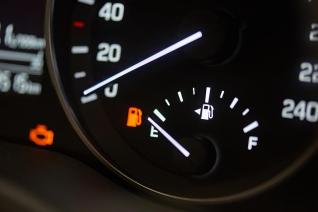
Empty Gas GaugeOne of the questions you are asked when renting a car is whether or not you want to prepay for gas or if you’d rather fill it up right before you return it.  Over the years,  I’ve settled for the first option: paying in advance and then returning with the tank mostly empty.  Sure, gas at the pump is likely to be a little cheaper than what the rental company will charge, but what ultimately constitutes a “full tank of gas”?  Then you have to figure in what time of day you are likely heading to the airport.  When traveling back to Hawaii, I often leave way before dawn, so I prefer not stopping at a gas station.  So pre-paid it is.

This last trip, I predicted gas for the return trip almost too well.  I mostly stayed around the homestead this trip.  Aside from one day-trip to Kentucky, I didn’t make any long drives.  So I filled it up a little, but tried to add just enough to the tank to get me to the airport.

So about a fourth of the way to the airport that morning, the gas light came on.  By my calculations, I should still have been able to make it to the airport with a bit to spare.  But at some point (relatively early on), the gas gauge just flashes a dash instead of giving you a predicted remaining mileage.  Which was a little unnerving to me.  Once you get down the ridge towards Nashville, there aren’t that many easy exits for obvious gas stations.  But I pressed on in hopes that I could make it the whole way.

And I did.  Which was great.  But I wasn’t expecting the nervousness of calling it so close.  I imagine next time I’ll allow for a little bit more buffer. We’ll see.

Either way, a great analogy for living and transitions in life.  On some level, it’s understandable to push until you’ve got nothing left in the tank.  On another, though, that idea is ludicrous.  Because even if there’s not another leg in the same direction, there still might be a return journey.  Life isn’t always a rental car situation: it’s a pit stop, not a terminal stop.

Last week I started my self-declared last semester with my “temporary vocational stretch.”  These last two weeks have been crazy.  The temptation is to just do enough to survive the moment, the meeting, the week in question.  But the road is longer that, and more gas is likely necessary.  And that’s okay.  Maybe it’s not always the best thing to “finish the trip” with as little in the tank as possible.  Maybe sometimes it’s more appropriate to always have more in the tank than you think is necessary.

(image from kawarthanow.com)

Posted in The Long Story, Travel | Leave a comment

Self-Knowledge and Systems

Self-knowledge is almost meaningless if a system is indifferent and unresponsive.

That’s one of my big take-aways from the last couple of years.

Self-knowledge is a good thing.  Not everything, mind you.  But it’s something.  Observation of what makes you tick, “why you get up in the morning,” what it is that brings joy or frustration.  Those are good things to realize about yourself, especially if you get a sense of those things over time and not just in the moment.

But all the self-knowledge in the world is meaningless if the system you are a part of is either indifferent or unresponsive to your realizations of self-knowledge.  Granted, most systems are by nature indifferent and unresponsive.  That’s why they are systems.  I suppose you could use the term frameworkOrganization might be a better fit.  But ultimately, people are behind systems.  And even opting out of a system is probably a kind of system.

There was a quote on the office door of my political science professor in college: freedom is what you do with what’s been done to you (or something like that).  The quote assumes a hierarchy of some kind, a contingency of the individual’s life on something bigger or greater or more powerful.  There’s something slightly defeatist about the quote. (I just looked it up; it’s attributed to Sartre.  So yeah, there’s something existential about it.)  But there’s something freeing about it, too, especially if it points you to what is beyond the system.  Because there is something beyond the system.  And that’s a good thing.

Next time: what I learned from renting a car.

Posted in Notes for a World's End, The Long Story | Leave a comment

Halfway Through

About fifty days ago, I started a journey that I had thought about for some time but ever gotten around to: I started reading Dante’s Divine Comedy.  I did it because one of my favorite newsletter-writers, Matthew Lee Anderson, promoted it as 100 Days of Dante.  Anderson is part of the honors program at Baylor University.  He also writes a lot about politics, ethics, and the Christian faith.

So we read three cantos a week and then get to watch one video per canto where someone, usually from an honors program, talks about key insights into that particular canto.  Yesterday, we hit the halfway mark.  34 cantos of Inferno and now 17 cantos of Purgatory.  Here’s the video for yesterday’s canto.  It’s by Dr. Brian Williams of the Templeton Honors College.  This is his second video.  Both of them have been amazing.

One of the things I like the most about the canto is that it says a lot about “the ordering of loves,” something that I was first introduced to because of Jamie Smith and Augustine.  If Williams is right, it is no coincidence that this topic finds its way into the very middle, the very heart, of Dante’s journey from hell to heaven.

As has been so often the case for me these last few months, I can’t help but think of C. S. Lewis’s The Great Divorce when reading and reflecting on The Divine Comedy.  Dante packs so much into his tale.  Lewis does the same in The Great Divorce, just with a much smaller page count.  After an initial reading of a canto from Robin Kirkpatrick’s edition, I watch the video and then reread the canto, this time from Anthony Esolen’s translation, which is one that I highly recommend.  His introductions and footnotes are quite good.

So halfway through, halfway there.  It’s been an interesting journey for me, if only to dispel some of my preconceptions about Dante’s greatest work.  I’m looking forward and looking ahead, which is exciting.

Posted in Books, Faith | Tagged , | Leave a comment

Last Chance to Breathe?

For those keeping up, yesterday’s Covid test came back negative.  So yesterday afternoon included a basketball game and time with the neighbors.  But today?  That’s the million-dollar, end-of-vacation question.

This semester will be an ending of sorts, mostly by choice.  I may have mentioned before that I started the school year with the decision that, come what may, I would be done with my 5-year “temporary vocational stretch.”  I’m okay saying that it’s been too much for too long for me.  And much of this past semester has affirmed the “decision” for me.  Now it’s a question of how I work towards the end.

At the same time that I’m trying to find a good way to tie off one thread, I’ve got to “on-board” two part-time teachers to a senior-level class.  Which means I need to have my head in the game even more with the classroom, too.

Beyond that, we have a new principal to work with.  We’re still in the process of trying to find a Christian Ministries coordinator (thus, my “temporary vocational stretch”).  We’ve got the Covid up-tick to navigate, too.  And I’m expecting the frustrations of the first semester to still be around for the second.

So how to spend the day?  Well, I was able to get a good chunk of work done before leaving for Tennessee.  And I was able to get some online-learning work done on New Year’s Day.  So, for at least the first week, I’m not in a bad place.  So maybe a movie is in order?  A chance to get to the gym?  Get some reading done?  Either way, it’s the last breath before the plunge.

All of this is a strong reminder of the importance of habits and routines.  When life is packed like this, it’s the habits and routines that will help carry you.  And so it’s important for God and healthy relationships with others to be the foundation of those habits and routines, which can be really difficult since you can’t see God and because healthy relationships can be difficult to maintain (whether you’re single or not).  And then it’s always true, what they say about the best-laid plans.

And I still haven’t done much debriefing of 2021 yet (beyond the few paragraphs above).  I’ll try and get to that this week, too.

Posted in Faith, Friendship, Teaching | Leave a comment

Return to the Lake District

I’m almost a little ashamed at how excited I was to see this today:

Between this and the new Around the World in 80 Days series that starts this Sunday, there’s a good bit of British television to enjoy!

Posted in Television, Travel, Uncategorized | Leave a comment

Itinerant Itinerary

My day started yesterday around 4 in the morning with an email from Delta that my flight out of Nashville had been cancelled and that they had already rebooked me: later flight out of Nashville and then connections in the two airports I have spent years trying to avoid- ATL and LAX.  The trip to ATL is probably like those times it’s cheaper to fly to Maui before leaving the islands: it’s an airline hub thing.

So I drove to BNA just a little later, dropped of my rental car, and grabbed a chicken-biscuit at Chik-Fil-A and had my quiet time.  ATL wasn’t that bad: I only had to take the tram one terminal over.  The tricky part was that that flight was delayed by about an hour and a half, meaning that any lag time I would have had at LAX was shot.  And there’s always the threat that a late flight will get even later before they actually arrived.  God bless Delta.  The first customer service agent I talked to said that if I missed that LAX flight (the last to HNL for the night), they’d hotel me and book me the next day.  Which was not an option for me from a work  perspective.  So I found some (really cheap) tickets for a American flight, which took off some pressure.

The pressure kicked in, though, when I landed at LAX with just a few minutes to try and find my new gate.  The tricky part was that Delta had booked my last leg with Hawaiian, which flies out of a different terminal than the Delta flight to HNL at about the same time.  Small chaos ensued.  I ran some, bags in hand.  And I got to the departure gate hearing my name over the loudspeaker with the warning of “last call.”  But I made it.

The only tricky part at that point was that I didn’t have a chance to pre-check with my HNL QR code (we still require quarantine for those without negative Covid tests or proof of vaccination).  So had I didn’t have the wrist-band that makes getting out of the airport easy.  But the process after landing wasn’t too bad at all.  Plus we landed at one of the recently-refurbished parts of the airport.  It was really nice and good to see.

So not a bad travel day.  Not my best, but also not my worst (here’s looking at you, summer storms and SFO).  The highlight was a quick conversation with a priest in ATL.  He humored some questions I had about the rhythms of life.  Gave me a couple of good book suggestions, which I’m always grateful for.

It’s rainy and overcast here in HNL.  Seems like it’s been that way a good bit lately, which is to be expected.  Covid numbers remain high here and everywhere else.  These next few weeks will be interesting.  I’ve got a few more days before school starts back.  This whole trip has been a reminder that life happens, that you try to be with family even during things like a pandemic, that you acknowledge that some things are beyond anyone’s control.  You try to be responsible and you pray for the best.  Such an interesting way for this year to come to a close.

Posted in Travel | Leave a comment

Learning about Learning

Even when I’m on break, I think a good deal about the classroom.  This break I’ve been reading Matthew Mullins’s Enjoying the Bible, which is a nice literary approach to the Bible that doesn’t land in some soft “Bible as literature only” spot.  I’m just about done with it and have been greatly encouraged by it.

So this weekend I came across this article about learning from Brian Fink.  It speaks to a perennial concern for most teachers about what students learn and why.  A sample paragraph:

There’s a difference between “cramming to pass and learning.” Unfortunately, many current pedagogical models favor the former over the latter – not necessarily in principle, but in practice – because the former provides an immediate tangible metric to evaluate, while the latter may neither show up immediately nor ever, at least in the form it was given. What’s more, teachers find themselves constantly going back over the materials, spending more and more instructional time reviewing and reassessing to make sure the students “get it.” But why? In that scenario, what does the student finally, actually, know, and at what cost to everything he didn’t?

I admit to walking the line with this. Part of why I encourage memorization of material is so that they key points can become background knowledge and because if you don’t know anything, you end up arguing emotions only.  But it can create a “cram to pass” scenario for those not necessarily paying attention.

It’s a good article.  I’m not sure I totally agree with Charlotte Mason’s approach (she plays a key role in the article), but I understand where she’s coming from.  I appreciate that Mason acknowledges a particularly tricky thing about teaching and assessments:

The teacher was deliberately instructed not to pause in the middle of the reading to pose comprehension questions or checks for understanding. By doing so, Mason argued, the teacher trains the student not to pay attention while they are reading, because they soon come to realize that the teacher will eventually tell them what they are supposed to know anyway. And when a student takes this to its logical conclusion, he or she realizes that no actual close reading of any text is required, because again, the teacher has not only told them ahead of time what they are supposed to know (anticipatory sets, objectives written on the board), and told them what they should be knowing as they read (pause for checks for understanding and discussion questions), but will also tell them again what they should have learned by providing a study guide for the upcoming assessment.

It’s a version of “will this be on the test” that I experience often, where students forgo thinking alone or with others because they’ll get the correct answer from me eventually (because they’ll need the correct answer on the test).

It’s good to think about thinking and to learn about learning, especially when it doesn’t fit the mold of an industrialized/instrumentalized education that too often happens today.

Posted in Teaching | Leave a comment

Time’s Fullness

One of the best essays that I read this year was this one by Paul Kingsnorth.   It stands well on its own, even as it also serves as a necessary coda to his most recent (and wonderfully written) book, Savage Gods.  Both recount significant aspects of Kingsnorth’s own journey.  His Substack, The Abbey of Misrule, is also worth following.

The folks at unherd.com recently posted another Kingsnorth piece, this one more about Christmas.  His first one, really.  A snippet about that:

This will be my first Christmas in the church. The Orthodox church, into which I was baptised just under a year ago, has a deep and old and demanding practice around this festival of light. For the last forty days, we have been fasting: today the fast is broken. A child is born, and everything has changed. The birth of Christ marked the beginning of a new age. The Orthodox church talks of Jesus of Nazareth as the “second Adam”. The first human messed up by rejecting God — by choosing control over communion, and falling into self-love. The incarnation of God in human form corrects the error: we get a second chance to turn from ourselves and look to the greater whole.

As the lights of Christmas Day dim, here’s a song to mark the moment.  It’s actually Scripture under the guise of a children’s song by Randall Goodgame.  Here’s a version of the song they used to Kickstart the album that included a song based on Galatians 4:4-7. Definitely a song appropriate to the day.

Merry Christmas!

Posted in Books, Faith, Music, Scripture | Tagged | Leave a comment

“I Will Find a Way”

It’s almost Christmas, so it’s time to repost one of my favorite Christmas songs.  It’s an odd one, more difficult than most Christmas songs.  Gullahorn explains a bit of the song’s origin here.  Whatever else it is, it is a song that builds beautifully and captures something essential about the work of God in our messy world.

Posted in Faith, Music | Leave a comment