The Problem with Perfect

There’s this moment in every season of Big Brother where they have a “double-eviction” night.  They basically run two weeks of game play in one evening.  From an audience perspective, it’s intense.  From a player’s perspective?  I can’t imagine.

We normally have two weeks for our breaks.  It’s one of the benefits of a modified year-round school year.  Because of Covid and our need for more professional development, we’ve had to rearrange the schedule some, which means only one week (and one day) of fall break.  I’m grateful for whatever we can get.  But there’s also this sense of trying to pack two weeks into one.  Granted, I don’t do well with vacations-sans-travel anyway, so I’m still trying to figure out how to parse out the time while also wrapping one cycle of things up and revving up another.

+ + + + + + +

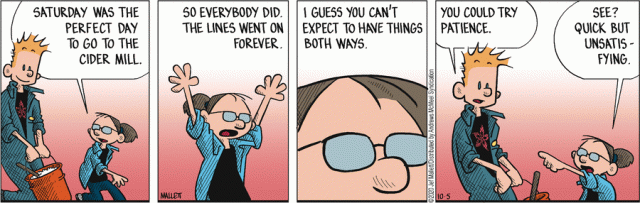
Here’s a recent Frazz that’s a nice mix of things, including an attempt at making patience look like the rapid-response solution.  Patience is often a fun thing to bring into the comics, as it’s something that just a few panels of story don’t have much room for.

Frazz Quick to Answer(image from gocomics.com)

Posted in Uncategorized | Leave a comment

Reconsiderations

One of the things that a longer break can allow for is a certain amount of reflection and reconsideration.  That’s something needed for Our Current Moment, I think.  So much of the last six months has been about trying to stay afloat, maintaining as much a sense of normal as possible.  And that has definitely been a worthy challenge.  Part of the tension of Our Current Moment, though, is whether or not anything like “getting back to normal” will ever actually happen.  What residual things will outlast the solutions of the moment?  And what opportunities are being presented to us through our experiences and (hopefully) gained wisdom?  That works on a number of levels: personal, spiritual, physical, vocational, you name it.  The challenge, then, is to make the time and find the people and the framework to engage in such necessary conversations.  I think that’s part of why I read what I read: reading is a way for me to engage the thoughts of others when I can’t necessarily find that engagement elsewhere.  It’s good to have the window of a week to reflect, to reconsider, and to move forward.  I hope to make something of it.

Posted in Notes for a World's End, The Long Story | Leave a comment

Walking into the Break

Playing this one going into the break.  It’s a remastered version of “Walk On” in celebration of the 20th anniversary re-release of All That You Can’t Leave Behind.  Definitely makes you feel old.  And while it’s one of my favorites, it’s not my favorite cut of the song.  True: a product of its time.  Also true: the band could sometimes catch lightning in a bottle in a way that other musicians could only dream to.

Posted in Faith, Music, The Long Story | Leave a comment

Almost Break

We’re less than 24 hours away from fall break.  One more set of classes, one last round of grading, some slides to put together for when we return.  And that’s about it.  For the most part.  In general.

Because of the way that we rolled out the school year, we’re down to one week of fall break instead of two (we’ll get some time back at the end of the year).  But we’re also returning to full concurrent learning, which we’ve been preparing for but haven’t moved to fully yet.  So there will definitely be some prep-time involved,  which will be good for helping the second quarter move smoothly.

But I’m excited to have a few days away, too.  I’ve got a short stack of novels to read, a couple of theology books to finish, and hopefully some writing to do.  And sleep.  Some good sleep.  And since we’ve started to exit the most recent lockdown, some of my formerly-regular spots have opened back up, which will be nice.  Maybe I’ll even catch a movie (sans popcorn and soda).

It’s been a good quarter . . . it’s feels almost impossible to think that it’s over.  Time runs funny with online learning.  So there will definitely be some reflection on my part to figure out what things can look like moving forward.

Posted in Teaching | Leave a comment

Being Bodies

A couple of days ago I mentioned listening to sermons and talks while getting some grading done.  Here’s another one that I listened to recently by Ephraim Radner.  In many ways, he’s quite different from some of the other writers/pastors/teachers that I follow, but that’s a good thing.  It definitely stretches me to think more holistically.  This is a challenging talk about being bodies.

Posted in Faith, Scripture, Teaching | Tagged | Leave a comment

Learning while Grading

It’s the end of the quarter, which means grades are almost due.  It’s nice to listen to sermon and interviews while taking care of things.  One that I listened to today was this recent interview with James K. A. Smith through the Trinity Forum.  Always Augustine, but always so much more, too.

Posted in Books, Faith, Notes for a World's End, Teaching | Tagged | Leave a comment

Toward a Sense of Suffering?

This last week we have been talking about the problem of evil in class.  It’s a short unit, but you’d like to think it’s something that will come back around (the discussion, not the evil) throughout a lifetime.  Attempting to reconcile good and evil is a difficult thing (unless you over-simplify it).  And that is particularly true for Christians.

Earlier this year, Ephraim Radner was interviewed by the Anglican Journal, primarily about his understanding of the Covid crisis.  He had published a piece or two that had gotten some attention and that demanded follow-up.  (He has since written another one, a piece that I’ve been thinking about for a few weeks now and hope to write about in the next week).  One thing I appreciate greatly about Radner is his sense of the span of a human life along with the need to ask difficult questions.

The question of God’s goodness in such circumstances is at the heart of the conversation for most people, of course.  As we learn in class, God’ goodness and omnipotence are most called into question because of evil.  And the church often doesn’t know how to talk about it.  From the interview:

Yes, the issue isn’t that people before our era didn’t think God was good. They thought that God was good, but they understood goodness differently. You know, Hebrews 12 has this thing about God punishes those whom he loves. Chastises. And that’s suffering, and that’s how you learn. [God is] like a parent, and so on. That whole framework is not one which is acceptable any longer, by and large. And so we don’t have a way of thinking about God’s goodness that can comprehend our own suffering as God-ordered.

I’m not denying that there are all kinds of problems with thinking these ways, you know—God’s justice, and so on. It is complicated, but in the past, by and large, that wasn’t the issue.

Why did it become an issue now? These problems, which are real—”How can we have a good God who also has us suffer and thinks that’s good?” and, “Why didn’t he make things better so we didn’t have to suffer?”—People began to ask those questions in the 17th, 18th centuries, not before, and by and large most people didn’t ask those questions. Now, everybody asks those questions.

And believers, by and large, don’t want to ask those questions—that’s why they’re believers. I’m talking about our current day. You know, plenty of skeptics and atheists and agnostics are willing to realize the complicated problematic character of God’s goodness as we project it out of ourselves onto God. By and large believers don’t want to do that, because they’re holding onto a rather small way, as you put it, of understanding goodness that fits certain cultural patterns and so on. I mean we are a culture that believes—[Canadian philosopher] Charles Taylor wrote this—that the moral goal is to alleviate all suffering as far as possible. We don’t necessarily act that way, but that’s our ethic as a culture. There’s nothing in the Bible about alleviating all suffering as far as possible.

And then concerning Jesus, who represents the divine response to the problem of evil:

He chose to suffer. I lay down my life—nobody takes it from me—and you’re going to have to do the same. That wouldn’t have surprised many people, because everybody knew they had to suffer, but as you said, the fact that one could sort of deify that reality—give it over to the all-good, all-powerful God, was shocking, and it remains shocking to that extent. It’s not an obvious concept. But it’s always been at the centre of the gospel. My point is that COVID now has unveiled the fact that we haven’t, I don’t think, done a very good job of holding on to that at all. I’m talking about within the churches.

There’s more to it than that, of course.  It’s an interview well worth your time.

Posted in Faith, Notes for a World's End, Scripture, Teaching | Tagged | Leave a comment

“A Love That Is Hard”

In preparation for the release of the 20th Anniversary Edition of All That You Can’t Leave Behind, U2 has released a lyric-video for a previously unreleased song from that “era” (if that’s the right word . . . it feels appropriate).  It’s definitely interesting to hear some musical and lyrical resonance from the time.  Here’s “Levitate.”

Posted in Music | Leave a comment

Approaching Quarter’s End

Today I recorded my last chapel talk of the quarter.  Mind you, I hadn’t planned on it happening today.  It was lunch time when a co-worker reminded me that next week was the last week of the quarter.  That plus the fact that I record chapel talks a week in advance has obviously messed with my sense of time.  And so it goes.

It’s a sobering thing to realize that we are a week-and-a-half out from the end of the first quarter.  On one hand, it’s flown by.  On another, the days have just been long.  My students have done a great job hanging in there (as best as I can tell).  It will be interesting to actually meet students face to face later this week (some, not many) and then next quarter (all of them, but never at the same time).  I’ll be curious to see how dynamics change, such as they were.

+ + + + + + +

Today, of course, marks the birthdays of Bilbo and Frodo Baggins.  It was fun to be reminded of that this morning.  When you’re young, you tend to feel like Frodo, I suppose.  But the older you get?  Definitely Bilbo: all you want to do is see mountains again and write your book.  Here’s a favorite clip from The Fellowship of the Ring directed by Peter Jackson.  Sad to remember that Ian Holm has passed just over three months ago.  A great scene.

Posted in Books, Movies, Teaching | Leave a comment

Twenty-Three

Today marked the 23rd anniversary of the death of Rich Mullins.  While I deeply love A Liturgy, a Legacy, and a Ragamuffin Band, I have found Brother’s Keeper becoming a truly close second.  On some level, it feels a little light, but I think it’s deceptive.  Here’s a recording of the title track with Mitch McVicker singing back-up.

Posted in Faith, Music | Tagged | Leave a comment