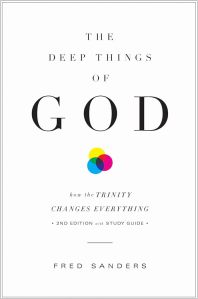
“The Grain of Prayer”

The folks over at Crossway recently posted an excerpt from The Deep Things of God by Fred Sanders having to do with a Trinitarian approach to prayer.  Like the rest of the book, it is an enjoyable and edifying read.  He writes about “the grain of prayer” in a way that illustrates key things about God, people, and prayer.  A quick excerpt:

Wood has a grain to it. The long fibers that make up a piece of wood all run in one direction, and a wise woodworker will always find the direction of that grain before starting to work. He can work along the grain or cut across it, but he avoids planing or sanding against that grain because that is to invite a clash with the directionality built into the piece of wood. Paper has a grain to it as well, which is why you can tear straight lines down the page but not across it. Cat fur has a grain, and if you stroke a cat against that grain, the results are not good for felines or humans. When you work with the grain of the wood, or the paper, or the cat, things go well. When you go against the grain, either because you are oblivious to the structural forces involved or because you consider them negligible, things do not go as well.

The act of prayer has, metaphorically speaking, a grain to it. Prayer has an underlying structure built into it, complete with a directionality that is worth observing. This grain is Trinitarian, running from the Spirit through the Son to the Father. It is a built-in logic of mediation, designed that way by God for reasons deeper than we are likely to fathom. But we do not need to understand it in order to benefit from its solid structural integrity. Nor do we need to take special lessons in praying in a properly Trinitarian fashion. The possibility of praying in a more Trinitarian way is all promise and no threat, all invitation and no danger. Christian prayer is already thoroughly, pervasively, structurally Trinitarian whether you have been noticing it or not. The only thing you have to add is your attention, to begin taking notice of what’s Trinitarian about prayer.

You can read the entire piece here.

Posted in Books, Church, Faith, Life in the Fifth Act | Tagged | Leave a comment

Sunday’s Best: Summertime Scenes

It’s summertime in the Sunday funnies.  Peppermint Patty and Marcie are spending the day out on a hike and run into something odd in nature.

The folks at WuMo bring out a tension that I’ve never understood: reading books at the beach.  I know there are people who do it, but it’s something that’s just beyond me.

And over in FoxTrot?  Well, Roger gives two of his kids a real summertime scare.

Posted in Comics | Leave a comment

My Summer in Scotland

Well, in a weird kind way I’ve spend most of my summer in Scotland.  True, I didn’t get any further east than Tennessee this summer in the real world, but in the world of tv, movies, and books, I’ve regularly found myself in the streets and countryside of Scotland.

It started early in the summer with Dept. Q on Netflix.  Dept. Q is a Scottish version of a Danish book series.  The story follows a London cop relocated to Edinburgh who is trying to make sense of his own near-death experience while also being tasked with a “cold case” office.  There’s not an awful lot of Edinburgh in the show, mostly the occasional “location” shot, but the story is solid if not a little bit gruesome in the end.

During my time in Tennessee, my folks and I watched Guilt on Masterpiece.  The show, which runs for three four-episode seasons, starts a couple of actors from Dept. Q (and ultimately one familiar face from Downton Abbey).  The story follows two brothers and what happens to them after they accidentally run over a man on the way back from a wedding.  It’s been compared to Fargo, which is actually quite fitting.  Definitely a darker comedy with a great soundtrack (and that ends surprisingly well).

When I got back from my time on the mainland, a friend and I caught 28 Years Later in the theater.  We had gone back to watch the earlier movies in the series (28 Days Later and 28 Weeks Later) and were pretty excited for this installment of the not-quite-zombies franchise.  This installment was set in Scotland, first off the coast and then across on “the mainland.”  It’s a simple-but-intense movie with lots of great vista shots (including a couple of shots of Sycamore Gap, which no longer really exists in our world, alas).

And now, as summer turns into another school year, I’m enjoying a trip to Aberdeen, Scotland via the latest Rivers of London novel by Ben Aaronovitch.  Stone and Sky is the tenth novel in the series, and it takes most of the cast from the Folly in London to the Granite City.  I always learn more than I expect about the places Peter Grant and crew visit in their adventures.  So far it’s a wonderfully slow build that seems to involve merpeople (the British edition of the dusk jacket is embossed to feel a bit like fish scales) and creatures from another dimension (?).  I’m savoring the book one chapter at a time.  Not quite an endless summer vacation, but I’m okay with it lingering a little bit longer into the school year.

Posted in Books, Movies, Television, Travel, Uncategorized | Leave a comment

Four Big Questions

Curt Thompson’s The Soul of Desire is the kind of book that paints a picture that you know is beyond your grasp.  He’s a professional writing from his own experience about a kind of community-building that he has created and refined and has great control of.  But I think that’s okay, even if it is a “crumbs from your table” kind of scenario.

Because we all need to learn to do the things that Thompson suggests in the book.  When we are at our best, we do those things naturally: being present, asking questions, helping each other see how God is at work.  Much like Made for People and How to Know a Person, practical things are given that churches and the people in them can find ways to be better Christians together.

Thompson ends the book with a list of four questions, two of which he spent a decent amount of time with earlier in the book.  These four questions are diagnostic questions that help us talk and think together.  They help us locate ourselves: our feelings, our motives, our hopes, and ultimately our desires.  They are:

  1. Where are you?
  2. What do you want?
  3. Can you drink the cup?
  4. Do you love me?

The first question is straight from the Genesis story of Adam, Eve, and God after the couple have eaten from the tree of the knowledge of good and evil.  The remaining three are from Jesus and reflect conversations he had with those needing healing, James and John (and their mother) positioning for power, and Peter as part of his “reinstatement” at the end of John’s Gospel.  At one point Thompson asserts that these questions can (and probably should) be asked by people in all kinds of settings, including work.  It really would be interesting to ask “where are you?” at the beginning of every meeting.  (I check in with my people more broadly/personally at the beginning of most meetings.  Maybe I should try this for a while instead.)

+ + + + + + +

As I type this, I’m about halfway through the book that Thompson wrote between The Anatomy of the Soul and The Soul of Desire.  I’m really enjoying The Soul of Shame, mostly because of how I know it fits with Thompson’s bigger picture (since I essentially skipped from book one to book three).  At the very least, Thompson gives his readers food for thought.  He’s also giving us questions to ask and dispositions and postures to maintain while thinking and asking and listening.  I think we’d all do well to listen to what he has to say.

Posted in Books, Church, Faith, Friendship, Life in the Fifth Act, Organizations and Institutions | Leave a comment

What You Get, What You Really Want

It seems to me that a good deal of “religious” conversation boils down to two things.  The first is conversation as reporting.  This usually comes from a good place, a place of some interest and concern.  Sometimes it can grow into a full conversation, but often it remains a shallow (but necessary) check-in.  And sometimes it can lead to the second kind of conversation: conversation for recruitment.  Because there are always needs, especially in any organization with strong non-profit/volunteer-dependent work to do.  I imagine we have all been on both sides of this kind of conversation.  It’s one of the things I grew tired of that led to my “long epilogue” period a while ago.

I’d like to think we’re all hoping and longing for something more in our “religious” conversations (or just conversations in general . . . unless we can accept that all conversations have an underlying religious nature to them).  One of the last things I’d like to mention from The Soul of Desire by Curt Thompson has to do with what we really want, what we’re always looking for, in relationships and conversations.  They are mentioned throughout the book without ever really getting a full explanation (as best as I can recall or as my notes reflect), but one you see them, they make sense.

Thompson suggests that there are four things that we are always looking for but that they are actually “relational in nature . . . not so much something we acquire as something we share with others.”  That’s an interesting nuance, realizing that you can’t “catch them all” and keep them for yourself.  That leaves them fleeting, fragile, and ultimately dependent on others.  These four things he calls the Four S’s: being seen, soothed, safe, and secure.  In healthy relationships, we are not invisible, not irritated, don’t feel endangered by the immediate, and don’t feel like we have to look over our shoulders to the periphery.  I don’t think the four S’s mean that we are being coddled; there’s something about this list that feels more like solid ground for real action than anything else.

Interestingly enough, the friars at the Poco a Poco podcast often use some of these words, or at least the sense of them, when they talk about how we relate to God.  You can find a couple of examples in this podcast on loneliness and this one on being chosen.  I do think our very human need for this things (and what we do when we can’t find them) speaks powerfully of the way that God has designed us while also reminding us how fragile these vital things are.  We’re looking for them even when we don’t realize it,  hoping to find it everywhere we turn.  Where else better to find them than in our “religious conversations”?

Posted in Books, Church, Faith, Friendship, Life in the Fifth Act, Organizations and Institutions, The Long Story | Leave a comment

Together

I was genuinely, and pleasantly, surprised by how much of Curt Thomspon’s The Soul of Desire is concerned with his idea of confessional communities.  I knew a bit about the idea from skimming through his podcast titles, but wasn’t quite sure what it would look like when fleshed out.  It really was fascinating to see how Thompson understands the role of a particular kind of community  in a Christian’s life.

+ + + + + + +

Before getting to that, let me back-track for a bit to talk about my own interest in community.  As a single guy living far from home for over two decades now, community has become something of a “pearl of great price” for me.  I’ve been blessed with good people in my life; for all of them I am grateful.  But I’ve spent years trying to make sense of (and find?) a Christian community that’s not just Sunday school or a small group or some kind of minor cult.

I partly blame part of this on Larry Crabb’s Connecting, which I read while in seminary.  Something about “turning our chairs to face each other” and telling our own stories as unedited as possible so that the Spirit might work really resonated with me.

And I partly blame C. S. Lewis’s The Four Loves, particularly the chapter on friendship.  One thing he points to in the book (and that is clear from any look at friendship in the ancient West) is Aristotle’s three kinds of friends: fun friends, useful friends, and virtuous friends.  The virtuous friend is the best kind (and the most rare) because that friend meet you where you are and helps you become who you should be.  Lewis, of course, focuses more on the “chosen-ness” of friendship, of finding those who share a common passion (thus asking “you, too?”).  In my head and heart, what better “you, too?” moment can there be beyond the discovery that someone is a fellow Christian, that someone is in the lifelong process of knowing and loving God, of becoming more like Jesus, of learning to walk in step with the Spirit?  It’s a great idea, I’m just not sure how well it works (particularly when there exists an almost-endless varieties of Christianity that focuses on things connected to but (one could argue) second-order from Jesus).

+ + + + + + +

All of this to say that Thompson’s confessional community concept is the closest thing I’ve seen to a group that could embody this kind of Christian friendship of virtue.  Granted, I think “friend” is a term used once, maybe twice, to describe the good work of that community.  And such communities tend to be more clinical than organic, which is tricky.  But there’s some genius to it.  From a neuroscientific perspective, Thompson reminds us:

The brain can do a lot of hard work for a long period of time, as long as it doesn’t have to do it by itself.

And so we need each other.  We need fellow Christians who can help us “work out our salvation with fear and trembling” (Thompson and Philippians 2:12).  I can’t help but think that’s one reason why Paul wrote so much about believers bringing good words to one another instead of always trying to getting in something tongue-inspired (see 1 Corinthians 14).

This is ultimately what Thompson is getting at with his idea of confessional communities:

… I am inviting us to imagine how, being sisters and brothers created by the Holy Trinity in the love of our Father, rescued by our older Brother the King, and nurtured and empowered but the Spirit as we dwell together, we see the resemblance of our Father in each other’s faces, hear our Brother’s delight in each other’s laughter, and revel in the Spirit’s joyful transformation of us as individuals and as a community in each other’s stories of new creation.

Wonderfully Trinitarian, this invitation.

Thompson does spend some time on the realities of the modern church and how (or if) this kind of community could even exist in it (or would it always be more akin to a parachurch thing).  Nonetheless, the book paints an encouraging picture of what a Christian community with deep interpersonal roots can look like, which is encouraging.

Posted in Books, Church, Faith, Friendship, Life in the Fifth Act, Scripture | Leave a comment

“Longing, Beauty, and Community”

A couple of months ago, Airbnb released this ad emphasizing their latest offering: experiences.

It’s a great ad, one that anyone who has planned international travel can appreciate.  I don’t think things are as black-or-white as the ad suggests, but there can definitely be a tendency to say “been there” without really “doing that.”  It’s immersion that matters, the ad says.  It’s making the food and not just eating it. It’s lighting a candle and praying a prayer in the cathedral an not just taking pictures of magnificent windows.

There is a heavy experimental aspect to Curt Thompson’s The Soul of Desire.  In fact, most of the book is Thompson’s attempt at helping the reader understand the dynamic of his “confessional communities.”  That’s part of why “community” is part of the book’s subtitle (which is replicated as the title of this post).

Beyond community, Thompson wants the reader to understand the place of longing and beauty in the “long game” of what God is doing in the new creation.  And he sees neuroscience as a significant key to things.  Most of us hear lots about community at church (or at least in the “Christian living” books we might read), but it feels like less is said about longing and beauty.  Perhaps rightly so: they are less tangible and more ambiguous than community.  Whereas community is writ large across the pages of the Bible, longing and beauty (though present) usually aren’t considered marquee attractions.  When you dig a little deeper, they appear: in particular biblical figures, in the Psalms, on prophetic imagery, and in the words and questions of Jesus.

I suppose the genius move that Thompson makes (a move he makes on the shoulders of Augustine and Lewis and Smith amongst others) is to make room for longing and beauty in community.  Longing and beauty are things to talk about with others, with longing rooted internally and beauty rooted externally.  Strangely enough, both draw us on, are ways that God can lead us to a better place because they are both framed in community.  But because they aren’t explicitly evangelistic/biblical (but aren’t they, though?), we don’t quite know what to do with them in the long run (and they aren’t exactly full-blown courses in seminary).  These two things, just like community, can be made part of a checklist, but they are also key to a particularly Christian experience.  The danger is that, like some kinds of travel, they become some kind of middle/upper-class trend that doesn’t go beyond that particle niche.  I think this is the kind of travel that no one should take for granted, a reminder that “wherever you go, there you are,” and that maybe tourism does the most good when it helps you love home better.

Or think of it this way: longing points us to what can be made beautiful, to a community that becomes beautiful and creates a kind of beauty together.  And that beauty, because it is rooted in Christ, is a part of the new creation and a hint of what Christians are waiting for.

Just a few thoughts about the big picture of the book before turning my attention to two things in particular.  Please take them for whatever they are worth.

Posted in Books, Church, Faith, Life in the Fifth Act, The Long Story, Travel | Leave a comment

Communion, Community, and the Soul

I’d like to spend a few posts this week reflecting on Curt Thompson’s The Soul of Desire, a book I mostly read while in Tennessee this summer.  I’d like to start with a few quotes and three points of to connect.

The first point to connect concerns God.  We’ll call that point “communion.”  Christians believe that the Triune God is knowable, that He has revealed Himself, and that He even dwells in us through the Presence of the Spirit.

The second point to connect concerns others.  We’ll call that point “community.”  Christians believe that we are called to live in fellowship with others through our churches, families, neighborhoods, and more.  We are called to love our neighbors as ourselves (the Old Testament and Jesus) and to outdo one another in love (Paul).

The third and final point to connect concerns ourselves.  We’ll call that point “the soul.”  Not quite the self, which might better name the individuals that we each construct over time.  At the very least, “soul” reminds us that there is more to us than flesh and blood, that there are deeper parts of us than momentary manifestations of emotions and moods.  The soul is the “understory” where all of the deep work happens.

So: communion with God, community with others, and something vital about ourselves we’ll call the soul.  These are the points of connection that Thompson writes about in The Soul of Desire.  They connect and are interconnected on a deep level, so much that Thompson asserts that

… our awareness of being known by God is measured by the degree to which we are known by each other.

Something that Thompson does well, and that helps his ideas resonate with me, is his setting the work of God in the lives of people in the context of the Christian idea of the new creation: that anyone who is in Christ is a new creation and what God makes new in Christ is forever.  This points to the well-worn idea that the kingdom of God is “now and not yet.”  Or, in Thompson’s more psychological terms:

Believing in Jesus, in the way John’s Gospel describes the notion of what it means to “believe,” necessarily puts us on a new path.  The hard part is that we take our old brains with us.

And so there’s the tension of old and new creation, of dueling kingdoms, the struggle between the flesh and the Spirit and its impact on our souls, our communion with God, and our community with others.  But we are not without hope, and that is a good thing.  And while the “solutions” presented The Soul of Desire aren’t necessarily practical (or fully possible) for most of us, there are some helpful tool within that are worth exploring.  Next time we’ll look at the four S’s.  Then we’ll look briefly at Thompson’s four questions.  We might also take a quick look at the place of beauty in Thompson’s thinking, too.

Posted in Books, Church, Faith, Life in the Fifth Act, The Long Story | Leave a comment

On Stupidity and Swimming

Sometimes Seth Godin’s shortest pieces are the ones that sing the most.  He had a couple of great ones this past week, one about stupidity and one about swimming.  The one about stupidity (and not being smart) is an interesting “splitting of the hairs” while the one on swimming is about more than swimming.  Turns out swimming, being in the water, flailing, is about focus and how we spend our energy.  Both are good, quick reads.

[A note on “how we spend our energy”.  This comes up often in Curt Thompson’s writings, about how much energy we expend to not deal with the things that should be dealt with and how freeing it can be to use our energy the right way.  Not an easy thing to do, but something good to be reminded of.]

Posted in Internet, Organizations and Institutions | Tagged | Leave a comment

Summer Reading: The Soul of Desire (part one)

One book I was able to finish before starting my summer mainland trip was Curt Thompson’s Anatomy of the Soul.  I did not intend to read his The Soul of Desire this summer, too, but it’s what I found myself reading during my time in Tennessee.

Taken with something like Fountain of Salvation by Fred Sanders, it’s hopefully a little obvious that I’m thinking about the nature of God and the nature of humanity, with a highly “personal” slant on both.  What does it mean for God to be triune: Father, Son, and Spirit?  And what does it mean to be made in His image and brought into relationship with Him?  And then, ultimately, what does it mean to be drawn into relationship with others?  I think these questions define “the understory” of every human life, really.

Thompson’s The Soul of Desire has a lot in common with the recent work of Andrew Root (When Church Stops Working and Evangelism in an Age of Despair), it’s just that Thompson starts with the individual and moves quickly to the communal.  Both writers want us to think about what it means to sit with someone else, what it means to discern the work of God in the life of a person trying to make sense of the mess of life.  Root’s approach is more organic; Thompson’s is more organized and (for lack of a better term) psychologized.  Thompson also starts with a nice nod to Smith’s You Are What You Love and about mankind’s nature to want, to desire (thus the book’s title).  A quote from early in The Soul of Desire:

What I really long for, it turns out, is for God to show up and compete (if indeed I am created to long for him like I long for nothing else as an expression of being loved by and loving him).I want him to appear in an embodied way in my life now (not just two thousand years or so ago) and give me a genuine experience that will persuade me to want him more than anything else.

It’s awkward, but there’s a part of it that rings true when it comes to our expectations of God.

Next week I’ll be spending two or three posts on some specifics from Thompson’s book.  I liked it a lot, much more than Anatomy of the Soul.  And while I don’t know how practical or possible Thompson’s ideas are for most of us, I do think he’s onto something (or many things) that we could all learn about how we relate to God and to one another.

Posted in Books, Church, Faith, Friendship, Life in the Fifth Act | Leave a comment