About Temptation

The folks over at Desert Fathers in a Year recently crossed the halfway point of their project.  One of the highlights of the project has been the occasional interview with Bishop Erik Varden, who does the exposition of each episode (and answers interview questions quite well).

Varden recently posted a snippet of July’s interview.  The snippet deals with the question of temptation and what to do when it happens in our lives.  I really like Varden’s answer to the question: it includes some good anthropology as well as a pithy response characteristic of the Fathers.  Definitely an internal disposition to aspire to.

Posted in Church, Faith, Life in the Fifth Act, The Long Story | Tagged | Leave a comment

(Super) Mural and Moments

With last week’s release of Fantastic Four: First Steps, the summer movie season has pretty much come to a close.  There are still some potentially fun movies coming out over the next month, but they aren’t quite “tent pole” movies like those we’ve seen these last couple of months.

A few fun Superman bits.

First: James Gunn recently released full images of the characters present in the “Hall of Justice” mural found in the headquarters of the “Justice Gang.”  It’s an interesting look at one version of the history of the DC universe.  We know from the movie’s opening shot that metahumans have been around for three hundred years.  Lots of interesting choices in the mural: lots of deep cuts that fans have been deciphering since Gunn released the images.  Fun seeing Max Mercury in the mix, as he was a key part of Mark Waid’s Flash run back in the day.

Second: Only a handful of clips of the movie have been released outside the theater.  Here’s one moment from the “kaiju” scene in the movie.  Short, yes, but still a nice moment for the character.

And here’s one more clip from the New York Times, this time with director James Gunn talking through some of the dynamics between a fun-yet-fraught conversation between Lois and Clark.

Posted in Comics, Movies | Tagged | Leave a comment

Sunday’s Best: Splishing and Splashing

There’s a fair amount of summer in today’s Sunday funnies.  Roger has Jason mowing the yard over in FoxTrot (and Jason responding with some interesting payment metrics).

In the world of Calvin and Hobbes, the summertime explorers find themselves walking the fine line of curiosity and learning (and all because of a snake).

But Frazz has a fun and simple visual that reminds us of two joys of summer: the splish and the splash of time at the pond.

Posted in Comics | Tagged | Leave a comment

Praying for Humility

Let’s make it three-for-three on the topic of prayer for this week.  On Wednesday I shared about about “The Grain of Prayer” from Fred Sanders.  Yesterday’s post shared the “longer version” of the Serenity Prayer.  Today’s post is about a prayer that I first discovered as a song.

This summer I spent a few days in a (mostly) silent retreat at an abbey in Oklahoma.  In the one actual conversation I had there, a fellow guest told me about “the Litany of Humility,” a wonderfully constructed prayer that inspires humility even in the reading.  You can read the whole thing here.

As soon as the fellow guest mentioned the content of the prayer, my memory turned to a song recorded by one of the Franciscan Friars.  It’s a great rendition of the prayer, which you can listen to a read below.

Speaking of the summer stay at the abbey: I could go four-for-four on prayer this week, but I’m still reflecting on the time at the abbey and the prayer I wanted to guide my time there.

Posted in Faith, Life in the Fifth Act, Music | Tagged | Leave a comment

On the Serenity Prayer

In yesterday’s post I shared something about prayer.  I think it appropriate to do the same today.

The Poco a Poco friars are taking the summer off as a way of marking the year of Jubilee, so I’ve been listening to some of their older podcasts.  This week I’ve been listening to their series from May 2022 on the spirituality of the recovery movement.  Early in the first episode, one of the friars quotes the Serenity Prayer credited to Reinhold Niebuhr.  Most of us know the opening lines of the prayer . . . most of us assume that’s all there is to the prayer.  Turns out that there was an addition made to the prayer (many sources say it’s not from Niebuhr) that I think are really interesting.  Here’s the “whole” thing (referred to as Niebuhr’s “poem”):

God, grant me the serenity to accept the things I cannot change,
Courage to change the things I can, and the wisdom to know the difference.

Living one day at a time; Enjoying one moment at a time;
Accepting hardship as the pathway to peace.
Taking, as He did, this sinful world as it is, not as I would have it.
Trusting that He will make all things right if I surrender to His Will;

That I may be reasonably happy in this life, and supremely
happy with Him forever in the next.
Amen

If nothing else, it’s a really nice addition, memorable in its own way, especially the “reasonably happy . . . supremely happy” bit at the end.  There’s something very real, down-to-earth about the whole thing (which is one reason why I think the recovery movement has a lot to offer the Church . . . or to help the Church see what it already has).

Posted in Church, Faith, Just As I Am, Recovery Journal | Tagged | Leave a comment

“The Grain of Prayer”

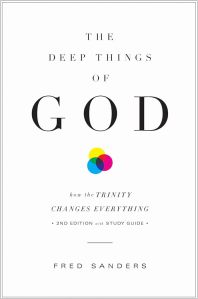
The folks over at Crossway recently posted an excerpt from The Deep Things of God by Fred Sanders having to do with a Trinitarian approach to prayer.  Like the rest of the book, it is an enjoyable and edifying read.  He writes about “the grain of prayer” in a way that illustrates key things about God, people, and prayer.  A quick excerpt:

Wood has a grain to it. The long fibers that make up a piece of wood all run in one direction, and a wise woodworker will always find the direction of that grain before starting to work. He can work along the grain or cut across it, but he avoids planing or sanding against that grain because that is to invite a clash with the directionality built into the piece of wood. Paper has a grain to it as well, which is why you can tear straight lines down the page but not across it. Cat fur has a grain, and if you stroke a cat against that grain, the results are not good for felines or humans. When you work with the grain of the wood, or the paper, or the cat, things go well. When you go against the grain, either because you are oblivious to the structural forces involved or because you consider them negligible, things do not go as well.

The act of prayer has, metaphorically speaking, a grain to it. Prayer has an underlying structure built into it, complete with a directionality that is worth observing. This grain is Trinitarian, running from the Spirit through the Son to the Father. It is a built-in logic of mediation, designed that way by God for reasons deeper than we are likely to fathom. But we do not need to understand it in order to benefit from its solid structural integrity. Nor do we need to take special lessons in praying in a properly Trinitarian fashion. The possibility of praying in a more Trinitarian way is all promise and no threat, all invitation and no danger. Christian prayer is already thoroughly, pervasively, structurally Trinitarian whether you have been noticing it or not. The only thing you have to add is your attention, to begin taking notice of what’s Trinitarian about prayer.

You can read the entire piece here.

Posted in Books, Church, Faith, Life in the Fifth Act | Tagged | Leave a comment

Sunday’s Best: Summertime Scenes

It’s summertime in the Sunday funnies.  Peppermint Patty and Marcie are spending the day out on a hike and run into something odd in nature.

The folks at WuMo bring out a tension that I’ve never understood: reading books at the beach.  I know there are people who do it, but it’s something that’s just beyond me.

And over in FoxTrot?  Well, Roger gives two of his kids a real summertime scare.

Posted in Comics | Leave a comment

My Summer in Scotland

Well, in a weird kind way I’ve spend most of my summer in Scotland.  True, I didn’t get any further east than Tennessee this summer in the real world, but in the world of tv, movies, and books, I’ve regularly found myself in the streets and countryside of Scotland.

It started early in the summer with Dept. Q on Netflix.  Dept. Q is a Scottish version of a Danish book series.  The story follows a London cop relocated to Edinburgh who is trying to make sense of his own near-death experience while also being tasked with a “cold case” office.  There’s not an awful lot of Edinburgh in the show, mostly the occasional “location” shot, but the story is solid if not a little bit gruesome in the end.

During my time in Tennessee, my folks and I watched Guilt on Masterpiece.  The show, which runs for three four-episode seasons, starts a couple of actors from Dept. Q (and ultimately one familiar face from Downton Abbey).  The story follows two brothers and what happens to them after they accidentally run over a man on the way back from a wedding.  It’s been compared to Fargo, which is actually quite fitting.  Definitely a darker comedy with a great soundtrack (and that ends surprisingly well).

When I got back from my time on the mainland, a friend and I caught 28 Years Later in the theater.  We had gone back to watch the earlier movies in the series (28 Days Later and 28 Weeks Later) and were pretty excited for this installment of the not-quite-zombies franchise.  This installment was set in Scotland, first off the coast and then across on “the mainland.”  It’s a simple-but-intense movie with lots of great vista shots (including a couple of shots of Sycamore Gap, which no longer really exists in our world, alas).

And now, as summer turns into another school year, I’m enjoying a trip to Aberdeen, Scotland via the latest Rivers of London novel by Ben Aaronovitch.  Stone and Sky is the tenth novel in the series, and it takes most of the cast from the Folly in London to the Granite City.  I always learn more than I expect about the places Peter Grant and crew visit in their adventures.  So far it’s a wonderfully slow build that seems to involve merpeople (the British edition of the dusk jacket is embossed to feel a bit like fish scales) and creatures from another dimension (?).  I’m savoring the book one chapter at a time.  Not quite an endless summer vacation, but I’m okay with it lingering a little bit longer into the school year.

Posted in Books, Movies, Television, Travel, Uncategorized | Leave a comment

Four Big Questions

Curt Thompson’s The Soul of Desire is the kind of book that paints a picture that you know is beyond your grasp.  He’s a professional writing from his own experience about a kind of community-building that he has created and refined and has great control of.  But I think that’s okay, even if it is a “crumbs from your table” kind of scenario.

Because we all need to learn to do the things that Thompson suggests in the book.  When we are at our best, we do those things naturally: being present, asking questions, helping each other see how God is at work.  Much like Made for People and How to Know a Person, practical things are given that churches and the people in them can find ways to be better Christians together.

Thompson ends the book with a list of four questions, two of which he spent a decent amount of time with earlier in the book.  These four questions are diagnostic questions that help us talk and think together.  They help us locate ourselves: our feelings, our motives, our hopes, and ultimately our desires.  They are:

  1. Where are you?
  2. What do you want?
  3. Can you drink the cup?
  4. Do you love me?

The first question is straight from the Genesis story of Adam, Eve, and God after the couple have eaten from the tree of the knowledge of good and evil.  The remaining three are from Jesus and reflect conversations he had with those needing healing, James and John (and their mother) positioning for power, and Peter as part of his “reinstatement” at the end of John’s Gospel.  At one point Thompson asserts that these questions can (and probably should) be asked by people in all kinds of settings, including work.  It really would be interesting to ask “where are you?” at the beginning of every meeting.  (I check in with my people more broadly/personally at the beginning of most meetings.  Maybe I should try this for a while instead.)

+ + + + + + +

As I type this, I’m about halfway through the book that Thompson wrote between The Anatomy of the Soul and The Soul of Desire.  I’m really enjoying The Soul of Shame, mostly because of how I know it fits with Thompson’s bigger picture (since I essentially skipped from book one to book three).  At the very least, Thompson gives his readers food for thought.  He’s also giving us questions to ask and dispositions and postures to maintain while thinking and asking and listening.  I think we’d all do well to listen to what he has to say.

Posted in Books, Church, Faith, Friendship, Life in the Fifth Act, Organizations and Institutions | Leave a comment

What You Get, What You Really Want

It seems to me that a good deal of “religious” conversation boils down to two things.  The first is conversation as reporting.  This usually comes from a good place, a place of some interest and concern.  Sometimes it can grow into a full conversation, but often it remains a shallow (but necessary) check-in.  And sometimes it can lead to the second kind of conversation: conversation for recruitment.  Because there are always needs, especially in any organization with strong non-profit/volunteer-dependent work to do.  I imagine we have all been on both sides of this kind of conversation.  It’s one of the things I grew tired of that led to my “long epilogue” period a while ago.

I’d like to think we’re all hoping and longing for something more in our “religious” conversations (or just conversations in general . . . unless we can accept that all conversations have an underlying religious nature to them).  One of the last things I’d like to mention from The Soul of Desire by Curt Thompson has to do with what we really want, what we’re always looking for, in relationships and conversations.  They are mentioned throughout the book without ever really getting a full explanation (as best as I can recall or as my notes reflect), but one you see them, they make sense.

Thompson suggests that there are four things that we are always looking for but that they are actually “relational in nature . . . not so much something we acquire as something we share with others.”  That’s an interesting nuance, realizing that you can’t “catch them all” and keep them for yourself.  That leaves them fleeting, fragile, and ultimately dependent on others.  These four things he calls the Four S’s: being seen, soothed, safe, and secure.  In healthy relationships, we are not invisible, not irritated, don’t feel endangered by the immediate, and don’t feel like we have to look over our shoulders to the periphery.  I don’t think the four S’s mean that we are being coddled; there’s something about this list that feels more like solid ground for real action than anything else.

Interestingly enough, the friars at the Poco a Poco podcast often use some of these words, or at least the sense of them, when they talk about how we relate to God.  You can find a couple of examples in this podcast on loneliness and this one on being chosen.  I do think our very human need for this things (and what we do when we can’t find them) speaks powerfully of the way that God has designed us while also reminding us how fragile these vital things are.  We’re looking for them even when we don’t realize it,  hoping to find it everywhere we turn.  Where else better to find them than in our “religious conversations”?

Posted in Books, Church, Faith, Friendship, Life in the Fifth Act, Organizations and Institutions, The Long Story | Leave a comment