
Let’s start with the classic Peanuts strip that ran at gocomics.com on Christmas day:

Most of us, I think, would relate a bit more with Charlie Brown, who understands the Christmas story primarily through the main images of the gospels. Linus, then, would be charged with unnecessarily complicating the Christmas story with issues of language and intertextuality. On one side, you might have the average church-goer on Christmas day with the preaching pastor on the other. Both are correct, of course. But the strip also suggests some important things concerning communication and religious truth and what we can or cannot handle.
+ + + + + + +
One of our last assignments at school this last semester was to think through the assertions made by Jonathan Merritt in this New York Times essay about the decline in the use of particularly Christian/spiritual language. Merritt’s argument is rooted in his own experience, moving from the Bible belt to a northern metropolitan area. But it also led to working with the Barna group, which is no small thing. From the article:
More than one-fifth of respondents admit they have not had a spiritual conversation at all in the past year. Six in 10 say they had a spiritual conversation only on rare occasions — either “once or twice” (29 percent) or “several times” (29 percent) in the past year. A paltry 7 percent of Americans say they talk about spiritual matters regularly.
But here’s the real shocker: Practicing Christians who attend church regularly aren’t faring much better. A mere 13 percent had a spiritual conversation around once a week.
For those who practice Christianity, such trends are confounding. It is a religion that has always produced progeny through the combination of spiritual speech and good deeds. Nearly every New Testament author speaks about the power of spiritual speech, and Jesus final command to his disciples was to go into the world and spread his teachings. You cannot be a Christian in a vacuum.
+ + + + + + +
Back in November, I mentioned a list of terms that I wanted to hover around for a while ruminate on, because they kept popping up in my mind or being evidenced in my interaction with others. One of those words was “constraints.” The term can easily apply to multiple dynamics in life. If Merritt is right, one of those constraints involves our language . . . and by easy extension . . . our relationships and communities. We are limited in vocabulary and by thought (because you need to be able to connect thoughts with words). So Merritt is correct in asserting that we have a problem of rhetoric on our hands. But it also reveals a loss in the grammar of the faith and shows a lack of thoughtfulness with the grammar we do have access to. And that’s why we too often find ourselves with a faith vocabulary that involves the instrumentalization of others.
How do we navigate well between parish and program life in churches when we have lost the good practice of communicating Gospel truth well amongst ourselves? How do we revive the language of real connection and community when it has been replaced with the institutional and instrumentalized? How do we take self talk and shop talk and redeem them with soul talk? How do we accomplish this task amongst ourselves, those walking in the faith, in a way that helps articulate what we know to those on the periphery?
+ + + + + + +
Perhaps we are entering a time where even Charlie’s “all I ever knew about was the stars and the sheep on the hillside” no longer communicates what we assume it does. That’s a sobering thought. But it’s also a thought we should entertain with hope, as it presents the opportunity of communicating well truths we too often take for granted.
 Today many Christians around the world spent time reflecting on the life of John the Evangelist, the apostle who penned a gospel and three letters found in the New Testament. John is a fascinating figure on multiple levels, particularly with what he “brings to the table” as the one non-synoptic gospel.
 One thing I’m trying to do a little more of as I get older is to establish some set “reading patterns” for different parts of the year. Holidays are often geared that way, of course. Then you work in classics like The Lord of the Rings or something from Lewis, and you have a nice rhythm of significant literature to reflect with at key moments in the year.
 And just like that the Advent season comes to an end. It was a good and challenging Advent season for me. We spent the weeks between Thanksgiving and exams thinking about Advent in chapel. My guide through much of that time was Fleming Rutledge through her collection of sermons and essays titled Advent. From the book’s introduction:
 Somewhere along the way, from some book I no longer remember, I learned that faith and imagination are intimately tied together. And that’s not just the “artistic” idea of the imagination. It’s something like Charles Taylor’s “social imaginary” idea: the way you perceive and sense the world to be, the way you understand it working or not. As a Christian, my belief in things I cannot see, that have been passed down by those who saw and heard and touched, that have been confirmed in odd but comforting ways in my own experience, requires a constant act of imagination, to believe things are a particular way even when there can be little or no evidence for it in the moment.
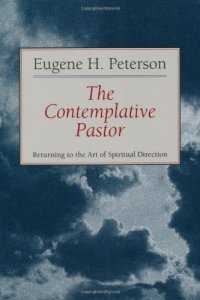 These last few weeks have been a reminder of the frustration that comes with being busier than you ever intended to be. In the midst of it all came news of the death of Eugene Peterson, who has probably shaped more of my understanding of church work than anyone else (he gives hands and feet to things that you get a sense of from thinkers like Nouwen or Bonhoeffer). One of Peterson’s best short pieces (and there are many) is “The Unbusy Pastor,” which I read in The Contemplative Pastor and which started making the rounds again online in the wake of Peterson’s passing. It’s a convicting piece that I’d thought I’d gloss on some over the next few days.


 Space Enough, and Time