
Last month I started a new tag and thread on the site about “Notes for a World’s End.” The premise of the thread was that this current moment is an odd but interesting turning point for me (and perhaps for others) on multiple levels. The hope of the thread is to draw together some resources and reflections for making this particular moment a little clearer, not out of despair but our of faith, hope, and love. I spent a few days looking at the first couple of questions asked in Henri Nouwen’s Spiritual Direction. And while I plan to return to Nouwen at some time soon, I’ve had a nice and challenging detour to my thinking thanks to a book I bought years ago but never read.
+ + + + + + +
 Every spring, I spend a quarter of the school year talking about ethics with seniors. It’s one of my favorite times of the year. There’s a lot of good presuppositional “stuff” that goes into the conversation of how we determine something to be right or wrong. And while I help my students be aware of multiple approaches to ethics, I hope that they will see the biblical story as a vital lens for decision-making. But that can be difficult since many students tend to write off the Christian faith as something that actually shuts down conversation. Some time ago, I think it was because of a comment by James K. A. Smith, I purchased a copy of Self, World, and Time, the first of three books about “ethics as theology” by Anglican theological Oliver O’Donovan. I just couldn’t get into it. I’ve since read a couple of shorter things by O’Donovan and found him to be a great, relatable thinker of the ethical dimension of the church in the 21st century. So I decided to give Self, World, and Time another chance. He has something good, I think, about “finding a way forward” for Christians striving to live faithfully and fittingly in our part of the biblical story.
+ + + + + + +
Within four pages of the the book’s first chapter, O’Donovan used a word, a metaphor, that I have come to appreciate greatly over the last few years, mostly because of its presence throughout the Gospel narratives and the writings of Paul. It is the image, the metaphor, of waking up/staying awake. O’Donovan roots this in a conversation about moral awareness, which definitely connects to a bigger picture of living fittingly and faithfully. O’Donovan asserts:
Let us say, we awake to our moral experience in the beginning. What seems like the beginning is not really a beginning at all. We wake to find things going on, and ourselves going on in the midst of them.
This moral awakening, O’Donovan, points to an “awakening that will be complete and final: ‘Awake, sleeper, rise from the death, and Christ will shine upon you!'” from the fifth chapter of Paul’s letter to the church in Ephesus. From there, he traces the biblical instances of waking from sleep, pointing out that the charge to “wake up” in the Old Testament seems to be spoken to God quite often. Then it shows up in the apocalyptic parables and sermons of Jesus, in certain moments of His passion week, and ultimately in John’s Revelation. O’Donovan concludes:
And so the command to wake is addressed in the New Testament chiefly to the church, which out to be able to count, if any agent could, on being awake already. It sets the church in a moment of crisis, put on the spot, by relating the achieved past to the future of Christ’s coming and to the immediate future of attention and action. Wakefulness is anything but a settled state, something we presume on, as we can usually presume we are awake as we go about our business. It brings us sharply back to the task in hand, the deed to be performed, the life to be lived. Waking is thrust on us. We do not consider it, attempt it and then perhaps achieve it; we are claimed for it, seized by it. That is why it is not just one metaphor among many for moral experience, but stands guard over the birth of a renewed moral responsibility.
+ + + + + + +
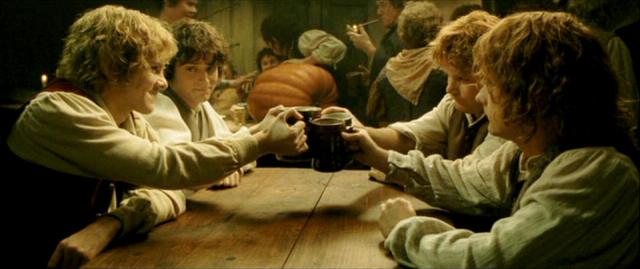
One can easily imagine the significance of this idea, this truth, to stories and literature involving high stakes and worlds on the brink of being lost forever. Often it is the weight of the world and one’s journey through it that tires one out, leaves us nodding off. You get a glimpse of that even (and perhaps especially) at the end of Frodo’s journey in The Lord of the Rings. Upon the completion of their task, as the four hobbits return to Hobbiton after Gandalf’s departure, Tolkien writes:
“Well here we are, just the four of us that started out together,’ said Merry. ‘We have left all the rest behind, one after another. It seems almost like a dream that has slowly faded.’
‘Not to me,’ said Frodo. ‘To me it feels more like falling asleep again.”
 + + + + + + +
And so in this little metaphorical (or digital) notebook for a world’s end I cannot help but write two simple words: stay awake. I’ll come back to the idea and O’Donovan’s approach to it over the next couple of days.
(images from amazon.com and lotr.wikia.com)
 Now that the school year is over, I have the time to think through changes for classes in the fall. I recently tracked down my copy of Stratford Caldecott’s The Beauty of the Word. Written from a particularly Catholic perspective, the book is a nice gloss on the classical trivium and Dorothy Sayers’ “Lost Tools of Learning.” It’s a good resources for me as I look to tweak some language and articulations of curriculum.
 I’ll be preaching at church this Sunday, my second time since our pastor resigned a few months ago. It’s always tricky for me to speak in front of a congregation, partially because I spend so much time in front of a classroom, which has a very different dynamic. Another tricky aspect of preaching is that speaking to a church in transition can be awkward because you want to talk about the transition while also NOT wanting to talk about the transition.
 Today marked the birthday of one of my favorite authors, G. K. Chesterton. To mark the occasion, a number of fans on Twitter shared how they were introduced to the early-20th century author. For many it was their involvement with the Roman Catholic church. For other, it was the writings of C. S. Lewis or some other apologist. For me, it was the autobiographical writings of Frederick Buechner. His first autobiographical book, The Sacred Journey, introduced the character of Sunday as found in The Man Who Was Thursday, which was the first full Chesterton book that I read in college. From there it was to Orthodoxy and then to some of his other writings. This past Christmas I joyfully ordered a copy of The Spirit of Christmas, a collection of essays, stories, and poems about the Christmas season. I look forward to reading it during the Advent and Christmas seasons for many years to come.
 (image from gocomics.com)
 A few weeks ago I asked my students a round of questions about marriage and friendship. As is often the case with seniors, the answers were interesting. A couple of kids, quite out of the blue, decided to answer my questions with references to Parks and Recreation, one of the last great sitcoms. The students pointed out the way that characters like Leslie Knope and Ben Wyatt and even Ron Swanson were able to embrace both romantic love and real friendship in ways rarely seen.
 Last night I caught a last-minute early showing of Solo: A Star Wars Story. I had kind of talked myself out of any early showing. Buzz around the movie had been mediocre at best. There had been some drama behind the scenes, which is always a warning sign (even if you bring in Ron Howard to fix it). But then, as the school year’s end came closer, I thought I’d see if there were any early tickets available. There were, and so I went.


 Space Enough, and Time