
 At the begin of Paul Auster’s apocalyptic In the Country of Last Things, the narrator makes a significant observation:
That is perhaps the greatest problem of all. Life as we know it has ended, and yet no one is able to grasp what has taken its place. Those of us who were brought up somewhere else, or who are old enough to remember a world different from this one, find it an enormous struggle just to keep up from one day to the next. I am not talking only of hardships. Faced with the most ordinary occurrence, you no longer know how to act, and because you cannot act, you find yourself unable to think. The brain is a muddle. All around you one change follows another, each day produces a new upheaval, the old assumptions are so much air and emptiness. That is the dilemma. On the one hand, you want to survive, to adapt, to make the best of things as they are. But, on the other hand, to accomplish seems to entail killing off all those things that once made you think of yourself as human.
A few pages later, the narrator concludes:
What you must do, then, is to be prepared for anything.
The story, of course, gets more difficult from there.
+ + + + + + +
In his grossly under-appreciated work, The End of Absence, journalist Michael Harris asserts something similar, perhaps a tad bit less apocalyptic, but nonetheless revealing. As he reflects on advances in technology, Harris is mindful that people of a certain again are able to recall both life before and after the digital divide of the last twenty years. After reminding the reader of the 20th century techno-cultural prophet Marshall McLuhan, Harris writes of a “profound wreckage” that our new “medium” has wrought. He continues:
As we embrace a technology’s gifts, we usually fail to consider what they ask from us in return– the subtle, hardly noticeable payments we make in exchange for their marvelous service. We don’t notice, for example, that the gaps in our schedules have disappeared because we’re too busy delighting in the amusements that fill them . . . Why would we bother to register the end of solitude, of ignorance, of lack? Why would we care than an absence has disappeared?
Harris’s wreckage is more hopeful than Auster’s narrator. He continues:
. . . if we work hard enough to understand this massive game changer, and the name the parts of the new game we want to go along with and the parts we don’t, can we then pack along some critical aspect of our earlier lives that these technologies would otherwise strip from us? Or will we forget forever the value of that lack and instead see only a collection of gains? It’s hard to remember what we loved about absence; we never ask for our deprivation back . . .
If we’re the last people in history to know life before the Internet, we are also the only ones who will ever speak, as it were, both languages.
Because of this, Harris asserts that we should ask two key questions moving forward into whatever is next: what will we carry forward? and what worthy things might we thoughtlessly leave behind?
+ + + + + + +
One thing I remember from some of my “philosophy of religion” studies in seminary was a quote from Anthony Thiselton that has long been lodged in my brain. If I remember it correctly, Thiselton one time asserted that “history reminds us of what is possible; fiction reminds us of what is essential.” I remember thinking the saying odd, like he had gotten the two things confused. But I think the statement is true. And now, as much or more than ever, we are living at a time where fiction and history, where what is possible and what is essential, are inextricably linked.
+ + + + + + +
Perhaps there are three kinds of people living today: those who have not heard of the Benedict Option, those who find the Benedict Option an utter necessity, and those who think that the Benedict Option is utter hogwash. It can be an interesting Rorschach test. The Benedict Option as articulated by Rod Dreher, of course, is often misconstrued as an over-reaction to our current historical moment, as a call to “head for the hills” because Christians have lost their say in what is vital to our culture. You don’t have to ascribe to this Option (or any of the myriad others named after whatever philosopher or thinker strikes your fancy) to realize, to understand that things have changed/are changing. you can see it in Kinneman and Lyon’s Good Faith or in Deneen’s Why Liberalism Failed. Every end of the political spectrum feels like everything is in danger right now. And every end of the spectrum is, in some way, correct.
The question is, how do we move through this? I’ve been asking myself that for some time, most recently in my reflections around Radner’s A Time to Keep. I would like to think that mine is a particularly Christian seeking and asking (though I sometimes find glimmers of hope and despair in other places, too). A lot of my reading has been about trying to find some way through, knowing that around has never really been an option. This has been brought to mind again recently because of life circumstance as well as the books I continue to read and the conversations I continue to long for.
+ + + + + + +
So I thought I’d start a thread for this. Whether it’s Wendell Berry or Henri Nouwen, Alan Jacobs or James K. A. Smith, Tolkien or Lewis or Chesterton, my students or my family or my friends, they all connect somehow to this thread for things found and lost and found again.
How do you “prepare for anything” in a world that’s been changing for longer than you’ve known it? And how do you hold on to and articulate unchanging truth in a world moving so quickly that the passing shadows end up chasing one another? How do you, as Harris asserts, know what to carry forward without leaving worthy things accidentally behind?
(image from rottentomatoes.com, because Edgar Wright’s The World’s End is brilliant and deserves mention every time possible)
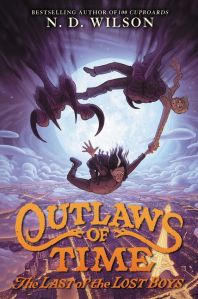 I spent most of today (except when mowing and weed-eating the yard) reading the third and final volume in N. D. Wilson’s Outlaws of Time series: The Last of the Lost Boys. Even though the second book in the series, The Song of Glory and Ghost, dropped this time last year (and I bought it release-week), I didn’t actually finish reading it until this morning, too. One of the great things about Wilson’s young adult fiction is that it’s just complicated enough (partly because of time-travel, partly because of an ever-deepening backstory) to really suck you in . . . once you get into the groove. A lot has happened with Wilson since I read the first book in the series. Wilson was diagnosed with a tumor behind his ear. He also released a “prequel” to his other two book series (100 Cupboards and The Ashtown Burials series). The third book in the Outlaws series reads much more like that book, The Door Before, than the first two Outlaws books in that it’s shorter and not quite as dense narrative/action-wise.


 Space Enough, and Time