Sunday’s Best: Valedictory Status and Writing

The week was full of thoughtful, funny strips.  Over at Frazz, Jef Mallett had Caulfield thinking deep thoughts about graduation season and valedictorians.  Here‘s how it starts, and here‘s a funny reminder of the importance of critical thinking.

Calvin had a series of one-off adventures, including a reminder of the different meanings of “bacon,” how little his thoughts are worth, and a fun existentially ironic moment about bugs.

And while Peanuts spent a little too much time with Woodstock trying to be a carrier pigeon, today’s Sunday strip is a funny piece about writing and the very human need to prove yourself right (especially when you’re wrong).

Posted in Comics, Teaching | Leave a comment

In the Backpack

Frederick Buechner starts The Alphabet of Grace, his theological “slice of life” book, with this wonderfully true assertion:

At its heart most theology, like most fiction, is essentially autobiographical.  Aquinas, Calvin, Barth, Tillich, working out their systems in their own ways and in their own language, are all telling us the stories of their lives, and if you press them far enough, even at their most cerebral and forbidding, you find an experience of flesh and blood, a human face smiling or frowning or weeping or covering its eyes before something that happened once.

As a theologian himself, he concludes:

That is to say, I cannot talk about God or sin or grace, for example, without at the same time talking about those parts of my own experience where these ideas became compelling and real.¹

The same is true, I believe, for the books you carry around with you.  When you are younger, you might read widely in hopes of finding voices similar to your own.  Then as you age, you tend to revisit those voices because they have proven themselves faithful to some standard: to God or your own experience or some other deep truth.

+ + + + + + +

I thought I’d take a quick moment to write about the books currently in my backpack.  There are four of them, and though none of them are particularly dense or hefty, they have taken a longer to read than I intended.

I started reading Curt Thompson’s Anatomy of the Soul after hearing an interview between him and Justin Whitmel Earley on the Made for People podcast about how friendship heals our brains.  I’ve got about three chapters left to read.  It’s a nice survey of neuroscience from the perspective of faith.

Hand-in-hand with Anatomy of the Soul is an odd book called Soul Making that I discovered through Twitter.  I call it odd because it’s not the kind of book you’ll find much anymore (the person who posted about the book of Twitter said about as much).  The book by Alan Jones attempts to bring together the work of the Desert Fathers with modern day psychology.  (The Desert Fathers are on my radar because of the Desert Fathers in a Year podcast I’ve been following this year.  Both of these books are about the interior life (in both striking different yet similar ways).  And Soul Making is written in such a way that I can read one or two snippets on the way to or from the gym in the morning.

Another book I’m taking way too long to read is N. T. Wright’s Spiritual and Religious.  It’s a book that’s new to the States (but was released a few years ago in Britain).  It’s Wright doing what Wright does best: retelling the story of Jesus with a good view of the big picture.  The chapters are short.  And while Wright’s voice is comfortable and familiar, he’s not just talking about gnosticism (which has been his usual foil for the last few years). The book is divides nicely into two parts, one fitting a pre-Easter mold and the other a post-Easter mold.

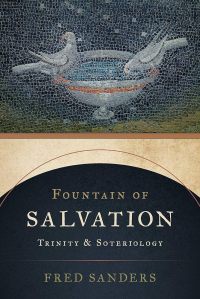
The most recent addition to my stack of backpack books is Fountain of Salvation by Fred Sanders.  I read another Sanders book last year (The Deep Things of God).  This book is just as good as that one, though it takes a slightly different approach to the Christian doctrine of the Trinity.  In all honesty, I think I ordered the book because I flipped ahead to the end of Wright’s book and liked what I saw enough that I knew it was time to read more on the doctrine of God (without realizing how Wright got there by the end of his book).

+ + + + + + +

My goal is to get three of the four books read before I board a plane in a couple of weeks.  (The book on the Desert Fathers will probably travel with me.). I’ve got two new fantasy books to make room for in July (a new Rivers of London novel and then the sequel to Impossible Creatures).  Sanders also has a new book dropping in August that I’m looking forward to.  I’d like to share some thoughts on the books over the next few days, if only to try and get back into the practice of writing more as summer vacation starts.

______________________________________________________

¹ Buechner, Frederick. The Alphabet of Grace. HarperCollins, 2009.

Posted in Books, Church, Commonplace Book, Faith, Friendship, Just As I Am, Life in the Fifth Act, The Long Story | Leave a comment

To the Funny Pages!

The folks over at gocomics.com recently posted one of my all-time favorite Calvin and Hobbes strips.  A little bit of optimism, a little but of realism.

And speaking of realism, here’s a recent reprint Peanuts strip with Peppermint Patty’s take on Charlie Brown’s hope about the little red-headed girl.

I also like the mix of optimism and realism (of sorts) in this Peanuts strip involving Woodstock and the last straw.

Here’s today’s Frazz strip, which is a sobering reminder of the realities of graduation season … and what comes next.

Finally: here’s this week’s  “Sunday’s Best” strip.  Garden life really can be fragile, so good for Mrs. Fox that she’s celebrating the little victories.

Posted in Comics | Leave a comment

AI, Two Birds, One Stone

It’s unfortunate how deeply and how quickly AI has changed the landscape of teaching.  It’s easier to use and necessary to look for when interacting with student work.  And it’s something that we’re all still learning about but with hard lines already drawn (often for good reasons).

Alan Jacobs, an author and humanities professor at Baylor, recently posted a piece “picking apart” another piece by Ted Gioia.  Gioia’s piece is a reflection on his time at Oxford; Jacobs is a reflection on the practicality of what Gioia seems to be suggesting as a way forward.  It’s a nice “dialogue”.  Both pieces are definitely worth your time.  You can find Jacobs’s piece here (with Gioia’s piece linked therein).

Posted in Teaching | Tagged | Leave a comment

Anselm on Teaching, Seeking, Desiring

We introduce Anselm and his version of the ontological argument for God’s existence relatively early in our junior Bible class.  Sometimes it clicks, sometimes it doesn’t; we consider it as much because it was the first of its kind as much as anything else.

I mention that because Richard Beck recently posted a passage, really a prayer, from Anselm’s Proslogion.  It’s a beautiful passage, very much like an Old Testament psalm.  It reads like some of Augustine’s writings in Confessions, wonderfully holding together apparent contradictions in order to prove a greater, full point.  You can find the longer piece here, but here’s the closing snippet:

Teach me to seek you, and when I seek you show yourself to me, for I cannot seek you unless you teach me, nor can I find you unless you show yourself to me. Let me seek you in desiring you and desire you in seeking you, find you in loving you and love you in finding you.

Posted in Books, Commonplace Book, Faith, Teaching | Leave a comment

“The True Thing About Restaurants”

Hulu just dropped the fourth-season trailer for The Bear, the show that makes your blood pressure sky-rocket just by mentioning it.  As good as it was, I felt like the show’s third season was holding back a little bit, so I’m interested to see where this season goes.  The dialogue, with its many hints about the philosophy of a restaurant, is quite promising.  

Posted in Television | Leave a comment

Sunday’s Best: Asking, Seeking, Knocking

This morning’s Gospel reading includes one of those “tricky”passages from Jesus’ Sermon on the Mount about prayer.  From biblegateway.com:

“Ask, and it will be given to you; seek, and you will find; knock, and it will be opened to you. For everyone who asks receives, and the one who seeks finds, and to the one who knocks it will be opened.Or which one of you, if his son asks him for bread, will give him a stone? 10 Or if he asks for a fish, will give him a serpent? 11 If you then, who are evil, know how to give good gifts to your children, how much more will your Father who is in heaven give good things to those who ask him!

The “tricky” part comes in with the sense that Jesus speaks in an unqualified tone: will, will, and will.  He then makes a comparison to people, who are “evil” and yet know how to give good gifts.  Then He points his listeners (and us) to the Father who gives every good thing.

(Interestingly enough, in the Sermon on the Plain in Luke’s Gospel, the Father’s giving of the Holy Spirit is how this moment comes to a head.)

Chip Dodd, counselor/author/podcaster takes this moment and uses it when he talks about human relationships: about what causes us to stop asking for what we need.  If I remember correctly, he brings it up in the context of codependency, where some level of healthy request is always off limits, always beyond the bounds of the possible.  And that moment of no longer asking, no longer seeking, no longer knocking is a sad and sobering sign of something being deeply wrong.

I do think that we are to ask, seek, and knock for what the Father has for us.  And I do think that the continuous nature of those actions can change us, can shape us and purify us.  Ultimately we are reminded that God is good Himself and that He is our treasure and that we must rely on Him.  It is because of that, because of who He is, that we can keep asking and seeking and knocking.

Posted in Scripture | Leave a comment

The Good Shepherd (and a quick word on 49)

This past Sunday, many churches celebrated Mother’s Day.  Other churches also commemorated “Good Shepherd Sunday,” which is celebrated every fourth Sunday of Easter.  The key text for the day is John 10, where Jesus says:

11 “I am the good shepherd. The good shepherd lays down his life for the sheep. 12 The hired hand is not the shepherd and does not own the sheep. So when he sees the wolf coming, he abandons the sheep and runs away. Then the wolf attacks the flock and scatters it.13 The man runs away because he is a hired hand and cares nothing for the sheep.

14 “I am the good shepherd; I know my sheep and my sheep know me— 15 just as the Father knows me and I know the Father—and I lay down my life for the sheep.

I really like what Bishop Erik Varden had to say concerning the day.  He writes of the difference between the “Sunday school picture” of Jesus as the Good Shepherd and what he’s come to understand the reality to be.  From his blog:

Only much later, when I started studying the Bible — and discovered what a fascinating, magnificent book it is — did I realise that the shepherd in fact stands for something rather different. Of course, ancient Israel was nomadic. People did not settle in one place. They moved around seeking favourable conditions for themselves and their flocks, which were their livelihood. A shepherd was exposed to risks: inhospitable nature, wild animals, bandits. The image par excellence of the Old Testament shepherd is David.

He goes on to say:

The Christ-image in the parable of the shepherd does not suggest a chilled hippie pursuing an alternative lifestyle. It suggests a profile of clear strategy, courage, and a spirit of sacrifice, qualities we look for in a trustworthy leader. 

When we turn to the Gospel we have just read, we find that it’s about trust above all. ‘My sheep hear my voice’, says the Lord: ‘I know them, and they follow me.’

Clear strategy, courage, a spirit of sacrifice, trust.  All true of Jesus, and all possible (on some level or another) for us, too.  Definitely a good reminder as the Easter season continues.

+ + + + + + +

Well, the first month of year 49 has been anything but boring.  It started with a couple of birthdays in the neighborhood coupled with various Easter things.  Then I caught a cold (which is always worse than it sounds and yet not).  Before I knew it, the calendar turned to May, which brings the end of the school year (which is always early for me since I teach seniors).  Now that the cold is gone, I’m trying to get back to a normal rhythm, which is a good challenge.  I’m curious to see what year 49 brings.  It’s just getting started, which is a sobering and exciting thought.

Posted in Church, Faith, Holidays, Scripture, The Long Story | Leave a comment

“Eyes Up Here”

So far, summer movie season has been something of a slow burn for me.  Thunderbolts* really was an enjoyable movie, was a perfect picture of an underdog story, really.  The tone and scope were right, the humor was well-balanced thanks to the honest weight of the various struggles present in the story.  And Florence Pugh was amazing.  But there’s a bit more of a break before Mission Impossible revs things up again.  Thankfully, DC and Warner Brothers dropped the final full trailer for this July’s Superman.  Check it out.

This trailer does a great job fleshing out the previous teaser without connecting too many (if any) dots.  Lois already knowing Clark’s secret is interesting.  The moments with the Kents are great (and way more “down to earth” than we’ve seen in previous versions of the story).  It does look like James Gunn is trying to pack in a lot (all those other heroes), but hopefully that speaks to a more fully realized world than it does to throwaway characters and potential spin-offs.  

This really is the movie I’m looking forward to most this summer.  The scope and sound look (and feel) appropriately amazing.  And it seems fresh enough that it can blaze its own trail without being beholden to previous tellings of the story.  “Hey, buddy.  Eyes up here” indeed.  Up, up, and away.

Posted in Comics, Movies | Tagged | Leave a comment

“Where There’s a Will . . .”

We’re just over three months into the “Desert Fathers in a Year” series.  So far, my favorite saying comes from the section on hesychia, which relates to the idea of deep peace.  The saying comes from Abba Arsenius:

Abba Mark said to Abba Arsenius, ‘Why do you run away from us?’ The elder said to him, ‘God knows that I love you, but I cannot be with God and with people. The thousands and ten thousands above have one will, but people have many wills, so I cannot forsake God and come among people.’ (from Wortley’s systematic collection)

I imagine this is the kind of quote that most of us can relate to.  You step out of the door and suddenly find yourself on the receiving end of the demands of many (neighbors, students, co-workers, church leaders, you name it).  And that is not an easy place to be, definitely a difficult place to nurture the “purity of heart that wills one thing.”

I love the wording of the initial question: running away.  We can all likely imagine ourselves doing the same.  And I love Arsenius’s heartfelt response: you know that I love you.

It does make me wonder if there is a way to be with others and still be with God.  I suppose worship is a key way to nurture that reality.  But even then we may find ourselves demanding something from others (or having a demand placed on us).  I still think there’s something significant about the placement of Jesus’ pronouncement in Matthew 18 that when two or three agree in his name that he will be there being right after difficult words about sin and stumbling in the church . . . that such an agreement is hard won and precious.  It’s not easy to know what to ask for when others are involved in the asking, too.  Everyone, it turns out, brings their own will to the table.

Posted in Books, Church, Faith, Friendship, Scripture, Teaching | Leave a comment