Third-Season Legends

Strange to think that DC’s Legends of Tomorrow will start its third season in a couple of months.  The show’s first season was rough . . . rough and stilted.  Season two was a great recovery, with much better dialogue and historical interactions.  Now the show does the time-warp again, morphing into something that will hopefully make for an even stronger  third season.  Here’s the trailer from San Diego Comic-Con.

Posted in Television | Tagged | Leave a comment

Back in a Flash (Fall 2017 Edition)

Even though we’re still a couple of months away from most fall-premiering television shows, events like San Diego Comic-Con have become a great excuse for premiering teasers and trailers.  Case in point: the trailer for the upcoming fourth season of The Flash on the CW.

It will be interesting to see how quickly they undo the third season’s finale-twist, which left Barry entering the Speed Force to keep some kind of balance.  Having a villain demanding Barry’s presence could make for an interesting twist.  I can’t imagine Barry being back fully by the episode’s end.  It would be interesting to see if the show could pull a late-run Buffy the Vampire Slayer, which saw the title character brought back from the dead . . . and sad that she had been brought back to earth from an afterlife of paradise.  Regardless, Team Flash has some ground to make up that was lost during the strangely stagnant season three.  Hopefully they can pull it off.

Posted in Television | Tagged | Leave a comment

The Thrill of Stranger Things

Of the many exciting trailers to come out of this past weekend’s San Diego Comic-Con, the latest trailer for the second season of Stranger Things sits high on the list.  This trailer, with great nods to Michael Jackson’s “Thriller,” makes some interesting pop culture connections that I can’t wait to see play out.

Posted in Internet, Television | Leave a comment

“Twice Upon a Time”

Here’s today’s teaser release for the Doctor Who Christmas Special.  No River Song saying “spoilers” needed here.

Posted in Television | Tagged | Leave a comment

Are You Ready, Player One?

A couple of Decembers ago I found myself in the Minneapolis/St. Paul airport without a novel to read.  I left the terminal bookstore with a copy of Cline’s Ready Player One (and this after at least a year of hearing great things about it but feeling it was too “cool” and self-aware).  Needless to say, I thoroughly enjoyed the book, thought Cline distilled pop culture and built his sad world well.  Here’s the SDCC-released first trailer for the upcoming movie, directed by Steven Spielberg.

Posted in Books, Movies | Leave a comment

Every Day Committed

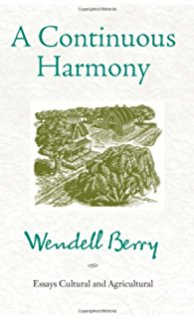
a continuous harmonyOne of my favorite Wendell Berry quotes comes from his “Notes from an Absence and a Return,” which can be found in A Continuous Harmony.   The short journal recounts Berry’s thoughts and experiences of returning to his Kentucky farm after a number of months away.  On March 3, 1969, Berry writes:

In ten days we leave here to start back to Kentucky.  For half a year now we’ve lived a life radically unlike the life we’ve chosen and made there at home.  What I get from the experience out here is the awareness that the life we want is not merely the one we have chosen and made; it is the one we must be choosing and making.  To keep it alive we must be perpetually choosing it and making its differences from among all contrary and alternative possibilities.  We must accept the pain and labor of that, or we lose its satisfactions and its joy.  Only by risking it, offering it freely to its possibilities, can we keep it.

Our commitment must be as fresh and new every morning as the mercies of God, it seems.  Resounding truth.

(image from amazon.com)

Posted in Books, Faith, The Long Story | Tagged | Leave a comment

Mountain Peaks and Friends on the Trail

Here’s a short-but-cool interview done with Andrew Peterson that name-drops most of my favorite singers, songwriters, and novelists.

Thanks to Anthony Myers for making and posting.

Posted in Faith, Music | Tagged | Leave a comment

Thirteen and Counting

And so the thirteenth Doctor has been revealed:

This is the first person playing the Doctor that I have any kind of viewing history with (Barty Crouch, Jr. doesn’t count for Tennant).  Jodie Whittaker has played the part of Beth Latimer in Broadchurch brilliantly.  One would like to think that the character will be able to move beyond the grief of the first two seasons, but I’m not sure that will happen (and we’re just at halfway through the show’s third and final season).

The other Broadchurch connection that the next season of Doctor Who has will be its show-runner: Chris Chibnall.  While his previous writing for Who hasn’t been all that spectacular (as opposed to Moffatt, who had penned some great stories), his work on Broadchurch more than gives him some cred.

Three questions will hang in the air for me between now and the beginning of series eleven.

  • One: how will the change take place?  I imagine that the Christmas special, the current Doctor’s last, will be more interior journey than exterior adventure.  Will there be much speechifying?  Will the high road of kindness simply become the high road of don’t-question-this-decision condescension?  Will something intentionally happen to or be revealed about the regeneration process?  Will the change come with a shrug and the decision to “try something different?”  A significant change should, I think, have a significant and in-story reason behind it.
  • Two:  what will happen to the audience?  “Everyone remembers their first Doctor” is a popular sentiment when reflecting on the franchise.  There is an inherent danger in reboots and resets (which Doctor Who has built into its basic premise).  Everyone’s first Doctor is also someone else’s last Doctor.  Will those utterly opposed to a female Doctor actually stop watching?  And will those saying “it’s about time we had a female Doctor” but who might be casual viewers stick around and bring others with them?
  • Three: can Chibnall and Whittaker bring new life to the show?  Something about the structure and formula of the show has gotten stale.  I’m one who usually blames the script.  I also think that the show’s attempt at minimizing the complex history of the show (and all things Gallifreyan) has kept it from running in a healthy direction.  That leaves only certain tropes to revisit (and revisit them we have . . . often).  The decision to do 40-minute weekly episodes brings particular constraints, too.  In its recent history, the show has worked best when there was a through-line or genuine theme for the season (Bad Wolf, the Silence, the Girl Who Waited).  Chibnall and Whittaker have quite the blank slate, I think.  I hope that they can embrace the opportunity in good and creative ways (i.e. no end-of-the-world episodes, no “totally in your head” episodes).  Granted, I’m sure I’m a hypocrite on this point (as in bring back more “significant people in history”).  Still, the show needs something like a deeper regeneration to take place.

In an interview given with the announcement, Whittaker noted that she is excitedly “stepping forward to embrace everything the Doctor stands for: hope.”  Hope, of course, works on many different levels.  Here’s hoping that Chibnall and Whittaker can deliver.

Posted in Television | Tagged | Leave a comment

When Life is Category over Character

small-town bankReading Wendell Berry in the 21st century is strange, mainly because much of what he wrote in the 1990s (and even the 1980s) is still relevant today.  I think it’s relevant, even if only as a reminder of the way things were . . . as a kind time-capsule  for a culture that sometimes seems hellbent on erasing particular parts of its history.

In his essay “Conserving Communities,”  Berry recounts the continuing shift in the American mindset from the agrarian to the industrial, when “old and once-valued customers . . . find that they are known by category rather than character.”  One of the most potent parts of the essay:

We are now pretty obviously facing the possibility of a world that the supranational corporations, and the governments and educational systems that serve them, will control entirely for their own enrichment– and, incidentally and inescapably, for the impoverishment of all the rest of us.  This will be a world in which the cultures that preserve nature and rural life will simply be disallowed.  It will be, as our experience already suggests, a post-agricultural world.  But as we now begin to see, you cannot have a post-agricultural that is not also post-democratic, post-religious, post-natural– in other words, it will be post-human, contrary to the best that we have meant by “humanity.”

That is ultimately what is at stake in most of our conversations today: what it means to be human.

(image from nytimes.com)

Posted in Books | Tagged | Leave a comment

Drowning in the Tides of History?

strange death of europeAt the same time that I’ve been reading various essays by Wendell Berry, I’ve been devouring Douglas Murray’s The Strange Death of Europe.  The two read together very well.  Both are about citizens and communities and culture.  And both were written in the context of community and culture being lost or radically changed.¹  From the introduction of The Strange Death of Europe:

. . . by the end of the lifespans of most people currently alive Europe will not be Europe and the peoples of Europe will have lost the only place in the world we had to call home.

Over the course of the book, Murray parses the realities of mass movements of people, Europe’s loss of historical identity, and the sense that the continent is “deeply weighed down with guilt for its past.”  In the introduction, Murray goes on to say:

The world is coming into Europe at precisely the moment that Europe has lost sight of what it is.  And while the movement of millions of people from other cultures into a strong and assertive culture might have worked, the movement of millions of people into a guilty, jaded and dying culture cannot.

Agree or disagree, there is no denying that the world is changing.  Many see what happens in Europe as a precursor to similar changes in the United States (as has often been the case historically).  And so the oft-asked question comes to mind: how then, shall we live?  And from Murray’s experience in the United Kingdom, how shall we live when we cannot acknowledge that anything has changed?  How can we live when asking necessary questions can be tantamount to a crime?

____________________

¹  For sake of comparison: Berry, writing in 1995, begins the collection noting that the 32 million farmers of the 1910-1920s was down to 4.6 million by the early 1990s.

(image from amazon.com, where you can also purchase the book)

Posted in 2017, Books | Leave a comment