Every Day Committed

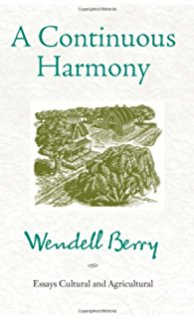
a continuous harmonyOne of my favorite Wendell Berry quotes comes from his “Notes from an Absence and a Return,” which can be found in A Continuous Harmony.   The short journal recounts Berry’s thoughts and experiences of returning to his Kentucky farm after a number of months away.  On March 3, 1969, Berry writes:

In ten days we leave here to start back to Kentucky.  For half a year now we’ve lived a life radically unlike the life we’ve chosen and made there at home.  What I get from the experience out here is the awareness that the life we want is not merely the one we have chosen and made; it is the one we must be choosing and making.  To keep it alive we must be perpetually choosing it and making its differences from among all contrary and alternative possibilities.  We must accept the pain and labor of that, or we lose its satisfactions and its joy.  Only by risking it, offering it freely to its possibilities, can we keep it.

Our commitment must be as fresh and new every morning as the mercies of God, it seems.  Resounding truth.

(image from amazon.com)

Posted in Books, Faith, The Long Story | Tagged | Leave a comment

Mountain Peaks and Friends on the Trail

Here’s a short-but-cool interview done with Andrew Peterson that name-drops most of my favorite singers, songwriters, and novelists.

Thanks to Anthony Myers for making and posting.

Posted in Faith, Music | Tagged | Leave a comment

Thirteen and Counting

And so the thirteenth Doctor has been revealed:

This is the first person playing the Doctor that I have any kind of viewing history with (Barty Crouch, Jr. doesn’t count for Tennant).  Jodie Whittaker has played the part of Beth Latimer in Broadchurch brilliantly.  One would like to think that the character will be able to move beyond the grief of the first two seasons, but I’m not sure that will happen (and we’re just at halfway through the show’s third and final season).

The other Broadchurch connection that the next season of Doctor Who has will be its show-runner: Chris Chibnall.  While his previous writing for Who hasn’t been all that spectacular (as opposed to Moffatt, who had penned some great stories), his work on Broadchurch more than gives him some cred.

Three questions will hang in the air for me between now and the beginning of series eleven.

  • One: how will the change take place?  I imagine that the Christmas special, the current Doctor’s last, will be more interior journey than exterior adventure.  Will there be much speechifying?  Will the high road of kindness simply become the high road of don’t-question-this-decision condescension?  Will something intentionally happen to or be revealed about the regeneration process?  Will the change come with a shrug and the decision to “try something different?”  A significant change should, I think, have a significant and in-story reason behind it.
  • Two:  what will happen to the audience?  “Everyone remembers their first Doctor” is a popular sentiment when reflecting on the franchise.  There is an inherent danger in reboots and resets (which Doctor Who has built into its basic premise).  Everyone’s first Doctor is also someone else’s last Doctor.  Will those utterly opposed to a female Doctor actually stop watching?  And will those saying “it’s about time we had a female Doctor” but who might be casual viewers stick around and bring others with them?
  • Three: can Chibnall and Whittaker bring new life to the show?  Something about the structure and formula of the show has gotten stale.  I’m one who usually blames the script.  I also think that the show’s attempt at minimizing the complex history of the show (and all things Gallifreyan) has kept it from running in a healthy direction.  That leaves only certain tropes to revisit (and revisit them we have . . . often).  The decision to do 40-minute weekly episodes brings particular constraints, too.  In its recent history, the show has worked best when there was a through-line or genuine theme for the season (Bad Wolf, the Silence, the Girl Who Waited).  Chibnall and Whittaker have quite the blank slate, I think.  I hope that they can embrace the opportunity in good and creative ways (i.e. no end-of-the-world episodes, no “totally in your head” episodes).  Granted, I’m sure I’m a hypocrite on this point (as in bring back more “significant people in history”).  Still, the show needs something like a deeper regeneration to take place.

In an interview given with the announcement, Whittaker noted that she is excitedly “stepping forward to embrace everything the Doctor stands for: hope.”  Hope, of course, works on many different levels.  Here’s hoping that Chibnall and Whittaker can deliver.

Posted in Television | Tagged | Leave a comment

When Life is Category over Character

small-town bankReading Wendell Berry in the 21st century is strange, mainly because much of what he wrote in the 1990s (and even the 1980s) is still relevant today.  I think it’s relevant, even if only as a reminder of the way things were . . . as a kind time-capsule  for a culture that sometimes seems hellbent on erasing particular parts of its history.

In his essay “Conserving Communities,”  Berry recounts the continuing shift in the American mindset from the agrarian to the industrial, when “old and once-valued customers . . . find that they are known by category rather than character.”  One of the most potent parts of the essay:

We are now pretty obviously facing the possibility of a world that the supranational corporations, and the governments and educational systems that serve them, will control entirely for their own enrichment– and, incidentally and inescapably, for the impoverishment of all the rest of us.  This will be a world in which the cultures that preserve nature and rural life will simply be disallowed.  It will be, as our experience already suggests, a post-agricultural world.  But as we now begin to see, you cannot have a post-agricultural that is not also post-democratic, post-religious, post-natural– in other words, it will be post-human, contrary to the best that we have meant by “humanity.”

That is ultimately what is at stake in most of our conversations today: what it means to be human.

(image from nytimes.com)

Posted in Books | Tagged | Leave a comment

Drowning in the Tides of History?

strange death of europeAt the same time that I’ve been reading various essays by Wendell Berry, I’ve been devouring Douglas Murray’s The Strange Death of Europe.  The two read together very well.  Both are about citizens and communities and culture.  And both were written in the context of community and culture being lost or radically changed.¹  From the introduction of The Strange Death of Europe:

. . . by the end of the lifespans of most people currently alive Europe will not be Europe and the peoples of Europe will have lost the only place in the world we had to call home.

Over the course of the book, Murray parses the realities of mass movements of people, Europe’s loss of historical identity, and the sense that the continent is “deeply weighed down with guilt for its past.”  In the introduction, Murray goes on to say:

The world is coming into Europe at precisely the moment that Europe has lost sight of what it is.  And while the movement of millions of people from other cultures into a strong and assertive culture might have worked, the movement of millions of people into a guilty, jaded and dying culture cannot.

Agree or disagree, there is no denying that the world is changing.  Many see what happens in Europe as a precursor to similar changes in the United States (as has often been the case historically).  And so the oft-asked question comes to mind: how then, shall we live?  And from Murray’s experience in the United Kingdom, how shall we live when we cannot acknowledge that anything has changed?  How can we live when asking necessary questions can be tantamount to a crime?

____________________

¹  For sake of comparison: Berry, writing in 1995, begins the collection noting that the 32 million farmers of the 1910-1920s was down to 4.6 million by the early 1990s.

(image from amazon.com, where you can also purchase the book)

Posted in 2017, Books | Leave a comment

Two-Day Countdown

And just like that, we’re two days away from finding out the who will next play the Doctor.

Posted in Television | Tagged | Leave a comment

Between Parties and Politics

turn of the crankLately I’ve been reading some of Wendell Berry’s older essays, most of them dating to the 1980s and 90s.  The first collection that I read, Another Turn of the Crank, begins with an interesting acknowledgment, even and especially twenty years later.

Nothing I have written here should be construed as an endorsement of either of our political parties as they presently function . . .

One reason for this is that I am an agrarian: I think good farming is a high and difficult art, that it is indispensable, and that it cannot be accomplished except under certain conditions . . .

Another reason is that I am a member, by choice, of a local community.  I believe that healthy communities are indispensable, and I know that our communities are disintegrating under the influence of economic assumptions that are accepted without question by both our parties– despite their lip service to various noneconomic values.

Then, as he tries to articulate his view on government, Berry asserts:

The proper role of government is to protect its citizens and its communities against conquest– against economic conquest just as much as conquest by overt violence.

Much has changed in the two decades since Berry penned these thoughts.  And much has stayed the same.  It’s an odd 21st century plus ça change, plus c’est la même chose.

Reading and reflecting on Wendell Berry is a real challenge and encouragement to me.  He reminds me of a different way of living, one that I experienced parts of growing up.  His has been “a long obedience in the same direction.”  And while I do not always understand or agree with every place he has ended up, I can appreciate the articulation of the journey.

I think many of us today find ourselves like Berry, somewhere between parties, somewhere odd on the political spectrum.  Our sense of what citizenship means might be different.  And we all love our communities, though many today would argue more for their “community” as an abstract, identity-politics kind of grouping as opposed to the people in your neighborhood.  Even with the differences, though, Berry’s sense of healthy is something you rarely (if ever) hear about anymore.  And even if you do, it’s health as a consequence of having courted disease.

I’d like to think that reading Wendell Berry can help make sense of the “rock and a hard place” where many of us find ourselves.

You can order your own copy of Another Turn of the Crank here.

Posted in Books | Tagged | Leave a comment

The Staircase

One Caedmon’s Call song that I haven’t heard (as it’s on the first Guild album) is the one called “Staircase.”  The song recently surfaced online.  Words, music, and passionate singing by Derek Webb.  Check it out.

Posted in Faith, Music | Tagged | Leave a comment

Walking through The Door Before

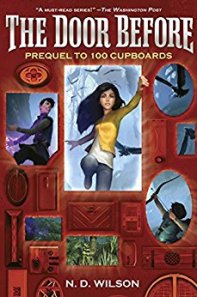
the door beforeIt has inadvertently been a summer for non-fiction.  Beyond some very-short stories by G. K. Chesterton, the only other fiction I’ve read has been the most recent release by N. D. Wilson: The Door Before.  Here’s the books opener:

Trees keep time the way time is meant to be kept.

They wrap the years around themselves in ringed layers,

expanding as the ages do.  And when time forks,

so do the trees, stretching branches into cousin futures,

plunging roots into sister pasts, binding

every leaf into the one story, the only story.

The story that began.  The story that cannot end,

because it can never stop growing.

The book is all about trees and living things, is centered on a mysterious grove of “lightning trees.  The book, which tells the story of Hyacinth Smith and her family, is advertised as a prequel to 100 Cupboards, N. D. Wilson’s first “series” of children’s books. I read them a few years ago and enjoyed them immensely.  Wilson wove many story strands together well, all while giving deep nods to the Christian tradition.  Beyond that, though, The Door Before is also a prequel of sorts to another of Wilson’s series, The Ashtown Burials.  That series is another great example of story strands hinting at the Christian tradition.  The story of The Door Before basically involves a family with one foot in both worlds.  And it works amazing well.  The book tells a story all its own while also really challenging the reader to go back and revisit the connecting books.  After finishing the story a week ago, I tried to find a wiki online that helped make inter-narrative connections, but it was to no avail.  Perhaps the story should have been titled The Door Back, as that’s the way it works its magic.

You can order your own copy of The Door Before here.  I highly recommend it and its connecting series.

Posted in Books, Faith | Tagged | Leave a comment

Playing to Your Strengths (and Weaknesses)

After being supremely impressed by The Tech-Wise Family, I decided to give one of Andy Crouch’s earlier books a try.  I chose Strong and Weak because it seemed simple and handy.  What I found inside was some quality thinking about leadership that really captured some challenging concepts.  It feels like Crouch has really sat with and through things.

Here’s a short clip about the premise of the book.  It’s a way of getting a toe wet before diving into the ocean.

Posted in Books, Faith | Leave a comment