“A Stranger Things Christmas”

This fan-made mash-up of Stranger Things and A Charlie Brown Christmas is a classic in its own right, I think.  Spoilers all through it, of course.  It’s good to see the Christmas lights in good and appropriate use . . .

(hat tip to relevantmagazine.com)

Posted in Internet, Television | Tagged | Leave a comment

The Deep Truth of Ordinary Things

bogost-play-anything-high-resLast week I got to watch a couple of episodes of the first season of Black Mirror, a BBC anthology show that’s been called the technology version of The Twilight Zone.  While the content pushed a number of envelopes, it did so to help us see something about the way we live life today, which isn’t always that easy or simple of a task.  How do we regularly look at the world around us with fresh eyes?

According to Ian Bogost, we do it by “playing games.”  From the preface to his new book, Play Anything:

The lesson that games can teach us is simple.  Games aren’t appealing because they are fun, but because they are limited.  Because they erect boundaries.  Because we must accept their structures in order to play them.  Soccer sees two teams of eleven players attempting to use their feet, torsos, and heads to put a ball into a goal.  Tetris asks you to position falling arrangements of four orthogonally-connected squares in order to produce and remove horizontal lines.  And yet the experiences games like soccer and Tetris create are far larger than those boundaries convey on their own.  That bounty results from the deliberate, if absurd, pursuit of soccer and Tetris on their own terms, within the limitations they erect.  The limitations make the games fun.

Which, quite honestly, is also true of good and engaging works of fiction.  Bogost continues:

What is we treated everything the way we treat soccer and Tetris- as valuable and virtuous for being exactly what they are, rather than for what would be convenient, or for what we wish they were instead, or for what we fear they are not?  Walks and meadows, aunts and grandfathers, zoning board of appeals meetings and business trips.  Everything.  Our lives would be better, bigger, more meaningful, and less selfish.

That’s what it means to play,  To take something- anything- on its own terms, to treat it as if its existence were reasonable.  The power of games lies not in their capacity to deliver rewards or enjoyment, but in the structured constraint of their design, which opens abundant possible spaces for play.

It truly is a well-rendered introduction, one that holds much promise for the rest of the book.  It seems to be a good turn-around on the idea of play, which has become a watchword for 21st century entertainment and culture.  From the preface’s last paragraph:

The ultimate lesson games give is not about gratification and reward, nor about media and technology, nor about art and design.  It is a lesson about modesty, attention, and care.  Play cultivates humility, for it requires us to treat things as they are rather than as we wish them to be.  If we let it, play can be the secret to contentment.  Not because it provides happiness or pleasure- although it certainly can- but because it helps us pursue a greater respect for the things, people, and situations around us.

Posted in Books | Tagged | Leave a comment

Theological Thinking and Doing

revolutionI’m always interested in (and frustrated by) the weird intersection between thought and action in the Christian faith.  The two should be hold well together, but we tend to focus one over the other, disparaging thoughtless deeds or deedless thought.  N. T. Wright acknowledges this early in The Day the Revolution Began.  It makes sense to how many books about the cross one might need to read (or write) in order to understand the implications of the event.

Theology, after all, was made for the sake of the church, not the church for theology . . . “The Word became flesh,” said St. John (1:14); and Paul described the “words of the cross” as “God’s power” (1 Cor. 1:18).  The flesh and the power are what matter in the end, rather than the pretty patterns of our words.  The point of trying to understand the cross better is not so that we can congratulate ourselves for having solved an intellectual crossword puzzle, but so that God’s power and wisdom may work in us, through us, and out into the world that still regards Jesus’s crucifixion as weakness and folly.  Yes, there are puzzles . . . But Jesus died for our sins not so that we could sort out abstract ideas, but so that we, having been put right, could become part of God’s plan to put his whole world right.  That is how the revolution works.  

A lot of it boils down to where you start and where you want to end.  Simple and complex, because starting and ending locations can be tricky at best and disastrous at worse.

I’m a little over halfway through The Day the Revolution Began.  It’s a great drawing-together of threads from other books by Wright.  His argument is convincing.  He’s trying to draw a better, wider horizon for how we think about the death and resurrection of Jesus.  And he does it by getting us to think as much like the early Jewish Christians as possible.

Posted in Books, Faith | Tagged | Leave a comment

Tom Haverford Talks Food

For all of the fun character on Parks and Recreation, it ends up being Tom Haverford that I laugh at the most.  Tonight I watched the episode where Leslie takes tries online dating and ends up matched with the “nerd” version of Tom.  Here’s how he breaks down his approach to talking about food.

Posted in Internet, Television | Leave a comment

Fantastic and the Bill of Rights

Captain Fantastic could easily have been the most faith-friendly movie of the year with its rooted-in-tradition, standing-against-culture mindset.  And while it didn’t (couldn’t?) deliver on that promise, it still attempted to be a considerable critique of contemporary living.  Here’s one of the best clips from the movie, in which Viggo Mortenson’s character points out the benefits of a particular kind of “classical” home-schooling.

Posted in Internet, Movies | Leave a comment

Ancient Revolution in the Tense Present

revolutionN. T. Wright’s most recent book dropped this week.  The Day the Revolution Began focuses on the death of Jesus.  One of the questions Wright tackles early in the book is the question of the revolution’s content.  From the book’s first chapter:

It wasn’t just that they believed Jesus had been raised from the dead.  They did believe that, of course, and that too was scandalous nonsense in their day as it is in ours.  But they quickly came to see his resurrection not simply as an astonishing new beginning in itself, but as the real result of what had happened three days earlier.  The resurrection was the first visible sign that the revolution was already underway.  More signs would follow.

That’s one of Wright’s strengths, really, the way he paints the picture of what early Christianity looked like.  That’s significant, because what we think today can seem so different from, almost diametrically opposed to, that early view.  Wright continues:

Most Christians today don’t see it like this– and, in consequence, most people outside the church don’t see it like that either.  I understand why.  Like most Christians today, I started my thinking about Jesus’ death with the assumption, from what I had been taught, that the death of Jesus was all about God saving me from my “sin,” so that I could “go to heaven.”  That, of course, can be quite the revolutionary idea for someone who’s never through of it before.  But it’s not quite the revolution the early Christians were talking about.  In fact, that way of putting it, taken on its own, significantly distorts what Jesus’s first followers were saying.  They were talking about something bigger, something more dangerous, something altogether more explosive.  The personal meaning is not left behind . . . But it is contained within the larger story.  And it means more, not less, as a result.

That’s the tension I’ve lived in over my time as a teacher: how to leave room for the personal dimension while also reminding students and teachers of that larger story.  I liken it to the cart (the personal story) and the horse (the bigger picture of what God is doing).  The only thing more frustrating that delineating the differences is what Christians refuse to genuinely talk about both realities.

I’m still early in the book.  I am hopeful that I will learn good things from Wright, even if I am ultimately taken back to the place where I began (only different from the journey).  I imagine I’ll be quoting more from the book as I make my way through it.

(image from harpercollins.com)

Posted in Books, Faith, Teaching | Tagged | Leave a comment

Run, Jesse, Run

Last night’s episode of The Flash took an interesting turn . . . or at least made an interesting “stop” along the way of season three.  After a conversation with Jay Garrick about tampering with the timeline, Barry Allen decided to stay in his current moment and work from there.  The Rival also returned, with full knowledge of how Barry had messed with the timeline.  Turns out that “this world” is being prepared for something.  Here’s the preview for next week:

My theory is that we’ll get back to the original timeline by season’s end, but not before this timeline has a high-stakes confrontation with some great force of evil.  I suppose only a season’s worth of time will tell.

Posted in Internet, Television | Tagged | Leave a comment

Lewis on Literature

literatureFall break has broken.  It came to an end last night with church, some orange chicken with  steamed rice, laundry, and the final pages of C. S. Lewis’s The Discarded Image.  The book, Lewis’s attempt at writing a “primer” for the medieval and Renaissance worldview, was a fun read, with new (old) concepts about the way the world works all over the place.  At the end, though, you get a nice consideration of literature (particularly in how it was “different” back then).  A standout quote for any point in history:

Literature exists to teach what is useful, to honor what deserves honor, to appreciate what is delightful.  The useful, honorable, and delightful things are superior to it: it exists for their sake; its own use, honor, or delightfulness is derivative from theirs.

Part of me balks at the idea of a utilitarian approach to literature, but I think I understand what Lewis is doing here.  It’s about the master you serve.  Too often, literature has little to do with the honorable and delightful; its only master is the useful (and that, an overly reductionistic usefulness).  A recovery of honor and delight in our approach to literature would be a step in the direction of the good.

(image from gloomwire.com)

Posted in Books, Commonplace Book | Tagged | Leave a comment

Pilgrim Days: A Hospitable World

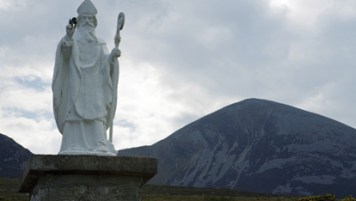
croagh-patrickBefore he gets into a discussion of the ways contemporary culture has re-defined the identity of the pilgrim, Bauman casts one last picture of the kind of world necessary for a “classical” pilgrimage to take place.  “Both life and and time were made to the measure of pilgrimage,” he asserts.  Bauman continues:

For the pilgrim, for the modern man, this meant in practical terms that he could-should-had-to select his point of arrival fairly early in life with confidence, certain that the straight line of life-time ahead will not bend, twist or warp, come to a halt or turn backwards.  Delay of gratification, much as the momentary frustration it begot, was an energizing factor and the source of identity-building zeal in so far as it was coupled with the trust in the linearity and cumulativeness of time.   The foremost strategy of life as pilgrimage, of life as identity-building, was ‘saving for the future,’ but saving for the future made sense as strategy only in so far as one could be sure that the future would reward the savings with interest and the bonus once accrued will not be withdrawn, that the savings will not be devalued before the bonus-distribution date or declared invalid currency; that what is seen today as capital will be seen the same way tomorrow and the day after tomorrow.  Pilgrims had a stake in solidity of the world they walked; in a kind of world in which one can tell life as a continuous story, a ‘sense-making’ story, such a story as makes each even the effect of the event before and the cause of the event after, each age a station on the road pointing towards fulfillment.

I imagine the such a system is both praised and condemned by many.  It hints at something of a closed system (or at least one no where near as open as the social systems of today).  I have inherited a version of this view, of course.  Sure, I live thousands of miles from my family and loved ones, but I have a sense of continuity and connection that undergirds a lot of what I think, feel, and believe.  I can better embrace uncertainty ahead because of the certain things behind.

The world of pilgrims- of identity-builders- met be orderly, determined, predictable, ensured; but above all, it must be a kind of world in which footprints are engraved for good, so that the trace and the record of past travels are kept and preserved.  A world in which traveling may indeed be a pilgrimage.  A world hospitable to the pilgrims.

Alas, that is not how Bauman’s essay ends.  In fact, it takes a turn to another direction in the next sentence:

The world is not hospitable to the pilgrims anymore.

More on that tomorrow.

(image of Croagh Patrick from ireland.com)

Posted in Faith, Internet, Teaching, The Long Story, Travel | Leave a comment

Pilgrim Days: The Desert and the Real

anthony-and-paulIn “From Pilgrim to Tourist,” Zygmut Bauman traces a line from the Christian concept of the pilgrim to the contemporary scheme of self-definition.  That line gets traced (metaphorically and historically) right through the desert.

‘We are pilgrims through time’ was, under the pen of St. Augustine not an exhortation, but a statement of fact.  We are pilgrims whatever we do, and there is little we can do about it even if we wished.  Earthly life is but a brief overture to the eternal persistence of the soul.  Only few would wish, and have the ability, to composes that overture themselves, in tune with the music of the heavenly spheres- to make their fate into a consciously embraced destiny.  These few would need to escape the distractions of the town.  The desert is the habitat they must choose.

And so many Christians in earlier times took to the desert for an intense kind of formation (a group that includes the likes of Saint Anthony in the image to the right).

The desert of the Christian hermit was set at a distance from the hurly-burly of family life, away from the town and the village, from the mundane, from the polis.  The desert meant putting a distance between oneself and one’s duties and obligations, the warmth and the agony of being with others, being looked at by others, being framed and moulded by their scrutiny, demands and expectations.  Here, in mundane quotidianity, one’s hands were tied, and so were one’t thoughts.  Here, horizon was tightly packed with huts, barns, copses, groves and church towers.  Here, wherever one moved, one was in a place, and being in a place meant staying put, doing what the place needed to be done.  The desert, on the contrary, was a land not yet sliced into places, and for that reason it was the land of self-creation.

A wonderfully rendered paragraph, for sure.  And it rings true, a reminder even of times that Jesus went to desolate places in the gospel stories.  In Bauman’s argument, though, the picture of the Desert Fathers ultimately (and perhaps inadvertently) leads to the Protestant approach to self-understanding, who “accomplished a feat unthinkable for the lonely hermits of yore: [the Protestants] became inner-worldly pilgrims.”  They did this by turning all of the world outside of the home into a kind of desert.  Bauman asserts that the language of Protestant pilgrimmage

is the kind of language in which one speaks of the desert: of nothingness waiting to become something, if only for a while; of meaninglessness waiting to be given meaning, if only a passing one; of the space without contours, ready to accept any contour offered, if only until other contours are offered; of a space not scarred with past furrows, yet fertile with expectations of sharp blades; of virgin land yet to be plowed and tilled; of the and of the perpetual beginning; of the place-no-place whose name and identity is not-yet.  In such a land, the trails are blazed by the destination of the pilgrim, and there are few other tracks to reckon with.

It’s a brave new world that ignores its ancient existence.  I can’t help but think of scenes from The Lord of the Rings where Frodo and company (whether the Nine or with Sam alone) where stone reminders of an earlier age stand out in stark landscapes as reminders of a deeper, older story.  For Frodo and company, those markers are more than sentimentality; they are a cause for hope and for courage.  Not so, though, in the land of modern pilgrimage.

In such a land, commonly called modern society, pilgrimage is no longer a choice of the mode of life; less still is it a heroic or saintly choice.  Living one’s life as pilgrimage is no longer the kind of ethical wisdom revealed to, or initiated by, the chosen and the righteous.  Pilgrimage is what one does of necessity, to avoid being lost in a desert; to invest the walking with a purpose while wandering the land with no destination.

This of course, is a dangerous land to walk through, certainly more dangerous than a fearful slog through the land of Mordor.

(image of Anthony and Paul from reproarte.com)

Posted in Faith, The Long Story | Leave a comment