Ancient Revolution in the Tense Present

revolutionN. T. Wright’s most recent book dropped this week.  The Day the Revolution Began focuses on the death of Jesus.  One of the questions Wright tackles early in the book is the question of the revolution’s content.  From the book’s first chapter:

It wasn’t just that they believed Jesus had been raised from the dead.  They did believe that, of course, and that too was scandalous nonsense in their day as it is in ours.  But they quickly came to see his resurrection not simply as an astonishing new beginning in itself, but as the real result of what had happened three days earlier.  The resurrection was the first visible sign that the revolution was already underway.  More signs would follow.

That’s one of Wright’s strengths, really, the way he paints the picture of what early Christianity looked like.  That’s significant, because what we think today can seem so different from, almost diametrically opposed to, that early view.  Wright continues:

Most Christians today don’t see it like this– and, in consequence, most people outside the church don’t see it like that either.  I understand why.  Like most Christians today, I started my thinking about Jesus’ death with the assumption, from what I had been taught, that the death of Jesus was all about God saving me from my “sin,” so that I could “go to heaven.”  That, of course, can be quite the revolutionary idea for someone who’s never through of it before.  But it’s not quite the revolution the early Christians were talking about.  In fact, that way of putting it, taken on its own, significantly distorts what Jesus’s first followers were saying.  They were talking about something bigger, something more dangerous, something altogether more explosive.  The personal meaning is not left behind . . . But it is contained within the larger story.  And it means more, not less, as a result.

That’s the tension I’ve lived in over my time as a teacher: how to leave room for the personal dimension while also reminding students and teachers of that larger story.  I liken it to the cart (the personal story) and the horse (the bigger picture of what God is doing).  The only thing more frustrating that delineating the differences is what Christians refuse to genuinely talk about both realities.

I’m still early in the book.  I am hopeful that I will learn good things from Wright, even if I am ultimately taken back to the place where I began (only different from the journey).  I imagine I’ll be quoting more from the book as I make my way through it.

(image from harpercollins.com)

Posted in Books, Faith, Teaching | Tagged | Leave a comment

Run, Jesse, Run

Last night’s episode of The Flash took an interesting turn . . . or at least made an interesting “stop” along the way of season three.  After a conversation with Jay Garrick about tampering with the timeline, Barry Allen decided to stay in his current moment and work from there.  The Rival also returned, with full knowledge of how Barry had messed with the timeline.  Turns out that “this world” is being prepared for something.  Here’s the preview for next week:

My theory is that we’ll get back to the original timeline by season’s end, but not before this timeline has a high-stakes confrontation with some great force of evil.  I suppose only a season’s worth of time will tell.

Posted in Internet, Television | Tagged | Leave a comment

Lewis on Literature

literatureFall break has broken.  It came to an end last night with church, some orange chicken with  steamed rice, laundry, and the final pages of C. S. Lewis’s The Discarded Image.  The book, Lewis’s attempt at writing a “primer” for the medieval and Renaissance worldview, was a fun read, with new (old) concepts about the way the world works all over the place.  At the end, though, you get a nice consideration of literature (particularly in how it was “different” back then).  A standout quote for any point in history:

Literature exists to teach what is useful, to honor what deserves honor, to appreciate what is delightful.  The useful, honorable, and delightful things are superior to it: it exists for their sake; its own use, honor, or delightfulness is derivative from theirs.

Part of me balks at the idea of a utilitarian approach to literature, but I think I understand what Lewis is doing here.  It’s about the master you serve.  Too often, literature has little to do with the honorable and delightful; its only master is the useful (and that, an overly reductionistic usefulness).  A recovery of honor and delight in our approach to literature would be a step in the direction of the good.

(image from gloomwire.com)

Posted in Books, Commonplace Book | Tagged | Leave a comment

Pilgrim Days: A Hospitable World

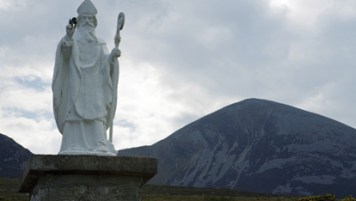
croagh-patrickBefore he gets into a discussion of the ways contemporary culture has re-defined the identity of the pilgrim, Bauman casts one last picture of the kind of world necessary for a “classical” pilgrimage to take place.  “Both life and and time were made to the measure of pilgrimage,” he asserts.  Bauman continues:

For the pilgrim, for the modern man, this meant in practical terms that he could-should-had-to select his point of arrival fairly early in life with confidence, certain that the straight line of life-time ahead will not bend, twist or warp, come to a halt or turn backwards.  Delay of gratification, much as the momentary frustration it begot, was an energizing factor and the source of identity-building zeal in so far as it was coupled with the trust in the linearity and cumulativeness of time.   The foremost strategy of life as pilgrimage, of life as identity-building, was ‘saving for the future,’ but saving for the future made sense as strategy only in so far as one could be sure that the future would reward the savings with interest and the bonus once accrued will not be withdrawn, that the savings will not be devalued before the bonus-distribution date or declared invalid currency; that what is seen today as capital will be seen the same way tomorrow and the day after tomorrow.  Pilgrims had a stake in solidity of the world they walked; in a kind of world in which one can tell life as a continuous story, a ‘sense-making’ story, such a story as makes each even the effect of the event before and the cause of the event after, each age a station on the road pointing towards fulfillment.

I imagine the such a system is both praised and condemned by many.  It hints at something of a closed system (or at least one no where near as open as the social systems of today).  I have inherited a version of this view, of course.  Sure, I live thousands of miles from my family and loved ones, but I have a sense of continuity and connection that undergirds a lot of what I think, feel, and believe.  I can better embrace uncertainty ahead because of the certain things behind.

The world of pilgrims- of identity-builders- met be orderly, determined, predictable, ensured; but above all, it must be a kind of world in which footprints are engraved for good, so that the trace and the record of past travels are kept and preserved.  A world in which traveling may indeed be a pilgrimage.  A world hospitable to the pilgrims.

Alas, that is not how Bauman’s essay ends.  In fact, it takes a turn to another direction in the next sentence:

The world is not hospitable to the pilgrims anymore.

More on that tomorrow.

(image of Croagh Patrick from ireland.com)

Posted in Faith, Internet, Teaching, The Long Story, Travel | Leave a comment

Pilgrim Days: The Desert and the Real

anthony-and-paulIn “From Pilgrim to Tourist,” Zygmut Bauman traces a line from the Christian concept of the pilgrim to the contemporary scheme of self-definition.  That line gets traced (metaphorically and historically) right through the desert.

‘We are pilgrims through time’ was, under the pen of St. Augustine not an exhortation, but a statement of fact.  We are pilgrims whatever we do, and there is little we can do about it even if we wished.  Earthly life is but a brief overture to the eternal persistence of the soul.  Only few would wish, and have the ability, to composes that overture themselves, in tune with the music of the heavenly spheres- to make their fate into a consciously embraced destiny.  These few would need to escape the distractions of the town.  The desert is the habitat they must choose.

And so many Christians in earlier times took to the desert for an intense kind of formation (a group that includes the likes of Saint Anthony in the image to the right).

The desert of the Christian hermit was set at a distance from the hurly-burly of family life, away from the town and the village, from the mundane, from the polis.  The desert meant putting a distance between oneself and one’s duties and obligations, the warmth and the agony of being with others, being looked at by others, being framed and moulded by their scrutiny, demands and expectations.  Here, in mundane quotidianity, one’s hands were tied, and so were one’t thoughts.  Here, horizon was tightly packed with huts, barns, copses, groves and church towers.  Here, wherever one moved, one was in a place, and being in a place meant staying put, doing what the place needed to be done.  The desert, on the contrary, was a land not yet sliced into places, and for that reason it was the land of self-creation.

A wonderfully rendered paragraph, for sure.  And it rings true, a reminder even of times that Jesus went to desolate places in the gospel stories.  In Bauman’s argument, though, the picture of the Desert Fathers ultimately (and perhaps inadvertently) leads to the Protestant approach to self-understanding, who “accomplished a feat unthinkable for the lonely hermits of yore: [the Protestants] became inner-worldly pilgrims.”  They did this by turning all of the world outside of the home into a kind of desert.  Bauman asserts that the language of Protestant pilgrimmage

is the kind of language in which one speaks of the desert: of nothingness waiting to become something, if only for a while; of meaninglessness waiting to be given meaning, if only a passing one; of the space without contours, ready to accept any contour offered, if only until other contours are offered; of a space not scarred with past furrows, yet fertile with expectations of sharp blades; of virgin land yet to be plowed and tilled; of the and of the perpetual beginning; of the place-no-place whose name and identity is not-yet.  In such a land, the trails are blazed by the destination of the pilgrim, and there are few other tracks to reckon with.

It’s a brave new world that ignores its ancient existence.  I can’t help but think of scenes from The Lord of the Rings where Frodo and company (whether the Nine or with Sam alone) where stone reminders of an earlier age stand out in stark landscapes as reminders of a deeper, older story.  For Frodo and company, those markers are more than sentimentality; they are a cause for hope and for courage.  Not so, though, in the land of modern pilgrimage.

In such a land, commonly called modern society, pilgrimage is no longer a choice of the mode of life; less still is it a heroic or saintly choice.  Living one’s life as pilgrimage is no longer the kind of ethical wisdom revealed to, or initiated by, the chosen and the righteous.  Pilgrimage is what one does of necessity, to avoid being lost in a desert; to invest the walking with a purpose while wandering the land with no destination.

This of course, is a dangerous land to walk through, certainly more dangerous than a fearful slog through the land of Mordor.

(image of Anthony and Paul from reproarte.com)

Posted in Faith, The Long Story | Leave a comment

Pilgrim Days: Streets and Houses

chartres-cathedralIn his consideration of identity culture and postmodern thinking, Zygmunt Bauman looks back to a particular moment in history for an image and a way of thinking about the world.

When Rome lay in ruins– humbled, humiliated and sacked and pillaged by Alaric’s nomads– St. Augustine jotted down the following observation: ‘[I]t is recorded of Cain that he built a city, while Abel, as though he were merely a pilgrim on earth, built none.’ ‘True city if the saints is in heaven’; here on earth, says St. Augustine, Christians wander ‘as on pilgrimage through time looking for the Kingdom of eternity.’

“The figure of the pilgrim,” Bauman asserts, “was not a modern invention; it is as old as Christianity.  But modernity gave it a new prominence and a seminally novel twist.”

This imagery isn’t just Augustinian, though.  Many early figures in the Hebrew Scriptures were pilgrims of a sort.  That becomes part of the argument of the New Testament letter to the Hebrews.  Moving from creation to Abraham, the writer asserts that

These all died in faith, not having received the things promised, but having seen them and greeted them from afar, and having acknowledged that they were strangers and exiles on the earth.  For people who speak thus make it clear that they are seeking a homeland.  If they had been thinking of that land from which they had gone out, they would have had opportunity to return.  But as it is, they desire a better country, that is, a heavenly one. Therefore God is not ashamed to be called their God, for he has prepared for them a city. (New International Version)

The pilgrim character of the faith can be a difficult stance to maintain, of course.  Like all analogies, it falls apart at some point.  Even still, it communicates something vital (and often missing) from our approach to faithful living.  Bauman goes on to say that

For pilgrims through time, the truth is elsewhere; the true place is always some distance, some time away.  Wherever the pilgrim may be now, it is not where he ought to be, and not where he dreams of being.  The distance between the true world and this world here and now is made of the mismatch between what is to be achieved and what has been.  The glory and gravity of the future destination debases the present and makes light of it.  For the pilgrim, only streets make sense, not the houses– houses tempt one to rest and relax, to forget about the destination.  Even the streets, though, may prove to be obstacles rather than help, traps rather than thoroughfares.  They may misguide, divert from the straight path, lead astray.  ‘Judeo-Christian culture,’ writes Richard Sennett, ‘is, at its very roots, about experiences of spiritual dislocation and homelessness . . . Our faith began at odds with place.’

There have been times in my life when this pilgrim mentality was quite clear and evident for me.  Reading about street and houses is something that I think of often (as a bus rider and oft-pedestrian who has rented for all of my adult life but who has great affection and appreciation for those who open and share their homes).  And I cannot help but think of The Way, which depicts a man’s journey on the Way of Saint James.  Something about that story resonates deeply in a way that is more than just escapism and tourism.

A lot of life is determined by what you are tethered to (and who determines that connection).  While the image of the pilgrim is far from the only analogy for the life of faith, I cannot help but feel that it is a necessary one.  Bauman does a good job of setting this up before picking it apart from a postmodern perspective.

(image of Chartres Cathedral from famouswonders.com)

Posted in Faith, Travel | Leave a comment

Pilgrim Days: Changes in Identification

camino-de-santiago-940545A few weeks ago, Rod Dreher spent a post reflecting on “From Pilgrim to Tourist- or a Short History of Identity” by Zygmunt Bauman as part of his continuing articulation of “the Benedict Option.”  A made a copy of the essay and stashed is away to read later.  I got to the piece a bit ago and was pleasantly surprised with what I found.

Walker Percy once said that an era, an age, is over long before the people living in it realize.  And so the task for many of us today is to figure out (quite literally) what in the world is going on.  Bauman begins his essay by considering a shift in the way personal identification has been constructed/discerned between the modern and postmodern periods.

From the outset, Bauman is clear that “if the modern ‘problem of identity’ was how to construct an identity and keep it solid and stable, the postmodern ‘problem of identity’ is primarily how to avoid fixation and keep the options open.”  It would be the difference between “teacher for life” and “teacher for a season.”  Where, though, does one’s identity come from?

This is of particular interest to me, mostly because I straddle all kinds of lines in life.  I’ve now spent more time away from home than not.  I am in my fourteenth year of a career that I would like to think of as a calling and vocation (though I think the concept is bigger than that).  As a single guy, I have not status signifiers like husband or father, which makes things deceptively simple.  And my understanding of the Christian faith means that who I am “in Christ” theoretically trumps  every other form of self-identification you might find on any given survey form.

One things of identity whenever one is not sure of where one belongs; that is, one is not sure how to place oneself among the evident variety of behavioral styles and patterns, and how to make sure that people around would accept this placement as right and proper, so that both sides would know how to go on in each other’s presence.  ‘Identity’ is a name given to the escape sought from that uncertainty. . . Identity entered modern mind and practice dressed from the start as an individual task.  It was up to the individual to find escape from uncertainty.  Not for the first and not for the last time, socially created problems were to be resolved by individual efforts, and collective maladies healed by private medicine.

I can’t help but think back to the narrative Yuval Levin traced in The Fractured Republic concerning culture and individuals moving from a consolidated “Great War” mentality to the expressive individualism that followed (and that is now in full bloom).  Bauman continues:

Not that the individuals were left to their own initiative and their acumen was trusted; quite the contrary- putting the individual responsibility for self-formation on the agenda spawned the host of trainers, coaches, teachers, counsellors and guides all claiming to hold superior knowledge of what identities could be acquired and held.  The concepts of identity-building and of a culture (that is, of the idea of the individual incompetence, of the need of the collective breeding and of the importance of skillful and knowledgeable breeders) were and could only be born together.  The “disembedded” identity simultaneously ushered in the individual’s freedom of choice and the individual’s dependency on expert guidance.

The talk of identity is groundwork laid for the better task of Bauman’s essay, which takes the image of the pilgrim and rethinks it in light of the postmodern question.  More on that tomorrow.

(image of the Camino de Santiago from inquisitr.com)

Posted in Faith, Internet, Teaching, The Long Story | Tagged | Leave a comment

Stranger Things Have Happened

About a month ago I finally got around to seeing Stranger Things on Netflix (thanks to friends and neighbors).  It’s pretty much everything every good review said: wonderfully nostalgic, well-paced, a real sense of the unexpected, Winona Ryder unrecognizable at first.  A great way to spend a few hours.

The folks over at 8-Bit Cinema have put together a four-minute, eight-bit version of the show.  While it may leave some pretty important (and good) moments out, it’s mostly just fun to see the show and the format mix.

The second season of the show is set to air next year.  Some people are already encouraging a moratorium on talking about spoilers for the second season.  You can read one such impassioned plea here.

I’ll be doing my best to avoid spoilers (after the following video).  All I knew going into season one was that something bad happened to Barb (though I didn’t know what).  I was expecting her to become a villain or something, but that didn’t happen.  If you do want spoilers, the best thing you can get so far is this teaser from Netflix.  It’s all text but it gives away the titles of each season two episode.

(hat tip to comicbook.com and gerrycanavan.wordpress.com)

Posted in Internet, Television | Tagged | Leave a comment

Beyond Common Things

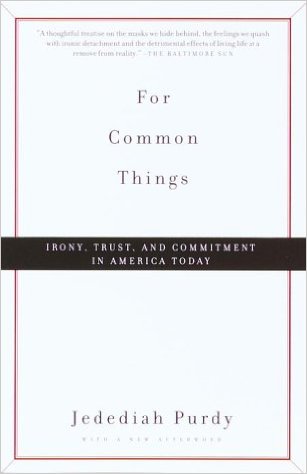
for-common-thingsA few months ago I spent some time working through Jedediah Purdy’s For Common Things.  I first heard of the book when it was name-dropped on The Newsroom.  When I read it, I found a genuine struggle with making sense of the world in a way that was both generative and formative.  As Purdy articulated the need for a non-ironic approach to the most important issues of our culture, I found myself agreeing more than not.  It was an odd bonus, of course, that the book actually came to print in 1999.  And so even though the book was obviously dated, it was both a reminder of “the way things were” as well as a hopeful sign for something different.

I have since bought Purdy’s other books and followed him on Twitter and tried to piece together what became of the non-ironic idealist.  It was clear things had changed for him (and for us all, of course), but I couldn’t quite find a good, succinct articulation of the change.  Then, about a week ago, an essay that Purdy had written in 2014 for n+1 magazine jumped the paywall, giving me my answer.

I left college in 1997 with a motto, Czesław Miłosz’s “What is unpronounced tends to nonexistence,” and a corollary, that pronouncing things might bring them into being. What I wanted to pronounce was politics. To me, that meant making all my book-learning come alive in a shared awareness that people create, preserve, or degrade their own world, joined to a sense that its justice or injustice, peace or violence, belongs to everyone. There were no movements then, and campus politics were tiny and self-involved. The dismaying figures on the big, pre-internet podiums—Thomas Friedman, Maureen Dowd—were materialists without dialectic, polemicists without politics, and I wanted to make them impossible.

That’s how the long essay begins, with something of a recapitulation of the author as evidenced in For Common Things.  It is a good reminder of culture in general, how different things were as so many of us left college.  From there, Purdy revisits the basic tenets of neoliberalism, (something that just in the last few days was discussed over at First Things in an interesting article here).  Of neoliberalism, Purdy says

The chief, and maybe sole, task of neoliberal politics is to stand watch over the market institutions—chiefly private property, free contract, and the right to spend money however one wants—that give those bargains their home. Neoliberalism welcomes market utopianism, wherein Bangladeshi factory conditions are automatically legitimate because workers agreed to work under them; but neoliberalism won’t be pinned down to a position where such conditions are celebrated. Challenged, neoliberalism switches to the tragic wisdom of (adulterated) Burke, (exaggerated) Hume, and (pretty faithfully rendered) Hayek. It might be nice if the world were different, neoliberal realism intones, but it is what it is, and so are we. Politics is no way out because, like the market, it is just the play of passions and interests, but lacking the discipline of the bottom line. Using politics to reorder social life is the dangerous dream of the utopian engineer. To try would just set loose the selfish, vain, and ignorant on our good-enough market system. Economic waste is the best we could expect from such efforts; the worst would be piles of dead. The neoliberal mind is never far from an interpretation of the 20th century’s worst disasters as symptoms of visionary politics.

It was in this context and understanding that Purdy had to find a way to articulate himself, to name the brand without becoming a brand himself (which is something that the book did for him).  He became the sincere (non-ironic) voice of hopeful wisdom in a world full of irony (cue the contrast with Dave Eggers, considered then the “sincere ironist”).  And so the challenge became, for Purdy, how to move in a world (how to speak and be heard in a world) full of commodification as a seemingly sincere and non-ironic person in a world riddled with irony.  Of the book’s greatest failure, Purdy writes

My signal failure in the book was refusing to decide between nostalgia and alienation, keeping both in play, with plenty of concrete, rustic details to buttress the nostalgic reading.

That failure helped make the book a success. My call, for politics addressed to political economy and ecology and anchored in would-be universal ideas of equality and collective responsibility, fell nonetheless into the idiom of identity politics, a story about commitments that tied them essentially to origins. Calling for substance, I defined myself by style—by the careful, unfunny sentences of someone raised by artisans, of a purveyor of seriousness, whatever Harper’s or the New Republic might imagine the politics of seriousness to be. Against a sense that speech, relationships, and actions were thinned out and cheap, I offered the handmade, the locally grown, sustenance grabbed directly from trees and the bodies of beasts. I anticipated, as it happened, the substantial “artisanal” economy of this decade.

Which now seems one of my book’s greatest failings. Identity, style, and the integrity of objects are all things that this world knows how to market. I knew, in the half-naive, half-sophisticated way that bright young people do, that this kind of story—tying a political perspective back to an origin story, weaving it into an identity—made sense to readers, teachers, and editors. I do not think I knew how perfectly this anticommodification style would lend itself to a commodification that offered an anticommodification frisson among its features.

Purdy says much in the essay about the socio-political climate of his young adulthood.  And while I wasn’t all that political myself in those times, the tenor of what he recollects is right.  He asks good questions and must confront a real sense of futility.  Near the essay’s end, Purdy remembers a particular moment.

One drunken evening in February 2000, I hacked and carved a hardback copy of For Common Things into thousands of paper shards. My housemate found me sitting in this butchered confetti, bleeding from one hand. I looked up at him and explained, “It’s full of lies.” As far as I can tell, I meant that I had falsified, simplified, used the consonance of sentences to slip around the dissonance of people and things. I was hacking at my own nostalgia and the glibness of seriousness. I also meant that I had failed: my poetics of political imagination had made nothing happen beyond selling books.

But the struggle has also brought with it a realization.

I realize now that I was trying to undo by writing what could only be undone by action, not alone but with others—and through connections that incantation alone would not conjure. Words, it turned out, did not have all the performative powers that 1990s book-learning sometimes seemed to suggest.

I was reading this essay last weekend while at a camp.  It was awkward explaining what I was reading to a co-worker who asked.  It’s odd sitting in a evangelical and conservative setting (during free time, mind you) reading a long-form essay by a guy who seems to embody the opposite of those evangelical and conservative ideals.  What I most respect about Purdy, though, is his willingness to struggle and to share.  We often see stories of failure.  We rarely see stories of genuine ideological struggle and what happens to the idealism of youth.  And while I don’t fully comprehend it, I cannot help but appreciate Purdy’s willingness to move beyond writing as the sole way of changing things.  Because he’s right.  I’m still trying to figure out a way of being in the world while holding fast to belief, ideals, and the power of words.

Purdy ends the essay with a helpful, practical image for how he sees life and vocation today.

Feeling out knots and tugging at them, looking for a loose end: you can help others by saying (when it’s true), Look here, this is stuck, try that. This good work fits the mood of the time. It’s modest, person-to-person. Is there anything spectacular left to do, without becoming fatuous?

It’s a good image, one that translates well to a number of contexts, including the classroom  (and the life of the heart and mind).

You can read the essay in its entirety here.  I think it’s worth your time, if only for a good challenge to how we approach the world around us.  I know that I haven’t come to the same conclusions as Purdy, but I understand a little better how he came to his current answers.  For that, I am thankful.

(image from amazon.com)

Posted in Books, Internet, Teaching | Tagged | Leave a comment

Nostalgia as Arson

forest-fireA couple of months ago I spent a few weeks “reflecting” my way through Yuval Levin’s The Fractured Republic, which suggested that both the political right and the political left were “stuck in the past” when trying to articulate Our Current Historical Moment.

Levin was recently interviewed by James K. A. Smith over at Comment Magazine.  It’s a good interview, as it digs in a little deeper into Our Current Historical Moment.  The question of nostalgia comes up early and often, though.  Turns out that nostalgia and revolution might be kissing cousins.

It’s interesting. I think what they have in common—this nostalgic framework and the revolutionary mindset—is that they’re both at their core escapist. They both want to solve the problems we have by essentially just burning down the environment in which they exist. I think they’re a little different in terms of what that escape would mean. There is a sense in which the nostalgic mindset is less ambitious, less radical exactly because it thinks of the ideal as something that’s remembered, so it could actually exist in the real world.

I think a revolutionary fervour, in a funny way—and Burke really saw this very clearly—it’s still about going back. It’s about going back all the way. I like to contrast Burke with Thomas Paine because Paine was incredibly explicit about this point. What revolution meant to him was to overthrow all of the artificial social constructions and return to a natural state—that it’s still there waiting for us to start over from.

So it’s a matter of “how far back” one wants to go in order to find correction for Our Current Historical Moment.

Alan Jacobs recently posted a humorous but true point about nostalgia.   Over at his blog, he writes

Whenever you suggest that history is a matter of losses as well as gains, whenever you call attention to what we’ve lost along the way, whether it’s something we deliberately set aside or something we just forgot to pack, a great chorus starts shouting “Nostalgia!” You may not even want to have packed it; you may think that we chose as well as we could have in the circumstances; but you need only hint that something of value, even of some tiny tiny value, that we once held we hold no longer, and it starts: “always the loud angry crowd, / Very angry and very loud,” crying: “Nostalgia!”

The lyric Jacobs quotes in from W. H. Auden’s “Law like love.”  You can read all of that post here.  And you can read the entire interview between Smith and Levin here.

(image from natureworldnews.com)

Posted in Books, Internet | Tagged , | Leave a comment