Pilgrim Days: Streets and Houses

chartres-cathedralIn his consideration of identity culture and postmodern thinking, Zygmunt Bauman looks back to a particular moment in history for an image and a way of thinking about the world.

When Rome lay in ruins– humbled, humiliated and sacked and pillaged by Alaric’s nomads– St. Augustine jotted down the following observation: ‘[I]t is recorded of Cain that he built a city, while Abel, as though he were merely a pilgrim on earth, built none.’ ‘True city if the saints is in heaven’; here on earth, says St. Augustine, Christians wander ‘as on pilgrimage through time looking for the Kingdom of eternity.’

“The figure of the pilgrim,” Bauman asserts, “was not a modern invention; it is as old as Christianity.  But modernity gave it a new prominence and a seminally novel twist.”

This imagery isn’t just Augustinian, though.  Many early figures in the Hebrew Scriptures were pilgrims of a sort.  That becomes part of the argument of the New Testament letter to the Hebrews.  Moving from creation to Abraham, the writer asserts that

These all died in faith, not having received the things promised, but having seen them and greeted them from afar, and having acknowledged that they were strangers and exiles on the earth.  For people who speak thus make it clear that they are seeking a homeland.  If they had been thinking of that land from which they had gone out, they would have had opportunity to return.  But as it is, they desire a better country, that is, a heavenly one. Therefore God is not ashamed to be called their God, for he has prepared for them a city. (New International Version)

The pilgrim character of the faith can be a difficult stance to maintain, of course.  Like all analogies, it falls apart at some point.  Even still, it communicates something vital (and often missing) from our approach to faithful living.  Bauman goes on to say that

For pilgrims through time, the truth is elsewhere; the true place is always some distance, some time away.  Wherever the pilgrim may be now, it is not where he ought to be, and not where he dreams of being.  The distance between the true world and this world here and now is made of the mismatch between what is to be achieved and what has been.  The glory and gravity of the future destination debases the present and makes light of it.  For the pilgrim, only streets make sense, not the houses– houses tempt one to rest and relax, to forget about the destination.  Even the streets, though, may prove to be obstacles rather than help, traps rather than thoroughfares.  They may misguide, divert from the straight path, lead astray.  ‘Judeo-Christian culture,’ writes Richard Sennett, ‘is, at its very roots, about experiences of spiritual dislocation and homelessness . . . Our faith began at odds with place.’

There have been times in my life when this pilgrim mentality was quite clear and evident for me.  Reading about street and houses is something that I think of often (as a bus rider and oft-pedestrian who has rented for all of my adult life but who has great affection and appreciation for those who open and share their homes).  And I cannot help but think of The Way, which depicts a man’s journey on the Way of Saint James.  Something about that story resonates deeply in a way that is more than just escapism and tourism.

A lot of life is determined by what you are tethered to (and who determines that connection).  While the image of the pilgrim is far from the only analogy for the life of faith, I cannot help but feel that it is a necessary one.  Bauman does a good job of setting this up before picking it apart from a postmodern perspective.

(image of Chartres Cathedral from famouswonders.com)

Posted in Faith, Travel | Leave a comment

Pilgrim Days: Changes in Identification

camino-de-santiago-940545A few weeks ago, Rod Dreher spent a post reflecting on “From Pilgrim to Tourist- or a Short History of Identity” by Zygmunt Bauman as part of his continuing articulation of “the Benedict Option.”  A made a copy of the essay and stashed is away to read later.  I got to the piece a bit ago and was pleasantly surprised with what I found.

Walker Percy once said that an era, an age, is over long before the people living in it realize.  And so the task for many of us today is to figure out (quite literally) what in the world is going on.  Bauman begins his essay by considering a shift in the way personal identification has been constructed/discerned between the modern and postmodern periods.

From the outset, Bauman is clear that “if the modern ‘problem of identity’ was how to construct an identity and keep it solid and stable, the postmodern ‘problem of identity’ is primarily how to avoid fixation and keep the options open.”  It would be the difference between “teacher for life” and “teacher for a season.”  Where, though, does one’s identity come from?

This is of particular interest to me, mostly because I straddle all kinds of lines in life.  I’ve now spent more time away from home than not.  I am in my fourteenth year of a career that I would like to think of as a calling and vocation (though I think the concept is bigger than that).  As a single guy, I have not status signifiers like husband or father, which makes things deceptively simple.  And my understanding of the Christian faith means that who I am “in Christ” theoretically trumps  every other form of self-identification you might find on any given survey form.

One things of identity whenever one is not sure of where one belongs; that is, one is not sure how to place oneself among the evident variety of behavioral styles and patterns, and how to make sure that people around would accept this placement as right and proper, so that both sides would know how to go on in each other’s presence.  ‘Identity’ is a name given to the escape sought from that uncertainty. . . Identity entered modern mind and practice dressed from the start as an individual task.  It was up to the individual to find escape from uncertainty.  Not for the first and not for the last time, socially created problems were to be resolved by individual efforts, and collective maladies healed by private medicine.

I can’t help but think back to the narrative Yuval Levin traced in The Fractured Republic concerning culture and individuals moving from a consolidated “Great War” mentality to the expressive individualism that followed (and that is now in full bloom).  Bauman continues:

Not that the individuals were left to their own initiative and their acumen was trusted; quite the contrary- putting the individual responsibility for self-formation on the agenda spawned the host of trainers, coaches, teachers, counsellors and guides all claiming to hold superior knowledge of what identities could be acquired and held.  The concepts of identity-building and of a culture (that is, of the idea of the individual incompetence, of the need of the collective breeding and of the importance of skillful and knowledgeable breeders) were and could only be born together.  The “disembedded” identity simultaneously ushered in the individual’s freedom of choice and the individual’s dependency on expert guidance.

The talk of identity is groundwork laid for the better task of Bauman’s essay, which takes the image of the pilgrim and rethinks it in light of the postmodern question.  More on that tomorrow.

(image of the Camino de Santiago from inquisitr.com)

Posted in Faith, Internet, Teaching, The Long Story | Tagged | Leave a comment

Stranger Things Have Happened

About a month ago I finally got around to seeing Stranger Things on Netflix (thanks to friends and neighbors).  It’s pretty much everything every good review said: wonderfully nostalgic, well-paced, a real sense of the unexpected, Winona Ryder unrecognizable at first.  A great way to spend a few hours.

The folks over at 8-Bit Cinema have put together a four-minute, eight-bit version of the show.  While it may leave some pretty important (and good) moments out, it’s mostly just fun to see the show and the format mix.

The second season of the show is set to air next year.  Some people are already encouraging a moratorium on talking about spoilers for the second season.  You can read one such impassioned plea here.

I’ll be doing my best to avoid spoilers (after the following video).  All I knew going into season one was that something bad happened to Barb (though I didn’t know what).  I was expecting her to become a villain or something, but that didn’t happen.  If you do want spoilers, the best thing you can get so far is this teaser from Netflix.  It’s all text but it gives away the titles of each season two episode.

(hat tip to comicbook.com and gerrycanavan.wordpress.com)

Posted in Internet, Television | Tagged | Leave a comment

Beyond Common Things

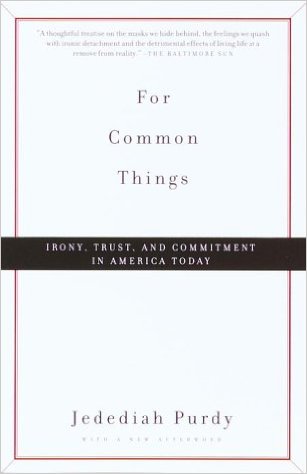
for-common-thingsA few months ago I spent some time working through Jedediah Purdy’s For Common Things.  I first heard of the book when it was name-dropped on The Newsroom.  When I read it, I found a genuine struggle with making sense of the world in a way that was both generative and formative.  As Purdy articulated the need for a non-ironic approach to the most important issues of our culture, I found myself agreeing more than not.  It was an odd bonus, of course, that the book actually came to print in 1999.  And so even though the book was obviously dated, it was both a reminder of “the way things were” as well as a hopeful sign for something different.

I have since bought Purdy’s other books and followed him on Twitter and tried to piece together what became of the non-ironic idealist.  It was clear things had changed for him (and for us all, of course), but I couldn’t quite find a good, succinct articulation of the change.  Then, about a week ago, an essay that Purdy had written in 2014 for n+1 magazine jumped the paywall, giving me my answer.

I left college in 1997 with a motto, Czesław Miłosz’s “What is unpronounced tends to nonexistence,” and a corollary, that pronouncing things might bring them into being. What I wanted to pronounce was politics. To me, that meant making all my book-learning come alive in a shared awareness that people create, preserve, or degrade their own world, joined to a sense that its justice or injustice, peace or violence, belongs to everyone. There were no movements then, and campus politics were tiny and self-involved. The dismaying figures on the big, pre-internet podiums—Thomas Friedman, Maureen Dowd—were materialists without dialectic, polemicists without politics, and I wanted to make them impossible.

That’s how the long essay begins, with something of a recapitulation of the author as evidenced in For Common Things.  It is a good reminder of culture in general, how different things were as so many of us left college.  From there, Purdy revisits the basic tenets of neoliberalism, (something that just in the last few days was discussed over at First Things in an interesting article here).  Of neoliberalism, Purdy says

The chief, and maybe sole, task of neoliberal politics is to stand watch over the market institutions—chiefly private property, free contract, and the right to spend money however one wants—that give those bargains their home. Neoliberalism welcomes market utopianism, wherein Bangladeshi factory conditions are automatically legitimate because workers agreed to work under them; but neoliberalism won’t be pinned down to a position where such conditions are celebrated. Challenged, neoliberalism switches to the tragic wisdom of (adulterated) Burke, (exaggerated) Hume, and (pretty faithfully rendered) Hayek. It might be nice if the world were different, neoliberal realism intones, but it is what it is, and so are we. Politics is no way out because, like the market, it is just the play of passions and interests, but lacking the discipline of the bottom line. Using politics to reorder social life is the dangerous dream of the utopian engineer. To try would just set loose the selfish, vain, and ignorant on our good-enough market system. Economic waste is the best we could expect from such efforts; the worst would be piles of dead. The neoliberal mind is never far from an interpretation of the 20th century’s worst disasters as symptoms of visionary politics.

It was in this context and understanding that Purdy had to find a way to articulate himself, to name the brand without becoming a brand himself (which is something that the book did for him).  He became the sincere (non-ironic) voice of hopeful wisdom in a world full of irony (cue the contrast with Dave Eggers, considered then the “sincere ironist”).  And so the challenge became, for Purdy, how to move in a world (how to speak and be heard in a world) full of commodification as a seemingly sincere and non-ironic person in a world riddled with irony.  Of the book’s greatest failure, Purdy writes

My signal failure in the book was refusing to decide between nostalgia and alienation, keeping both in play, with plenty of concrete, rustic details to buttress the nostalgic reading.

That failure helped make the book a success. My call, for politics addressed to political economy and ecology and anchored in would-be universal ideas of equality and collective responsibility, fell nonetheless into the idiom of identity politics, a story about commitments that tied them essentially to origins. Calling for substance, I defined myself by style—by the careful, unfunny sentences of someone raised by artisans, of a purveyor of seriousness, whatever Harper’s or the New Republic might imagine the politics of seriousness to be. Against a sense that speech, relationships, and actions were thinned out and cheap, I offered the handmade, the locally grown, sustenance grabbed directly from trees and the bodies of beasts. I anticipated, as it happened, the substantial “artisanal” economy of this decade.

Which now seems one of my book’s greatest failings. Identity, style, and the integrity of objects are all things that this world knows how to market. I knew, in the half-naive, half-sophisticated way that bright young people do, that this kind of story—tying a political perspective back to an origin story, weaving it into an identity—made sense to readers, teachers, and editors. I do not think I knew how perfectly this anticommodification style would lend itself to a commodification that offered an anticommodification frisson among its features.

Purdy says much in the essay about the socio-political climate of his young adulthood.  And while I wasn’t all that political myself in those times, the tenor of what he recollects is right.  He asks good questions and must confront a real sense of futility.  Near the essay’s end, Purdy remembers a particular moment.

One drunken evening in February 2000, I hacked and carved a hardback copy of For Common Things into thousands of paper shards. My housemate found me sitting in this butchered confetti, bleeding from one hand. I looked up at him and explained, “It’s full of lies.” As far as I can tell, I meant that I had falsified, simplified, used the consonance of sentences to slip around the dissonance of people and things. I was hacking at my own nostalgia and the glibness of seriousness. I also meant that I had failed: my poetics of political imagination had made nothing happen beyond selling books.

But the struggle has also brought with it a realization.

I realize now that I was trying to undo by writing what could only be undone by action, not alone but with others—and through connections that incantation alone would not conjure. Words, it turned out, did not have all the performative powers that 1990s book-learning sometimes seemed to suggest.

I was reading this essay last weekend while at a camp.  It was awkward explaining what I was reading to a co-worker who asked.  It’s odd sitting in a evangelical and conservative setting (during free time, mind you) reading a long-form essay by a guy who seems to embody the opposite of those evangelical and conservative ideals.  What I most respect about Purdy, though, is his willingness to struggle and to share.  We often see stories of failure.  We rarely see stories of genuine ideological struggle and what happens to the idealism of youth.  And while I don’t fully comprehend it, I cannot help but appreciate Purdy’s willingness to move beyond writing as the sole way of changing things.  Because he’s right.  I’m still trying to figure out a way of being in the world while holding fast to belief, ideals, and the power of words.

Purdy ends the essay with a helpful, practical image for how he sees life and vocation today.

Feeling out knots and tugging at them, looking for a loose end: you can help others by saying (when it’s true), Look here, this is stuck, try that. This good work fits the mood of the time. It’s modest, person-to-person. Is there anything spectacular left to do, without becoming fatuous?

It’s a good image, one that translates well to a number of contexts, including the classroom  (and the life of the heart and mind).

You can read the essay in its entirety here.  I think it’s worth your time, if only for a good challenge to how we approach the world around us.  I know that I haven’t come to the same conclusions as Purdy, but I understand a little better how he came to his current answers.  For that, I am thankful.

(image from amazon.com)

Posted in Books, Internet, Teaching | Tagged | Leave a comment

Nostalgia as Arson

forest-fireA couple of months ago I spent a few weeks “reflecting” my way through Yuval Levin’s The Fractured Republic, which suggested that both the political right and the political left were “stuck in the past” when trying to articulate Our Current Historical Moment.
Levin was recently interviewed by James K. A. Smith over at Comment Magazine.  It’s a good interview, as it digs in a little deeper into Our Current Historical Moment.  The question of nostalgia comes up early and often, though.  Turns out that nostalgia and revolution might be kissing cousins.

It’s interesting. I think what they have in common—this nostalgic framework and the revolutionary mindset—is that they’re both at their core escapist. They both want to solve the problems we have by essentially just burning down the environment in which they exist. I think they’re a little different in terms of what that escape would mean. There is a sense in which the nostalgic mindset is less ambitious, less radical exactly because it thinks of the ideal as something that’s remembered, so it could actually exist in the real world.

I think a revolutionary fervour, in a funny way—and Burke really saw this very clearly—it’s still about going back. It’s about going back all the way. I like to contrast Burke with Thomas Paine because Paine was incredibly explicit about this point. What revolution meant to him was to overthrow all of the artificial social constructions and return to a natural state—that it’s still there waiting for us to start over from.

So it’s a matter of “how far back” one wants to go in order to find correction for Our Current Historical Moment.

Alan Jacobs recently posted a humorous but true point about nostalgia.   Over at his blog, he writes

Whenever you suggest that history is a matter of losses as well as gains, whenever you call attention to what we’ve lost along the way, whether it’s something we deliberately set aside or something we just forgot to pack, a great chorus starts shouting “Nostalgia!” You may not even want to have packed it; you may think that we chose as well as we could have in the circumstances; but you need only hint that something of value, even of some tiny tiny value, that we once held we hold no longer, and it starts: “always the loud angry crowd, / Very angry and very loud,” crying: “Nostalgia!”

The lyric Jacobs quotes in from W. H. Auden’s “Law like love.”  You can read all of that post here.  And you can read the entire interview between Smith and Levin here.

(image from natureworldnews.com)

Posted in Books, Internet | Tagged , | Leave a comment

Simple Song for the MacLaren’s Gang

I just finished a longer-than-anticipated rewatch of the eighth season of How I Met Your Mother.  Complain all you want about how the ninth season ended, but the eighth season’s wrap stands out as one of my favorite moments from the show.

What you get in the episode is the set up of a perfect storm.  The show’s five primary characters are converging on a wedding from various places and with various secrets and plans (new jobs, new places of residence).  And then, as the scenes play out, the audience gets to see something that none of those primary characters knows is coming . . . the Mother.

It’s a wonderfully-staged convergence (aided mightily by The Shin’s “Simple Song.”  One that chokes me up every time (and that I’ll probably repost every few years just because it’s so good).  The only weakness of this particular clip is that it doesn’t include the conversation between Ted and Lily, which gives some even greater context.  Have to save something for the show, I suppose.

Posted in Internet, Music, Television | Tagged | Leave a comment

Teaching in the Balance

classroomThis year at work I’m taking part in an instructional leadership group.  Every few weeks, I gather with co-workers to watch teaching samples, read a
ticles, and discuss best practices in the classroom in the hopes that
it be teachable and transferable.  And while I enjoy the time, I couldn’t help but chuckle when I read Carl Trueman’s recent First Things essay about teaching.  In “Teaching as Joyful Rebellion,” Trueman rues the reality that too often teaching is about anything but actual content.

Teaching—true teaching, not the mere imparting of techniques or earning potential—is perhaps the most delightful calling and privilege in the world. It has its challenges, but it brings incomparable joys. The second greatest joy I have as teacher is seeing that flash of light in a student’s eyes when a previously unknown or misunderstood concept suddenly becomes clear because of something I have said. And the greatest joy (albeit a rarer one) is the one I experience when a student writes or says something that indicates they have gone far beyond that which I, as a teacher, have been able to teach them. When they become greater, I delight that I become less. For such is the proper order of things, if teaching is truly about truth and not about power or making disciples. Yet neither joy is possible where there is no truth to discover and where the world is simply whatever the loudest and most aggressive among us care to claim that it is. Good teaching is a matter of metaphysics.

It’s a fair critique, I think.  At the very least, it’s the reminder that part of loving teaching means loving what you teach, perhaps even more than how you teach it.  You can read the entire post here.  It’s worth your time.

(image from epi.sc.edu)

Posted in Faith, Internet, Teaching | Leave a comment

Still Getting LOST

This past weekend, composer Michael Giacchino gathered an orchestra and played some of the great music that made up the soundtrack for LOST.  The “We Have to Go Back” concerts covered two nights and six seasons of television.  Here’s a clip of the show’s finale, with scenes from the show’s controversial wrap playing to the side.  I dare you to get through the entire eight minutes and not shed a tear . . .

Posted in Internet, Music, Television | Tagged | Leave a comment

Sullivan’s Silence: Potential Solutions

silence-in-the-reading-roomPerhaps the most interesting turn in Andrew Sullivan’s “I Used to be a Human Being” essay takes place when he turns attention to religious tradition.  Silence, a potential cure for our digital addictions, has always had a home in places and people of faith.  More interesting, still, is his turn to Charles Taylor.

In his survey of how the modern West lost widespread religious practice, A Secular Age, the philosopher Charles Taylor used a term to describe the way we think of our societies. He called it a “social imaginary” — a set of interlocking beliefs and practices that can undermine or subtly marginalize other kinds of belief. We didn’t go from faith to secularism in one fell swoop, he argues. Certain ideas and practices made others not so much false as less vibrant or relevant. And so modernity slowly weakened spirituality, by design and accident, in favor of commerce; it downplayed silence and mere being in favor of noise and constant action. The reason we live in a culture increasingly without faith is not because science has somehow disproved the unprovable, but because the white noise of secularism has removed the very stillness in which it might endure or be reborn.

The English Reformation began, one recalls, with an assault on the monasteries, and what silence the Protestants didn’t banish the philosophers of the Enlightenment mocked. Gibbon and Voltaire defined the Enlightenment’s posture toward the monkish: from condescension to outright contempt. The roar and disruption of the Industrial Revolution violated what quiet still remained until modern capitalism made business central to our culture and the ever-more efficient meeting of needs and wants our primary collective goal. We became a civilization of getting things done — with the development of America, in some ways, as its crowning achievement. Silence in modernity became, over the centuries, an anachronism, even a symbol of the useless superstitions we had left behind. The smartphone revolution of the past decade can be seen in some ways simply as the final twist of this ratchet, in which those few remaining redoubts of quiet — the tiny cracks of inactivity in our lives — are being methodically filled with more stimulus and noise.

James K. A. Smith spent some time sifting through the thoughts of Taylor (particularly in How (Not) to Be Secular and then also in his Cultural Liturgies series).  We have definitely embraced a digitally-enhanced social imaginary, one where a world without digital things is impossible to comprehend.  Sullivan’s assertion that faith lost its hold because of a lack a healthy silence to combat the white noise of modernity is potentially the most spot-on and damning critique of contemporary Christian practices (if only we’d remove our earbuds in order to listen).

Sullivan continues a more religious train of thought from the Catholic Mass

From the moment I entered a church in my childhood, I understood that this place was different because it was so quiet. The Mass itself was full of silences — those liturgical pauses that would never do in a theater, those minutes of quiet after communion when we were encouraged to get lost in prayer, those liturgical spaces that seemed to insist that we are in no hurry here. And this silence demarcated what we once understood as the sacred, marking a space beyond the secular world of noise and business and shopping.

to the Judeo-Christian understanding of the Sabbath

That Judeo-Christian tradition recognized a critical distinction — and tension — between noise and silence, between getting through the day and getting a grip on one’s whole life. The Sabbath — the Jewish institution co-opted by Christianity — was a collective imposition of relative silence, a moment of calm to reflect on our lives under the light of eternity. It helped define much of Western public life once a week for centuries — only to dissipate, with scarcely a passing regret, into the commercial cacophony of the past couple of decades. It reflected a now-battered belief that a sustained spiritual life is simply unfeasible for most mortals without these refuges from noise and work to buffer us and remind us who we really are. But just as modern street lighting has slowly blotted the stars from the visible skies, so too have cars and planes and factories and flickering digital screens combined to rob us of a silence that was previously regarded as integral to the health of the human imagination.

And while I don’t believe Sullivan’s critique of the contemporary church is the point of the essay, you can’t help but see the challenge he presents to believers and church leaders today.

If the churches came to understand that the greatest threat to faith today is not hedonism but distraction, perhaps they might begin to appeal anew to a frazzled digital generation. Christian leaders seem to think that they need more distraction to counter the distraction. Their services have degenerated into emotional spasms, their spaces drowned with light and noise and locked shut throughout the day, when their darkness and silence might actually draw those whose minds and souls have grown web-weary. But the mysticism of Catholic meditation — of the Rosary, of Benediction, or simple contemplative prayer — is a tradition in search of rediscovery. The monasteries — opened up to more lay visitors — could try to answer to the same needs that the booming yoga movement has increasingly met.

And imagine if more secular places responded in kind: restaurants where smartphones must be surrendered upon entering, or coffee shops that marketed their non-Wi-Fi safe space? Or, more practical: more meals where we agree to put our gadgets in a box while we talk to one another? Or lunch where the first person to use their phone pays the whole bill? We can, if we want, re-create a digital Sabbath each week — just one day in which we live for 24 hours without checking our phones. Or we can simply turn off our notifications. Humans are self-preserving in the long run. For every innovation there is a reaction, and even the starkest of analysts of our new culture, like Sherry Turkle, sees a potential for eventually rebalancing our lives.

My hope is that Sullivan’s challenge will not get lost in the constant deluge of our digital world, though I fear that is simply “how it is these days.”  If you haven’t yet, I highly recommend that you read the entire essay.  It is well worth your time and attention (and your careful personal and institutional reflection).  You can read the essay in its entirety here.

(image from cityroom.blogs.nytimes.com)

Posted in Faith, Internet, Teaching | Tagged | Leave a comment

Celebrating Birthdays and the Promise of Adventure

Today, September the 22nd, is of particular importance to fans of JRR Tolkien’s Lord of the Rings, as it serves as the birthdays of both Bilbo and Frodo Baggins.  Thanks to the calendar work Tolkien did (that can be found in the appendices of The Return of the King) and of the work of websites like TheOneRing.net, fans can see that the date was also significant for being the day Biblo arrived by barrel at Laketown and that Sam would eventually leave for the Grey Havens.

Here’s the extended version of Biblo’s birthday party from Peter Jackson’s rendition of The Fellowship of the Ring.  It’s a nice way to spend a few minutes on this fine Thursday.

Posted in Books, Internet, Movies | Tagged | Leave a comment