Sullivan’s Silence: Our Noisy Moment

Monday saw the drop of a raresmartphones essay from Andrew Sullivan, former blogger with the Daily Dish.  The essay, “I Used to Be a Human Being,” recounted Sullivan’s struggle with detoxing from digital culture, from blogging to smart phones.  The piece got lots of traction from all different corners, which is always cool, particularly as he referenced some of my favorite writers/thinkers (like Nicholas Carr, Alan Jacobs, and Matthew Crawford).  Thought I’d spend a couple of posts pointing out some favorite moments from the essay.

One of the things I like most about “I Used to Be a Human Being” is how Sullivan traces the quick ascendancy of our most recent digital culture.  While it didn’t happen overnight in our lifetimes, it did happen in the blink of an eye when you look at the big picture.

Since the invention of the printing press, every new revolution in information technology has prompted apocalyptic fears. From the panic that easy access to the vernacular English Bible would destroy Christian orthodoxy all the way to the revulsion, in the 1950s, at the barbaric young medium of television, cultural critics have moaned and wailed at every turn. Each shift represented a further fracturing of attention — continuing up to the previously unimaginable kaleidoscope of cable TV in the late-20th century and the now infinite, infinitely multiplying spaces of the web. And yet society has always managed to adapt and adjust, without obvious damage, and with some more-than-obvious progress. So it’s perhaps too easy to view this new era of mass distraction as something newly dystopian.

But it sure does represent a huge leap from even the very recent past. The data bewilder. Every single minute on the planet, YouTube users upload 400 hours of video and Tinder users swipe profiles over a million times. Each day, there are literally billions of Facebook “likes.” Online outlets now publish exponentially more material than they once did, churning out articles at a rapid-fire pace, adding new details to the news every few minutes. Blogs, Facebook feeds, Tumblr accounts, tweets, and propaganda outlets repurpose, borow, and add topspin to the same output.

What’s been frustrating about the trend is how few people pushing technology have spent much time looking at all of the angles of digital influence.  Sure, some of that could be chalked up to a sense of “the unknown,” but we do have all of our previous technological jumps to help us be a bit more critical of what we’re getting ourselves into.

And the engagement never ends. Not long ago, surfing the web, however addictive, was a stationary activity. At your desk at work, or at home on your laptop, you disappeared down a rabbit hole of links and resurfaced minutes (or hours) later to reencounter the world. But the smartphone then went and made the rabbit hole portable, inviting us to get lost in it anywhere, at any time, whatever else we might be doing. Information soon penetrated every waking moment of our lives.

And it did so with staggering swiftness. We almost forget that ten years ago, there were no smartphones, and as recently as 2011, only a third of Americans owned one. Now nearly two-thirds do. That figure reaches 85 percent when you’re only counting young adults. And 46 percent of Americans told Pew surveyors last year a simple but remarkable thing: They could not live without one. The device went from unknown to indispensable in less than a decade. The handful of spaces where it was once impossible to be connected — the airplane, the subway, the wilderness — are dwindling fast. Even hiker backpacks now come fitted with battery power for smartphones. Perhaps the only “safe space” that still exists is the shower.

Am I exaggerating? A small but detailed 2015 study of young adults found that participants were using their phones five hours a day, at 85 separate times. Most of these interactions were for less than 30 seconds, but they add up. Just as revealing: The users weren’t fully aware of how addicted they were. They thought they picked up their phones half as much as they actually did. But whether they were aware of it or not, a new technology had seized control of around one-third of these young adults’ waking hours.

This past week, I talked my students through the idea of a frog dying in boiling water because the temperature was turned up gradually and without much notice.  The science behind the anecdote is questionable (you can check YouTube for that), but the sentiment is clear and obvious.  It’s a different take on the opening story in David Foster Wallace’s Kenyon College address, “This is Water.”  We are in the water, our culture, and the very temperature of the water has changed (thanks to digital technology, in a way).  It’s a bit of what Douglas Coupland was going for in his short work, The Age of Earthquakes.

For Sullivan, the solution was walking away from technology.  Much of the essay retells some of that story.  He traces the idea of silence from the Protestant Reformation to the annual Burning Man event.  It’s a long read, but it’s also a good one.  And while you may not agree with all of Sullivan’s many views, I do think he speaks truth on a vital issue for us today, we whose very brains are being continually rewired by the digital landscape around us.

You can read the whole essay here.  Tomorrow, I’m going to make note of some of the overtly Christian connections in the piece, which includes an indictment on contemporary Christian spirituality in America.

(image from comfortade.com)
Posted in Faith, Internet | Tagged | Leave a comment

Kristen Bell Goes to the Good Place

I wasn’t planning on watching (m)any new shows on television this fall season.  I got word at the last minute, though, of a new show by Michael Schur (of Parks and Recreation fame) called The Good Place.  The show follows the story of Eleanor Shellstrop, a super-selfish character played by Kristen Bell, who unexpectedly ends up in a version of heaven.  It’s all skewed (from an orthodox perspective), but it has some great moments that line up with the worldview questions I talk about in class throughout the year.  Here’s a clip where “the afterlife” is explained.

The folks at Entertainment Weekly interviewed Schur about the math behind the good/bad behavior calculations.  It’s a funny explanation that you can read about here.

Two episodes aired last night.  Kant and Aristotle had their names dropped in the second episode.  Some interesting approaches to ethics, morality, perfectionism, and the nature of the world around us.

I’m not sure how long the show will last (it’s a bit of a stretch for network television).  It’s sharp, though.  And it’s a perfect picture of the absurdity of an afterlife devoid of any real classical theology (Christian or otherwise).  It must be the heaven as rendered in moralistic therapeutic deism.

Posted in Faith, Internet, Teaching, Television | Leave a comment

Nineteen

Today marked nineteen years since the death of Rich Mullins.  I am grateful to the high school friends who introduced me to his music and for the musicians who have kept his legacy of honest and contextual songwriting alive.  Just this weekend I was blessed in revisiting Brothers Keeper, an album that never gets enough airplay in my collection.

Here’s a clip of Mullins singing “The Breaks” recorded a couple of weeks prior to the accident that took Mullins’ life.

Posted in Faith, Internet, Music | Tagged | Leave a comment

End of Summer Song

I suppose summer ends in different ways for different people.  The start of a new school years.  Labor Day.  A certain feel to the season of movies.  The return of network television after a summer of reruns (or reality television, thank you, Big Brother).  Here’s a classic Andrew Osenga song about summer coming to an end.  Wonderfully dated and enjoyable.

Posted in Internet, Music, Uncategorized | Leave a comment

All We Ever Do

It seems like “All We Ever Knew” by The Head and the Heart comes on every time I turn on the radio.  And while the song isn’t as coherent as I would like, it simple line of “all we ever do is all we ever knew” sticks with me long after the radio is turned off.

Here’s the music video, pretty simple by most standards.  It’s true for most of us, though, the all we ever do boils down to all that we’ve ever know.  So the question becomes “how do we wake up” from such an existence?

Posted in Internet, Music | Leave a comment

A Reduction of Dimensions

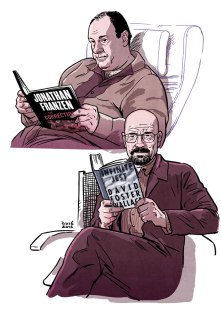
readingI’m often interested in the interplay of genres and forms, particularly when it comes to storytelling and when one form seems to subsume another.  The easy target, of course, is television and the internet.  The relationship between television and the novel comes up often, too.  David Foster Wallace, a child of the television and a writer of novels, thought about it some, particularly in the context of loneliness.  In a recent article at The New Atlantis, Erik P. Hoel brings up the question of “fiction in the age of screens” in light of what that means for writers, including those who move from the printed page to the silver screen.

It is something about the interiority of novel-reading, Hoel seems to suggest, that will remind us that we are always more than the categories used by culture to define us.

Novels will always have a place because we are creatures of both the extrinsic and the intrinsic. Due to the nature of, well, the laws of reality, due to the entire structure and organization of how universes might simply have to be, we are forced to deal with and interact entirely through the extrinsic world. We are stuck having to infer the hidden intrinsic world of other consciousnesses from an extrinsic perspective. This state leaves us open to solipsism, as Wallace suggested in saying that novels are a cure for loneliness. But the loneliness that novels cure, unlike television, is not social. It is metaphysical.

At the same time, our uncomfortable position — both flesh and not — also puts us in danger, beyond just that of solipsism, of forgetting the intrinsic perspective, of ignoring that it holds an equal claim on describing the universe. In contemporary culture there has been a privileging of the extrinsic both ontologically and as explanation. We take the extrinsic perspective on psychology, sociology, biology, technology, even the humanities themselves, forgetting that this perspective gives us, at most, only ever half of the picture. There has been a squeezing out of consciousness from our explanations and considerations of the world. This extrinsic drift obscures individual consciousnesses as important entities worthy of attention.

Recently I overheard a conversation between two psychiatrists in the hallway next to my lab. One doctor was describing a patient, a young woman whose primary problem seemed to be that she was spending too much money on clothes. For the next five minutes the two debated what medications to put her on. Extrinsic drift is why people are so willing to believe that a shopping addiction should be cured by drugs, that serotonin is happiness or oxytocin is love. It’s our drift toward believing that identities are more political than personal, that people are less important than ideologies, that we are whatever we post online, that human beings are data, that attention is a commodity, that artificial intelligence is the same as human intelligence, that the felt experience of our lives is totally epiphenomenal, that the great economic wheel turns without thought, that politics goes on without people, that we are a civilization of machines. It is forgotten that an extrinsic take on human society is always a great reduction of dimensions, that so much more is going on, all under the surface.

Given its very nature, the novel cannot help but stand in cultural opposition to extrinsic drift. For the novel is the only medium in which the fundamental unit of analysis is the interiority of a human life. It opposes the unwarranted privileging of the extrinsic half of the world over the intrinsic. It is a reminder, a sign in the desert that seems to be pointing nowhere until its flickering neon lettering is read: There is something it is like to be a human being. And what it is like matters. The sign points to what cannot be seen.

I like the author’s approach to the intrinsic/extrinsic perspective and approach, how we tend to deal with reality categorically in a way that forgets the individuals (which is interesting because you would think the opposite is most true).  It falls in line with Yuval Levin’s assertion that the have misconstrued identity and community.

That last paragraph is great.  You can read the whole article here.

(image from thenewatlantis.com)

Posted in Books, Internet, Television | Leave a comment

A Jingle of Loose Change

From earlier this year, when Peterson was in Hawaii.  Can’t believe I hadn’t already posted this, as it’s a good clip of a great song.

Posted in Faith, Internet, Music | Tagged | Leave a comment

Fifty Years of Star Trek

The first episode of Star Trek aired 50 years ago today.  And while I’ve had an on-again/off-again relationship with the franchise, I can surely appreciate its contribution to the collective consciousness of 21st century America.  I think the only show I followed faithfully was probably Voyager, and even then I disappeared for a while before seeing if they ever made it back to the Delta Quadrant.

The folks at Paramount have released a short “50th Anniversary” trailer that hits some real high points of the story.  Check it out.

Posted in Internet, Movies, Television | Leave a comment

Reminders of the Sacred Journey

frederick-buechnerIt was the music of Wes King that led me to the books of Frederick Buechner.  King’s “Magnificent Defeat” was inspired by a Buechner sermon of the same name.  I remember in college reading through Buechner’s sermons and early biographical works (particularly The Sacred Journey, which I would eventually use in a class).  Discovering Buechner was a creative turn for me, finding a preacher who wielded words well and to great effect, who captured something about the sentiment of living without falling into sentimentality.  I’m thankful I have his writings to carry with me as I grow older.

Musician Andrew Peterson recently posted an “address” he recently delivered at the Buechner Institute at King College titled “The Consolations of Doubt.”  From the start, Peterson captures something great about Buechner’s style and influence.

Once upon a time I lived in a world of dirt roads and diamondbacks. Alligators haunted the lakes, four wheelers and hunters haunted the woods, and as Flannery O’Connor famously said, Christ haunted the South. He was everywhere. He was in the Bible verse printed on the front page of the church bulletin, he was in the oddly hyphenated words in the hymnbook, he showed up on the church marquee, he was prayed to before the football games and before meals, he was on bumper stickers next to confederate flags, his name lifted jubilantly from the tongues of worshipers during four hour Sunday meetings on one side of the tracks, and on the other the name of Jesus launched like a rocket from my father’s mouth as he paced behind the podium where the white folks sat dutifully and muttered an occasional “Amen.”

Buechner’s sermons always remind you that your own story is a nestled story, told in the messy context of day-to-day life full of vital detail.

From there, Peterson tells of his own idiosyncratic struggle with the doubts of faith and how Buechner’s challenge to “listen to your life” helped him understand that struggle well.  He weaves in Thomas Merton and C. S. Lewis and Michael Card and the doubts of faith and then brings things together.

Before Buechner I had no context in which to admit to myself, let alone to anyone else, that this God, this basket in whom I have deposited every last one of my eggs, was a mystery as much as he was a revelation. Because of Buechner’s frank and persistent admission that he isn’t quite sure about this whole Jesus thing 100% of the time—and lest you get defensive on his behalf, why don’t we all just admit here that it’s just as true of us?—I found myself opening up to a new and deeper consolation than that of surety—the consolation of doubt.

The consolation that comes when one traveler says to the other, “I’ve been here before, and I still don’t know where I’m going. It’s a mystery, but at least we’re in this thing together.” And wherever two or more are gathered in his name, even if they’re lost and angry and doubtful and confused, Jesus is in their midst. Maybe especially so.

The whole address is a worthy effort and a great way to spend some time.  You can read the whole thing here.

(image from urbansimplicity.net)

Posted in Books, Faith, Internet, Music | Leave a comment

Tools (Reflections on Demolition)

Last night this three-day weekend started with a viewing of Demolition, starring Jake Gyllenhaal and Naomi Watts.  I think I was probably one of the five people who actually saw it in the theater when it dropped this past spring.  It’s the kind of movie that, were I in my mid-twenties, I’d take multiple friends for a viewing.  The movie, trailer below, plays out a bit like Fight Club for the financial district (that and underground fighting is replaced with sledgehammers and screwdrivers).

For all of the power tools and house destruction, there’s an subtlety to the movie.  It happens in particular scenes: conversations about work on the commuter train, conversations about foul language at the kitchen table, inner monologues that surprise you in direction they take.

One of my favorite moments in the movie is when Gyllenhaal’s character, Davis, starts to wonder if his whole life has become a metaphor (am I the fallen tree?  am I the wind that fell the tree?).  From early in the movie, you get the sense that the movie is about a young man who has (supposedly) been given tools to fix things.  But when things fall apart, he uses the tools to take things even farther.  The question, then, is what you can do to put things back together again.  In its way, it’s a generational story about emptiness and loss and, well, the inability to pass on the kinds of tools that matter and can make a life.

In my humble estimation, the only weakness to the movie is its need to go in a romantic direction (and the unexpected by-product that comes with that).  I suppose that’s a big part of trying to sell any movie that’s not an action flick these days.

It’s an odd hero’s journey, one quite illuminating at its best.  It takes an interesting (though potentially questionable) approach to grief (of the lack thereof).  It’s not necessarily the kind of movie you’d watch often.  But once in a while, in a world unaware of its need for repair, it’s something good to think through.

Posted in Internet, Movies | Leave a comment