
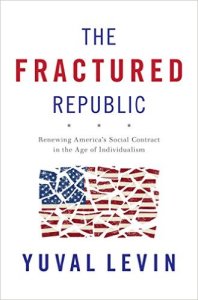
 If there’s a book out this summer that’s worth your time and money, it’s Yuval Levin’s The Fractured Republic. I read it a few weeks ago and have been mulling over it ever since. In the book, Levin draws a picture of how 20th century America became 21st century America. In doing so, he points out that the thing most political leaders in the 21st century want to do is go back in time, to realign our common life with some particular moment from decades ago. From the introduction:
… in our time, in particular, our politics is overwhelmed by an usually intense and often debilitating frustration that is rooted in a form of that illusion [that getting back to a good place in national life is that easy], but runs deeper. Liberals and conservatives both frequently insist not only that the path to the America of their (somewhat different) dreams is easy to see, but also that our country was once on that very path and has been thrown off course by the foolishness or wickedness of those on the other side of the aisle. Liberals look back to the postwar golden age of midcentury America, which they believe embodied the formula for cultural liberalization amid economic security and progress until some market fanatics threw it all away. Conservatives look fondly to the late-century book of the Reagan era, which they say rescued the country from economic malaise while recapturing some of the magic of the confident, united America of that earlier midcentury golden age, but was abandoned by misguided statists.
Each side wants desperately to recover its lost ideal, believes the bulk of the country does, too, and is endlessly frustrated by the political resistance that holds it back. The broader public, meanwhile, finds in the resulting political debates little evidence of real engagement with contemporary problems and few attractive solutions. In the absence of relief from their own resulting frustration, a growing number of voters opt for leaders who simply embody or articulate that frustration.
Over the next few days I’m going to write through a few of Levin’s major points. Some of what he sees and says seems to be true for other, smaller organizations and communities, only writ large. Even individuals can find themselves trapped, frozen in time, by a certain nostalgia. Nostalgia has its place, of course. But it cannot be something that keeps you from being faithful and effective in the current moment. As Levin suggests:
To learn from nostalgia, we must let it guide us not merely toward “the way we were,” but toward just what was good about what we miss, and why.
That, I believe, is thinking in the right direction.
You can read a review of the book by James K. A. Smith here.
 The stakes aren’t all that high for me with the recent release of Pokemon Go as a mobile app. It’s at least two generations removed from what was important to my childhood (I draw the first line at the Teenage Mutant Ninja Turtles, but that’s a conversation for another time). App-wise, I’m already a few trendy app-releases behind to have much interest in it (that first line got drawn at Snap Chat). But I get the excitability of the app. Even last night a (younger) friend asked if I had downloaded the game because he thought I’d be good at it considering my approach to transportation. And while one should never say never . . .
 Try as we might to make it otherwise, place matters. At our best, we are people rooted in place and time in a way that makes us mindful of the good and bad of our moment. This is less and less true, I think, particularly as each unique place looks more and more like every other formerly unique place (thus: wherever you go, there you are). I often feel it when I travel, primed for it by a strong hometown and home state culture, reinforced by living in a state with a strong sense of its historic culture (and the struggle to maintain that culture against the forces of contemporary life).
 I think it’s great that Josie and the Pussycats wound up at #48 on the list. It’s a much better movie than audiences gave it credit for. It harkens back to the days of The Matrix, Fight Club, and Memento for me, particularly in its subversiveness, which the A. V. Club list points out. Still, I’m not sure how ha-ha funny it actually is. It embraces and subverts “everything Archie” quite nicely, really.
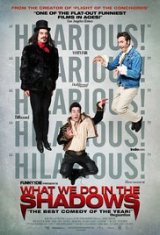 One of my favorite movies of the last five years, What We Do in the Shadows, is ranked at #26. From New Zealand, the story follows four vampires trying to make their way in 21st century Wellington. It’s told as a documentary that centers around an upcoming annual gathering of the creatures of the night. All of the vampire mythology is on display (like mind control and entry issues) to great effect. Even now, I crack up a but just thinking about the adventures of Viago and friends. The movie’s creator is starting work on the third Thor movie. After that, we’re supposed to get a look into the world of werewolves.
 It was pretty cool seeing all of Edgar Wright’s work on the list (and quite high up, really). Scott Pilgrim Vs. the World, the one movie sans Simon Pegg, was ranked at #9. I remember seeing that one at Dole and my group of friends being divided straight down the middle in terms of how great (or horrible) the movie was. Wright’s “Cornetto’s Trilogy” showed up scattered through the fifty: The World’s End at #31, Hot Fuzz at #13, and Shaun of the Dead at #5. Having just watched it again recently, I can say that Shaun of the Dead holds up really well, both as a zombie movie and as a comedy. I really like Wright’s sensibility with the screen and with creative ways of storytelling (cuts and repetitions can work wonders with a story). After rematching Shaun, I revisited both seasons of Spaced, which are a great look at early Wright.
 Wendell Berry’s
  Throughout his lecture on
  Abstraction is a powerful thing. It works in favor of whoever can wield it, really. Wendell Berry knows this, particularly when it comes to how we see the places around us (just as much as the people, really). In his


 Space Enough, and Time