Deep Enough to Dream

The summer is almost over for me.  I don’t make it through a summer without thinking about the music of 1997: the self-titled studio release from Caedmon’s Call, the greatest hits album of Steven Curtis Chapman (which included “Not Home Yet” and “I Am Found in You”), and Chris Rice’s Deep Enough to Dream (both album and song).  (It was also the summer that I picked up Rich Mullins’ Songs complication).  Here’s a live recording of Rice singing “Deep Enough to Dream” and its “lazy summer afternoon.”  A classic and a favorite.

Doesn’t seem to be a lot of Rice out there online, which is unfortunate.  His music makes for great long-distance driving music.  You can check out his personal website (with his poetry and artwork) here.

Posted in Faith, Internet, Music | Tagged | Leave a comment

Our Sclerotic Systems

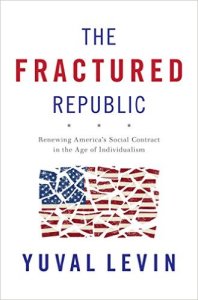
too bigEven though Yuval Levin’s The Fractured Republic is all about understanding modern-day America, it can also easily read as a parable for other institutions and organizations.  Everything is connected, of course.

So Levin’s description of our national systems and programs is particularly telling, as they are the product of specific moments but have been perpetuated long beyond that moment.  He calls these systems sclerotic:

But the truest models of sclerosis in our time are the public institutions that hail from the era of consolidation.  These are the centralized, bureaucratized programs and agencies at all levels of government (from Medicare to state welfare agencies to large school districts, among many others) that persist is the model of midcentury technocracy. . . These institutions have not kept pace with our changing society, but because our political debates are themselves deeply nostalgic, we tend to argue about whether such institutions should be kept as they are or government should be rolled back to what it was before they existed—neither of which looks very plausible.

And so you end up “stuck” with programs that have inadvertently become “sacred cows” of the national structure.  The same thing plays out often in smaller organizations and institutions.  The debate around these “sacred cows” reeks of dysfunction (and many in the conversation can sense it).  The programs remind us, though, of “better days” and have become so intrinsic to a form of group identity that it feels like a real damned-if-you-do/damned-if-you-don’t situation.

In my mind, this serves as a cautionary tale for implementing “big solutions” to anything. In the end, everyone gets “taxed,” from those who implement, those who maintain, and even those who benefit.  I think of Wendell Berry’s assertion that there are no good big solutions for big problems, only a good collection of small solutions.  That approach, of course, can lend to its own kind of chaos.  Regardless, a certain kind of humility mixed with a particular creativity seems to be necessary for understanding and success here.

(image from kassoon.com)

Posted in Books, Uncategorized | Tagged | Leave a comment

Renorming (and who benefits)

NormI believe it was marketing guru Seth Godin who introduced me to the idea that history may not repeat, but it definitely rhymes.  That’s the sense you get when reading Yuval Levin’s The Fractured Republic.  Sometimes patterns and trends really do exist, really do play out in history.  Case in point: the idea of times of cultural crisis resulting in something different (though perhaps not “new”).  From Levin on what happened in the 1970s after the shifts in the 50s and 60s towards individualism:

Americans thus sought a cure for the malaise and pandemonium of the 1970s not through the revival of an old consolidating tendency, but through the maturation of the new spirit of individualism and liberation.  There was no fighting the core fact of postwar America—the fact of an intensifying deconsolidation—but there could be better ways to live it.  The spirit of individualism, the nation could readily see, had gone too far and grown too wild.  America’s old norms no longer held sway.  But people cannot long abide an absence of norms, and so in the course of the later 1970s and into the 1980s, American society went through what political scientist Francis Fukuyama, in his 1999 book The Great Disruption, called a “renorming.”  This meant not the recovery of old cultural rules and taboos, but the development of new ones.  These new norms were rooted in the new ethic of individualism but geared to giving people’s lives some stability and structure.

And because everything is connected, there are obvious economic consequences to such shifting and renorming (into what Levin asserts is a more diffuse society).

Over and over, the effects of America’s diffusion, and then of its efforts to adjust to that diffusion, seemed to reach the wealthy and advantaged as rewards, but hit the poor and disadvantaged as punishments.  If the new American ethic pushes every individual to become more like himself or herself, rather than more like everyone else, it will, even at its best, tend to accentuate differences, to increases distances, and to turn a range of distinctions into a set of bifurcations.

What’s true of the 70s is also true of this decade in the 21st century.

I think it was an episode of Sherlock, though I cannot say with certainty, where I learned one question that could lead to a world of learning: the question of “who benefits.”  For all the good that certain changes are doing for certain groups of people, those changes are doing something even better for others.

You can get a copy of Levin’s The Fractured Republic here or at any reputable bookstore.

Posted in Books, The Long Story | Tagged | Leave a comment

Pokemon Go as Reality Filter?

pokemon go

(Pokémon Go/Gustave Caillebotte, “Le Pont de l’Europe,” 1876 from CityLab.com)

Nicholas Carr (writer of The Shallows and The Glass Cage) recently posted his own “take” on the Pokemon Go/augmented reality discussion, mostly from the vantage point of art and Instagram.  The article starts with one of Carr’s own “Theses in Tweetform”: Instagram shows us what a world without art looks like.  And it gets even better from there.

The article is great and can be read here.  I really liked the image that he used, so I traced it back to its source, CityLab.com.  They had also posted an article about Pokemon Go and augmented reality, comparing it to Charles Baudelaire’s poetry and the French idea of the flaneur.  It’s a much more graceful reading of the moment.  You can read that article here.

Posted in Books, Internet, Teaching | Leave a comment

You Are Here (When Is That?)

Pushpin on map

The first half of Yuval Levin’s The Fractured Republic is an attempt to explain the contemporary American landscape by revisiting the major trends of the twentieth century.  It’s a tall order that, from my perspective, he handles well and without much repetition.  This, of course, helps flesh out his assertion that both of America’s major political parties are trapped in an unhealthy nostalgia trap.

Levin calls (roughly) the first half of the twentieth century in America an “age of conformity.”  This includes, of course, both world wars and the depression in between.

In very broad terms, the first half of the twentieth century (and the final decades of the nineteenth) can be seen as an age of growing consolidation and cohesion in American life.  As our economy industrialized, the government grew more centralized, the culture became for aggregated through mass media, and national identity and unity were frequently valued above personal identity, individuality, and diversity. … become more like everyone else.

Levin does a great job of teasing out the connective tissue in these different areas, particularly in how the common cause of war and economic collapse put many (though not all) Americans on some kind of “same page.”  When the second World War was over, though, all bets were off.  Which led to what Levin labels an “age of frenzy.”

The second half of the twentieth century and the opening years  of the twenty-first have instead been marked by growing deconsolidation and decentralization. The culture has become increasingly variegated, the economy has diversified and become more deregulated, and individualism and personal identity have triumphed over conformity and national unity.  In these years, a great many of the more powerful forces in American life have been pushing every American not to become more like everyone else, but to be more fully himself or herself.

Levin points to the psycho-social impetus that came about through books on child-rearing and Americanized approaches to self-awareness and self-fulfillment.  The concepts of consolidation and centralization are key to understanding Levin’s argument on multiple levels.  The two concepts work hand-in-hand even as they work against one another, and interesting symbiosis.

All of this leads to what Levin calls an “age of anxiety.”  Part of this anxiety comes from a what Levin calls a “hollowing out” of America in a number of areas, which results in concentrations “on the fringe” instead of “in the middle.”  In this age, centralization works differently, too.

Growing concentration and diminishing centralization are therefore not opposite forces, but increasingly complementary patterns in our times—both embodied in the bifurcation of American life.  This peculiar combination is closely related to the tendency toward a greater centralization of power in the federal government to accompany greater individualism in the culture and economy.  Increasingly, society consists of individuals and a national state, while the  mediating institutions—family, community, church, unions, and others—fade and falter.  Again, we find concentration at the ends and a growing vacuum in the middle.

Such bifurcated concentration also involves a kind of constriction of movement or change—a sense in which everyone is always in the process of becoming more like what they already are.  This phenomenon presents itself as more constrained mobility in our economy, as a growing rigidity in our politics, and as a narrowing of the radius of trust in the larger society.

The idea of a society made up solely of individuals and the state (or nation) is key in understanding his approach to potential solutions for our country.

(image from timemanagementninja.com)

Posted in Books, Faith | Tagged | Leave a comment

Nostalgia and Our Fractured Republic

fracturedIf there’s a book out this summer that’s worth your time and money, it’s Yuval Levin’s The Fractured Republic.  I read it a few weeks ago and have been mulling over it ever since. In the book, Levin draws a picture of how 20th century America became 21st century America.  In doing so, he points out that the thing most political leaders in the 21st century want to do is go back in time, to realign our common life with some particular moment from decades ago.  From the introduction:

… in our time, in particular, our politics is overwhelmed by an usually intense and often debilitating frustration that is rooted in a form of that illusion [that getting back to a good place in national life is that easy], but runs deeper.  Liberals and conservatives both frequently insist not only that the path to the America of their (somewhat different) dreams is easy to see, but also that our country was once on that very path and has been thrown off course by the foolishness or wickedness of those on the other side of the aisle.  Liberals look back to the postwar golden age of midcentury America, which they believe embodied the formula for cultural liberalization amid economic security and progress until some market fanatics threw it all away.  Conservatives look fondly to the late-century book of the Reagan era, which they say rescued the country from economic malaise while recapturing some of the magic of the confident, united America of that earlier midcentury golden age, but was abandoned by misguided statists.

Each side wants desperately to recover its lost ideal, believes the bulk of the country does, too, and is endlessly frustrated by the political resistance that holds it back.  The broader public, meanwhile, finds in the resulting political debates little evidence of real engagement with contemporary problems and few attractive solutions.  In the absence of relief from their own resulting frustration, a growing number of voters opt for leaders who simply embody or articulate that frustration.

Over the next few days I’m going to write through a few of Levin’s major points.  Some of what he sees and says seems to be true for other, smaller organizations and communities, only writ large.  Even individuals can find themselves trapped, frozen in time, by a certain nostalgia.  Nostalgia has its place, of course.  But it cannot be something that keeps you from being faithful and effective in the current moment.  As Levin suggests:

To learn from nostalgia, we must let it guide us not merely toward “the way we were,” but toward just what was good about what we miss, and why.

That, I believe, is thinking in the right direction.

You can read a review of the book by James K. A. Smith here.

Posted in Books, Faith | Tagged | Leave a comment

Pocket Monster Round-Up

pokemon-go-catchThe stakes aren’t all that high for me with the recent release of Pokemon Go as a mobile app.  It’s at least two generations removed from what was important to my childhood (I draw the first line at the Teenage Mutant Ninja Turtles, but that’s a conversation for another time).  App-wise, I’m already a few trendy app-releases behind to have much interest in it (that first line got drawn at Snap Chat).  But I get the excitability of the app.  Even last night a (younger) friend asked if I had downloaded the game because he thought I’d be good at it considering my approach to transportation.  And while one should never say never . . .

It’s been interesting to watch the cultural gatekeepers of the fourth estate try and make sense of the fad.  Lots of humor about it, which is good.  McSweeney’s got into it with this mash-up of the game and Anthony Bourdain.  They also posted something of biting satirical piece with this “memo from the CIA” concerning the release of the game at this particular moment in history.  The folks over at Vox have a running list of articles about the topic.  You’ve got a look at the possibility of the game’s origin being rooted in Japanese bug collecting.  You’ve also got an article giving a rundown of the awkward and inappropriate places that those little pocket monsters keep popping up (think the National Holocaust Museum and Arlington Cemetery).

Two particular articles caught my attention yesterday (thanks to Twitter).  The first has to do with the economics of the game, particularly its place in the trend towards financial growth of disembodied businesses.  Consider:

But the Pokémon Go economy also has some real downsides. One has to do with regional inequality. Nintendo and its partners are rumored to be earning more than $1 million per day from Pokémon Go. That money is flowing away from small and medium cities and toward big technology companies concentrated in big cities.

And obviously Pokémon Go isn’t the only example of this. Amazon is doing something similar in the retail industry, diverting business away from local retailers and sucking cash into its corporate headquarters in Seattle. Companies like Google, Facebook, and Vox Media are drawing ad dollars that previously went to local newspapers and television stations.

and

But the Pokémon Go economy is different. Nintendo and its partners obviously needed to invest some cash in hiring programmers and designers to build the game. But the sums involved here are tiny compared with the cost of building a new car assembly line. And Pokémon Go seems unlikely to produce very many opportunities for complementary local businesses. People play on their smartphones, so there’s no need for Pokémon cyber cafes. Smartphones are too cheap for smartphone repair shops to be a good business.

The comforting thing is that this is just the next extension in the way the world works in the 21st century.  And there are those that are suggesting that truly creative/entrepreneurial types are finding ways to profit from the manic moment.  This short article from The Ringer points to those making money driving (younger) players around (slowly) to maximize both safety and gameplay.

The second Vox article is the one that I find most interesting.  The article starts by briefly discussing the importance of talking about the game, kids-game that it might be.  From the article:

The backlash to Pokémon Go coverage is understandable. How can it be worth expending all this energy on some video game? But Pokémon Go isn’t really a game. It’s a new technology.

Venture capitalist Chris Dixon has a line I like. “The next big thing will start out looking like a toy,” he says. Welp, Pokémon Go looks like a toy. Hell, it is a toy. But it’s also the first widespread, massive use case for augmented reality — even though it’s operating on smartphones that aren’t designed for AR. So what’s going to happen as the hardware improves, the software improves, and the architects learn to use these more immersive environments to addict us more fully?

The author paints a kind of bleak picture, which is both unfortunate and helpful.  His concern is the ascendance of augmented reality, which amounts to another way for people to check our from what is most real.

Augmented reality begins with Pokémon. It begins as a toy. But it won’t remain a toy. It’s going to become an industry, a constant, a coping mechanism, a way of life. It will change how we spend our time, how we compete for status, how we interact with our loved ones. It will change the behaviors we think of as normal — already we’re seeing Pokémon Go run into racism; it won’t be long until AR cuts across other fault lines in our society.

Technology is about to change how we live once again. That’s why Pokémon Go needs to be covered.

You can read the whole article here.

The last few weeks have reminded me that life and culture can still throw some unexpected curveballs.  Who knew a game app could be one of them?

(image from bgr.com)

Posted in Internet | Leave a comment

What You Find When You Look

thumb_IMG_0478_1024Try as we might to make it otherwise, place matters.  At our best, we are people rooted in place and time in a way that makes us mindful of the good and bad of our moment.  This is less and less true, I think, particularly as each unique place looks more and more like every other formerly unique place (thus: wherever you go, there you are).  I often feel it when I travel, primed for it by a strong hometown and home state culture, reinforced by living in a state with a strong sense of its historic culture (and the struggle to maintain that culture against the forces of contemporary life).

Writer and editor Matthew Schmitz (of First Things) recounts a recent trip to England in his article titled “An Accidental Pilgrimage.”  In the article, Schmitz recounts how he found hints of his Christian (and particularly Catholic) faith in a culture many consider post-Christian.  The article hits high stride at the end, where he brings his experience in England to bear on what he perceives to be a particularly American approach to faith.

Flannery O’Connor described the American South as “Christ-haunted”. We Americans are proud of this observation, believing it indicates our nearness to God. We do not realise that one cannot draw close to a ghost. For an American, it seems more natural that Christ be accepted into one’s heart than that he be placed on one’s tongue. Rather than encounter him through sacrament and stone, we go searching for him in the vicissitudes of emotion or the obscurities of philology. What we find is a disembodied Christ, whether he is reconstructed by fundamentalist preachers on revivalist lines or by historical-critical scholars on liberal-humanist ones. Only in such a country could Jesus seem a mere spirit.

In England, Christ is no wisp or symbol, but an incarnate Lord, a king who once held the nation under his sway. He is bodied forth everywhere in ancient churches and sites of pilgrimage. These sites speak the truth of the Incarnation: Christ took on flesh, and so assumed definite physical limits. He founded a Church visible in history that has definite limits as well. There is no danger of collapsing the Second Person of the Trinity into the Third. Christ’s Church is his body, and even where the Church has been turned to ruin, we recognise him, for we know that his body was wounded.

Is he a bit harsh?  Perhaps.  But I get the sense of what he’s going for. It’s worth reflecting on, worth thinking about what our approach to our faith might (or might not) leave behind in material evidence.

You can read the rest of the article here.

Posted in Faith, Internet, Travel | Leave a comment

Cinematic Comedy This Century

The folks at the A. V. Club recently put together a “top 50 best comedies since 2000” list.  Like most lists, its an interesting read, particularly if it helps you see how your own tastes have changed over time.  It’s also interesting to be reminded of the places you’ve lived over the course of time the list deals with.  Some thoughts:

JosieI think it’s great that Josie and the Pussycats wound up at #48 on the list.  It’s a much better movie than audiences gave it credit for.  It harkens back to the days of The Matrix, Fight Club, and Memento for me, particularly in its subversiveness, which the A. V. Club list points out.  Still, I’m not sure how ha-ha funny it actually is.  It embraces and subverts “everything Archie” quite nicely, really.
The remake of Ocean’s Eleven comes in at #41.  I prefer Ocean’s Twelve, myself.  Julia Roberts gets the best moment in that one.

One of my all-time favorite movies, I ♥ Huckabees, comes in at #38.  It’s one of the first movies that I loved while living in Hawaii.  What a wonderfully odd philosophical journey that Jason Schwartzman’s character goes through.  Like the article mentions, it’s the last “odd” movie by David O. Russell (recently of Joy).  This is one of those movies that I liked so much that I bought the (special edition) soundtrack.  “How am I not myself?” indeed.

Punch-Drunk Love comes in at #33.  That might have been my first Adam Sandler movie.  Saw it in Fort Worth and loved it.  It’s a sad kind of funny.  Kind of like The Mexican, which  sadly, did not make the list.  The beautifully biting Young Adult comes in at #30.  I was surprised at how dark the movie went and that I went along with it.  Ghost World, which is ranked at #26 that feels like an artifact from a million years ago.  I saw it because it was a comic book adaptation (that I had not and have not read).

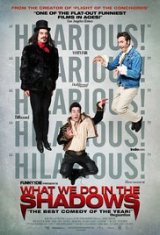
vampiresOne of my favorite movies of the last five years, What We Do in the Shadows, is ranked at #26.  From New Zealand, the story follows four vampires trying to make their way in 21st century Wellington.  It’s told as a documentary that centers around an upcoming annual gathering of the creatures of the night.  All of the vampire mythology is on display (like mind control and entry issues) to great effect.  Even now, I crack up a but just thinking about the adventures of Viago and friends.  The movie’s creator is starting work on the third Thor movie.  After that, we’re supposed to get a look into the world of werewolves.

Hard to believe that one of the movies from earlier this summer made it to #19 on the A. V. Club list.  I was one of the only people laughing throughout the viewing of The Lobster that I caught at Dole.  It’s a great, if not utterly fantastic, look at a culture that ask but deifies marriage (to the detriment of singletons).  Don’t get me wrong: the movie is tragic on almost every level.  It’s not one I’ll be showing around anytime soon.  But it’s one that sticks with you long after the screen frustratingly cuts to black.

shaunIt was pretty cool seeing all of Edgar Wright’s work on the list (and quite high up, really).  Scott Pilgrim Vs. the World, the one movie sans Simon Pegg, was ranked at #9.  I remember seeing that one at Dole and my group of friends being divided straight down the middle in terms of how great (or horrible) the movie was.  Wright’s “Cornetto’s Trilogy” showed up scattered through the fifty: The World’s End at #31, Hot Fuzz at #13, and Shaun of the Dead at #5.  Having just watched it again recently, I can say that Shaun of the Dead holds up really well, both as a zombie movie and as a comedy.  I really like Wright’s sensibility with the screen and with creative ways of storytelling (cuts and repetitions can work wonders with a story).  After rematching Shaun, I revisited both seasons of Spaced, which are a great look at early Wright.

Lots of great movies on the list.  Lots that I haven’t seen.  A few that I’ve tried to watch but couldn’t quite get into.  A few movies that you might think would make the list but didn’t (Just Friends?).  I do wonder if they’ll get around to giving the same treatment to animated movies.  I just saw The Secret Lives of Pets, and it was pretty funny.  It would be interesting to see how various studios (Pixar included) mix together when viewed through the lens of comedy.

If you haven’t already, you can check out the A. V. Club’s comedy list here.

Posted in Internet, Movies | Leave a comment

Once More with Affection

kitchenWendell Berry’s case for affection is an interesting and potent one, especially in light of a contemporary culture that seems content on consuming itself.  And because of its limited use, affection could be a term that helps reinvigorate something vital about life today.  He finds a strong presence of affection in E. M. Forster’s Howard’s End.  In it he gets the sense that

Knowledge without affection leads us astray every time. Affection leads, by way of good work, to authentic hope.

And affection, it seems, is ultimately rooted in the something like the household.  Berry takes a decidedly (James K. A.) Smithian approach to thinking about affection and “housekeeping” when he names something vital to “life in Howard’s End.”  Smith would talk of our daily, consistent practices as “habitations of the Spirit.”  Berry’s take:

The great reassurance of Forster’s novel is the wholeheartedness of his language. It is to begin with a language not disturbed by mystery, by things unseen. But Forster’s interest throughout is in soul-sustaining habitations: houses, households, earthly places where lives can be made and loved. In defense of such dwellings he uses, without irony or apology, the vocabulary that I have depended on in this talk: truth, nature, imagination, affection, love, hope, beauty, joy. Those words are hard to keep still within definitions; they make the dictionary hum like a beehive. But in such words, in their resonance within their histories and in their associations with one another, we find our indispensable humanity, without which we are lost and in danger.

“Soul-sustaining habitations,” he says, “places where lives can be made and loved.”  It’s a nice thought, and a true one, too.  Perhaps not for all of us, and perhaps not all of the time.  But some of us, I cannot help but believe, have a strong sense of what he’s talking about, either in the homes of our childhood or of our homes today.  I’d argue that you could extend the range of the concept to churches and schools and parks and any place frequented by those with soul enough for it.

In “It All Turns on Affection,” Berry speaks of the significance one the place of affection against the dominant mega- company, farm, culture.  It’s an argument that scales both down and up, I believe.  Affection reminds us to be mindful of any system that does not find some healthy root in the personal.

In the end, Berry gives us a good list of watchwords: truth, nature, imagination, affection, love, hope, beauty, joy.  They may be used often in our culture, but I cannot help but think that Berry views them differently.

(image from simpleandsereneliving.com)

Posted in Books, Faith, Teaching | Tagged | Leave a comment