
 Got my copy of N. D. Wilson’s Outlaws of Time: The Legend of Sam Miracle yesterday, and I’m looking forward to spending some quality time with it this weekend. Wilson has had at least one article and one interview pop up in the media the last few days. The article, “Why I Write Scary Stories for Children” is a well-rendered piece. And while it revisits earlier themes of his work, the article moves things forward well by personalizing the topic of why he writes children’s books with a darker edge. Consider:
There is absolutely a time and a place for The Pokey Little Puppy and Barnyard Dance, just like there’s a time and a place for footie pajamas. But as children grow, fear and danger and terror grow with them, courtesy of the world in which we live and the very real existence of shadows. The stories on which their imaginations feed should empower a courage and bravery stronger than whatever they are facing. And if what they are facing is truly and horribly awful (as is the case for too many kids), then fearless sacrificial friends walking their own fantastical (or realistic) dark roads to victory can be a very real inspiration and help.
I particularly like the story of how he handled his oldest son’s issue with the White Witch’s minions in the Narnia books. And then later:
I don’t write horror. But I do write stories about terrified sheltered kids and fatherless kids and kids with the ghosts of abuse in their pasts. Those kids encounter horrors—witches and swamp monsters, black magical doors and undying villains, mad scientists and giant cheese-loving snapping turtles. Those kids feel real pain, described in real ways. They feel real loss. They learn that the truest victory comes from standing in the right place and doing the right thing against all odds, even if doing the right thing means losing everything. Even if doing the right thing means death. My characters live in worlds that are fundamentally beautiful and magical, just like ours, in worlds that are broken and brutal, just like ours. And, when characters live courageously and sacrificially, good will ultimately triumph over evil.
I think the strong, almost tangible, presence of evil in stories like The Lord of the Rings and the Harry Potter books is what grants them such impact. But it’s also a risky move to make, as you (literally) don’t want to scare readers (or viewers) away.
It’s a great article. You can read it in its entirety here.
I’ll let you know how the book is after I finish it.
(image from theonering.net)
 I’ve been trying to think of some way forward for some time now. Forward in lots of ways really: faith, work, relationships, the rhythms of life. I get bits and pieces here and there, often from what I read, sometimes from the words and encouragement of others. Something that I find myself more and more convinced of, though, it that the way forward is going to look (at least a little bit, if not a lot) like looking back. You get a sense of that with the Benedict Option. You get a strong sense of it in the Old Testament. And you get a sense of it in the ideas of others who are trying to figure out how to be faithful in “what comes next.”
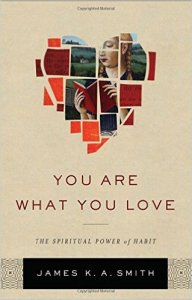
 One of the greater challenges for churches at this point in the 21st century (and perhaps in any century) is how to work and worship for the formation of young people. For years, it seemed like youth work was the cutting edge of the church: it was where all of the good and appropriately-forward thinking was taking place. These days, from my outsider perspective, something about youth ministry seems somehow gutted. In You Are What You Love, Smith attempts to address the question of raising young believers. He works his way through the worship and communal aspect of the church. He plays off of the part of youth culture that seems addicted to emotion and a kind of anti-intellectualism. Consider:
 One of the ways that You Are What You Love moves beyond James K. A. Smith’s other books on “cultural liturgies” is how it approaches the implications for daily life. Smith spends one solid chapter on marriage and “household life.” It’s great stuff, particularly in how it references the Orthodox wedding ceremony as a better picture to guide marriages.


 Space Enough, and Time