The Possibility of Being Wrong: Klosterman Style

Vulture just announced that Chuck Klosterman will be releasing a new book this June.  The new book, What If We’re Wrong: Thinking about the Present As If It Were the Past, follows an interesting thematic vein (much like his last non-fiction work, I Wear the Black Hat).  This time, though, it’s the idea of our post-modern certainty and klostermanhow it might look in a prospective historical context.  From the Vulture announcement:
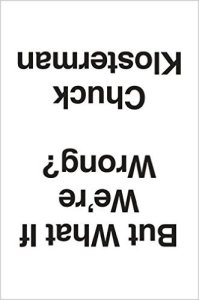
“We live in a period of extremely high certitude about what we believe, and we’re completely obsessed with the present tense, as if the present will always be this way,” Klosterman says. But any study of human history will tell you that’s never been the case, and the book is Klosterman’s effort to explore what our current standards of thought might be overlooking. He spoke to Richard Linklater about dreams, once considered the most important window into the human psyche. He spoke to Neil deGrasse Tyson and Brian Greene about the possibility of our basic understanding of gravity being overturned one day, as Aristotle’s was. And he looked at the changing reputations of various authors in an attempt to understand what makes literature get “remembered.” As Klosterman put it to us, “Could the most famous American novelist of this period be completely unknown, in the case of Kafka, or known but not respected, like Melville?” (Or even a blogger at a well-regarded pop-culture site? Hmmm.)

You can read the rest of the Vulture post here.

Add this to my list of things to look forward to in 2016.

(image from amazon.com)

(and yes, the cover just might look like that)

Posted in Books, Internet | Leave a comment

Peterson on the Specific and the Accessible

ap-inside4-305x305Andrew Peterson (who just played a concert in Hawaii) was recently interviewed by CCM Magazine.  At one point, he is asked about the assertion that the more specific a song’s content, the more accessible it can be to listeners (which, of course, sounds counter-intuitive).  His response:
There’s this assumption that you have to broaden your focus if you really want to reach a lot of people, but there’s a long list of huge songs that are actually very specific and vulnerable. A few months back I was a part of an adoption fundraising concert my church put on, and they asked a bunch of songwriters to do cover songs. I chose “The Heart of the Matter” by Don Henley. Chances are, if you’re anywhere near my age or have ever listened to the radio, you have heard that song.

When I started learning the lyrics I was astonished by how vulnerable and confessional it was. I mean, I knew the song was deep, with a chorus like, “I’ve been trying to get down to the heart of the matter … and I think it’s about forgiveness … even if you don’t love me anymore.” But Henley lets us into his selfishness, his regret, the fact that he let work come between him and the one he loves. It’s what I love about Rich Mullins’ best songs.

On the other hand, writing from a sharp focus might limit the breadth of your reach when it comes to radio or whatever, but it also might deepen the reach into the heart of that one person who was really ambushed by the song. If I had to choose between reaching a ton of people with a shallow song, or reaching deep into the heart of just a few people with a song that’s about a very specific kind of heartache, there’s no doubt which I would choose. I’m one of those people whose life was literally changed because of a song.

I like the idea of there being two kinds of “reach,” with one being radio and the other being the heart of the listener.  It’s also nice to see a nod to Rich Mullins.  It was a cool moment when Peterson segued into Mullins’s “I See You” during last week’s concert.

You can read the rest of the interview here.

(image from andrew-peterson.com)

Posted in Faith, Internet, Music | Leave a comment

The Good Sadness of the Hungry Ones

Last week, Moment ran an interview with David Brooks, whose “evolution” has been an object of interest for many.  Brooks’s The Road to Character was one of the better reads of 2015.  The interview included some candid tidbits worthy of reflection.

For instance, when asked about his quest for meaning, balance, and generosity of spirit, Brooks replied:

It’s going okay. Every day, I try to read something of some meaning. This morning, I read a book about how we find our callings. I always try to keep a book like that open. The question is: Am I a better person? I hope so. My mornings are sadder.

I had a student come up to me at the end of this class I taught at Yale, and he said, “Since I’ve been taking the class, I’m much sadder than I used to be.” And I took that as a win. Sadness is not quite the right word. Hunger and longing is what I mean. There’s a biblical verse, “Blessed are the hungry ones.” So I’m hungry for this sort of knowledge. I have this vision that if I do this long enough, I’ll be the sort of person who, when people come to you for advice, I’ll have answers, I’ll have wisdom. I’m not sure it will really work that way, but the one measurable thing I’ve noticed in my life is that people never used to confide in me, and now, they do. I don’t always know what to say, but I’m getting there.

These days I’m finding the “quest for wisdom” compelling because too much advice seems too short-sighted.

Most pertinent to me today, though, is his view on the individual versus the communal.  Today we talk ethical systems in class, which has become more boring the more students can’t articulate anything beyond a kind of moral subjectivism.  When asked about our inability to talk big picture:

Universities and a lot of institutions became very amoral because they didn’t know what to say. We became such a diverse society that it became hard to know what to say without insulting somebody. And then we became a very individualistic society. If there’s something I’ve been frustrated with, it’s our excessively individualistic society. That’s led to a belief that everyone should come up with their own values and no one should judge each other. That destroys moral conversation and becomes just a question of feelings. That, to me, was the big wrong turn.

You can read the rest of the interview here.  It’s worth your time.

Posted in Books, Internet, Teaching | Leave a comment

The Lake District, Three Months Later

Three months ago, I was hiking through the Lake District with a group of students and teachers.  Even though it was autumn, there was much green to be seen (and some wild blackberries to eat).  It’s definitely not verdant or autumnal there now, as this video from The Guardian shows.  Such a beautiful place!

Posted in Travel | Leave a comment

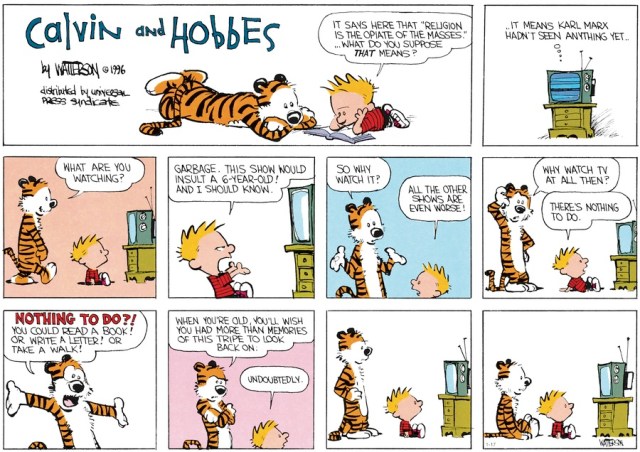
Sunday’s Best: What Karl Marx Hadn’t Seen

This week’s decades-old Calvin and Hobbes Sunday strip by Bill Watterson captures a number of things well . . .

clv11c

I think it was David Foster Wallace who helped me understand the concept of “watching TV.”  On Tuesday nights, I watch The Flash.  Other times, when I flip through channels with no real or specific intent, I am “watching TV.”  Enjoy the former; beware the latter.

Makes you wonder what Hobbes thinks of the internet.

(comic from gocomics.com)

Posted in Uncategorized | Leave a comment

Meanwhile, on Earth-2 . . .

I mentioned a few weeks ago that one of my early-2016 hopes was to see The Flash take its second season on the (inter-dimensional) road.  This preview gives a nice peek at what’s about to happen on The Flash:

There’s geek-talk, of course, about the identity of Zoom, the season’s big bad (who doesn’t have much presence in this trailer).  There’s also some speculation about how much this Earth-2 might resemble some other of DC Comics’ infinite earths.  Good to know we’re closer and closer to Barry breaking the dimensional barrier. (Will there be a cosmic treadmill involved?)

Posted in Internet, Television | Leave a comment

Didn’t See THAT Coming

It’s the one that sneaks up on you that really gets you.

(hat tip: comicbook.com)

Posted in Internet, Movies | Leave a comment

Next Week and Tomorrow

We’re less than a week away from the winter return of The Flash, which means the premiere of DC’s Legends of Tomorrow is just around the corner.  I have to admit that I’m a bit skeptical.  Arrow has always been a bit too grim for me.  The Flash, on the other hand, has found a nice, Silver Age balance between heavy and humorous.  This has been especially true over this second season, as the cast seems amazingly comfortable in their roles.

And so skeptical: yes.  Still hopeful, though.  It’s the first big small-screen collection of live-action heroes in a while.  I’m a long-term fan of many of the characters, but I’m not sure how they’ll translate from the page to the screen (it’s the wings, really).  But if they get the chemistry right and the time travel elements plays out intelligently, then the CW might have a keeper (in the show and in this viewer).  Here’s the most recent trailer for the show, which debuts next Thursday.

Posted in Internet, Television | Leave a comment

Ten Questions

Yesterday, marketing guru Seth Godin posted ten questions worth asking about work:

What are you doing that’s difficult?

What are you doing that people believe only you can do?

Who are you connecting?

What do people say when they talk about you?

What are you afraid of?

What’s the scarce resource?

Who are you trying to change?

What does the change look like?

Would we miss your work if you stopped making it?

What do you stand for?

What contribution are you making?

These are some great questions. They imply that work can be about more than just doing a job. Questions of fear and change and connection speak to the heart about things that matter.

It’s been a busy week for me . . . the busiest week of my year, really. But I believe it is good work, and I’m thankful for it. Godin and his questions help keep me in line . . . in the right direction. That’s a good thing, for sure.

Posted in Internet, Teaching | 1 Comment

Remembrance of Things Past (Kenobi Edition)

The folks over at comicbook.com posted an interesting video to their site today.  It uses scenes from Star Wars: Revenge of the Sith as actual “flashback” footage in Star Wars: A New Hope.  Check it out:

I’m still not sold on what seems to be the prevailing notion that RotS is the best of the prequels.  It’s mistakes are too glaring and the stakes were too high.  Regardless, the clip is a nice attempt to weave some things together.

Posted in Internet, Movies | Leave a comment