Goodbye to Goodbye? Michael Harris on Absence

This past weekend I came across Michael Harris’s The End of Absence.  It’s an interesting read, often summing up and building off of the thoughts of other books I’ve read about technology and culture over the last couple of years.  What makes Harris’s take different is his challenge to those of us who have lived on both sides of the internet’s existence, what we do with the lack of “lack” in an internet-driven world (because we are all on all the time).  His question and comment:

. . . if we work hard enough to understand this massive game changer, and then name the parts of the new game we want to go along with and the parts we don’t, can we then pack along some critical aspect of our earlier lives that those technologies would otherwise strip from us? . . . If we’re the last people in history to know life before the internet, we are also the only ones who will ever speak, as it were, both languages.

Here’s a short video of Harris from The Rotman School about “engineering absence.”  Some interesting thoughts, for sure.


Posted in Books, Internet | Tagged , | Leave a comment

The Day of the (Different) Doctor

Capaldi as the DoctorBreath deep, because the air is strangely fresh in the newest series of Doctor Who.

At least that’s my take on it after watching the premiere of the new season at the theater.  I’m glad I waited this time around, as it made everything much more immediate.  While the episode had many of the traits of modern Who, it also had a risky sensibility that I liked.

The thing that I liked most about the episode was its healthy self-awareness.  Moffatt knew he was doing something different from the get-go by casting an older Doctor, and he doesn’t dodge the issue.  The episode says a lot about what it means to know someone.  And almost every character in the episode gets a comment to that effect.  Not only that, but there are some nice references to older stories whose significance dawns on you even as it dawns on the Doctor.  And because it’s a callback, it doesn’t feel like an unnecessary retread.

Peter Capaldi feels like a natural at this.  He plays confidently-confused perfectly.  And while Clara isn’t my favorite companion, she definitely does things that no other companion in recent memory could do, and she does so amazingly.  Even the Paternoster Gang worked well for me in the episode, which was a nice surprise.

The question that always has to be asked, though, is whether or not the episode was scary.  No Daleks here.  No Weeping Angels in sight.  And yet the seen in the restaurant, once you realize what is going on, is quite creepy and effective.  I’m not even sure that the villain in the episode had a real name.  His visual, though, was brilliant.

BBC America definitely knows how to make fans happy.  As with the 50th Anniversary Special, the episode was book-ended by extra material.  And while the post-show “making of” video was enjoyable, it was the introduction by Strax that was brilliant.  In order to help the new viewer, Strax made a video blog about the various incarnations of the Doctor.  Lots of humor, lots of joking around about what made each Doctor unique (and laughable).  Hopefully it will show up online sometime.

I feel like I’ve said both too much and nothing at all.  I’m glad the Doctor is back.  And I’m glad that while he is himself, he is also something and someone different.  I think it will make for a wonderfully enjoyable season.


Posted in Internet, Television | Tagged | Leave a comment

A Different Kind of Sophomore Slump

Last week I posted excerpts and a link to a “message to college freshmen.”  One of my favorite authors, James K. A. Smith, recently wrote his own “letter to college sophomores” that serves as a nice kind of sequel.  He takes a similar approach in terms of forthrightness but takes it to an interesting level of academic disposition:

It’s not just that you’re a year wiser; you carry the air of the newly enlightened. Your curiosity has hardened into a misplaced confidence; your desire to learn has turned into a penchant to pronounce, as if wisdom were a race to being the quickest debunker. You used to wonder about the social vision behind Philip Larkin’s poetry, or whether Thomas Aquinas’s notion of natural law could really work in a secular age, but now you seem more intent on unmasking “micro-aggressions” and detecting colonial prejudice in a canon that you increasingly disdain.

And:

Unlike during those first few months of freshman year, your thinking on almost any subject now is becoming easy to predict. The causes you’re passionate about, while not without merit, are almost clichéd. You seem less interested in mining the complexity of problems and more interested in making a hasty display of moral outrage and coming down on the correct side of any debate—because of course there’s only one right way to think.

Pendulum’s swing, for sure.  That’s definitely true for knowledge and our quest for it.  It’s something we all struggle with.  You can read the whole letter here.

Posted in Faith, Internet, Teaching | Tagged | Leave a comment

Waiting for a Different Doctor

Big weekend for fans of Doctor Who.  It’s been months since we saw the quick flash  of Matt-Smith-into-Peter-Capaldi, which means its also an interesting weekend for Who fans.  It’s been some time since there’s been a dramatically older Doctor in the house, definitely since the show became such a popular show with a younger American demographic.  So I’m curious to see how much of a stand-in for all of those fans who just don’t know what to do with a dramatically different Doctor.

Meanwhile I’ll be doing my best to stay away from Saturday’s TV premiere so that I see it fresh at the theater Monday night.  I didn’t wait to see the fiftieth anniversary special, which I (slightly) regret.  I’m thinking that even if I stay away from the internet, someone in the line at the theater will say something to ruin the story for me.  Until then, here’s the trailer for the premiere: “Deep Breath.”

Posted in Internet, Television | Tagged | Leave a comment

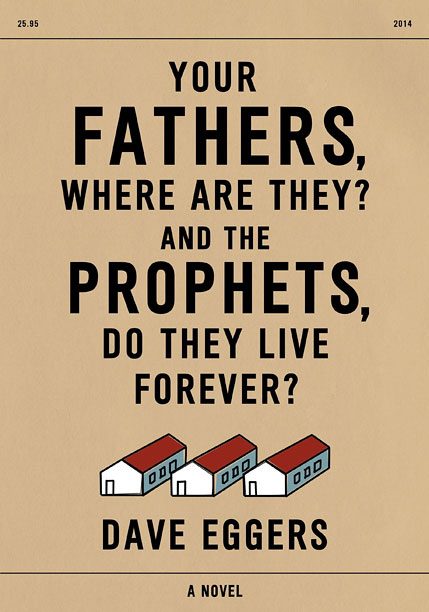
Eggers’s ‘Fathers & Prophets,’ the Novel of Our Times?

Your Fathers Where Are They?The title of Dave Eggers’s newest novel comes from early in the book of Zechariah, who spoke for God near the end of the time of exile.  “The LORD was very angry with our forefathers.  Therefore tell the people: This is what the LORD Almighty says: ‘Return to me,’ declares the LORD Almighty, ‘and I will return to you . . . Where are your forefathers now? And the prophets, do they live forever? But did not my words and my decrees, which I commanded my servants the prophets, overtake your forefathers?'” (New International Version)

Religious allusion aside, this is not the kind of book that you’d find at your local Christian bookstore.  And while it hasn’t gotten the critical acclaim as Eggers’s earlier works, I can’t help but think there’s something very right and important about it.  The novel is actually a continual dialogue between an estranged young man named Thomas and a selection of strangely significant people.  It’s is not an easy book to read: the language is coarse and the situation tricky.  And while it almost repeats the tinges of absurdity present in Eggers’s The Circle, it also repeats that novel’s timeliness.  The questions Thomas asks are hard questions, just like the answers they demand are difficult: questions about promises and culture, security and force,  trust and just how did things go wrong in early 21st-century America?  In many ways, the book reminds me of the energetic force of Eggers’s earlier works (though this time without the optimism).  In the end, the book is a kind of secular call to repentance, one a little closer-to-home than we are used to, I would imagine.

It’s a difficult book to recommend, as I imagine it is beyond the comfort zone of many of us (especially if we look to fiction to take us away from the problems of the world).  It could easily be seen as a political novel, which would also make it easy for some to write off.  If you’re interested in checking it out, the folks at Longreads have posted the first chapter online.  Be warned: the language is rough.  But I think Eggers is trying to articulate something, trying to through broad a real net in which to catch something of significance to those of us around in the late summer of 2014.  You can find that first chapter here.  Should you read it, let me know what you think.

Posted in Books, Faith, Internet | Tagged | Leave a comment

Augustine and the Compelling Character of God

From Book One of Henry Chadwick’s translation of Augustine’s Confessions:

Who then are you, my God? What, I ask, but God who is Lord? For ‘who is the Lord by the Lord,’ or ‘who is God but our God?’ Most high, utterly good, utterly powerful, most omnipotent, most merciful and most just, deeply hidden yet most intimately present, perfection of both beauty and strength, stable and incomprehensible, immutable and yet changing all things, never new, never old, making everything new and ‘leading’ the proud ‘to be old without their knowledge; always active, always in repose, gathering to yourself but not in need, supporting and filling and protecting, creating and nurturing and bringing to maturity, searching though even though to you nothing is lacking: you love without burning, you are jealous in a way that is free from anxiety, you ‘repent’ without the pain of regret you are wrathful and remain tranquil.  You will a change without change in your design.  You recover what you find, yet have never lost.  Never in any need, you rejoice in your gains; you are never avaricious, yet you require interest.  We pay you more than you require so as to make you our debtor, yet who has anything which does not belong to you?  You pay off debts, though owing nothing to anyone; you cancel debts and incur no loss.  But in these words what have I said, my God, my life, my holy sweetness? What has anyone achieved in words when he speaks about you? Yet woe to those who are silent about you because, though loquacious with verbosity, they have nothing to say.

Posted in Commonplace Book | Leave a comment

Put It In A Common Place . . . Book

This semester I’m getting to teach my Faith & Literature class.  I require my students to keep a commonplace book throughout the semester that includes significant quotes and reflections.  The last time the class ran, my students had to take the idea of a commonplace book “on faith.”  This time around, though, I had a solid essay by Alan Jacobs about the history of the concept and its mutation throughout recent history.  Consider:

It was in the sixteenth century, especially in England, that the practice of such recording became widespread and recommended by the learned to all thoughtful and literate persons. This happened for two reasons. First, in that time paper became more widely available and considerably cheaper than it had been”developments prompted by the invention of the printing press but that benefited the private scribbler as well. And the printing press had another consequence: By making it so much faster and easier to disseminate texts of every kind” from Bibles (and commentaries thereon) to ghost stories, breathless accounts of notorious murders, and scurrilous poems on leading politicians”the world of print created a panic, the kind of panic distinctive to people who feel swamped by information.

Jacobs draws a line from commonplace books to journals to blogs and often revisits the idea of “information overload” and the need to keep record of “the most important things.”  Sometimes its quote with commentary; often it’s the quote alone.  Either way, the essay is a quality read and a worthy endeavor for all of us.  You can read it here.  And check back here later in the week for some of my favorite quotes from Augustine’s Confessions, the first thing read in class this semester.

Posted in Books, Internet, Teaching | Tagged | Leave a comment

Apes and a Time That Will Not Return

When the sun sets on the cinematic summer of 2014, Dawn of the Planet of the Apes will stand out as one of the season’s best. Like so many of the best sequels, it moves the story forward in a way that honors what happened previously while telling a story all its own.

The film-makers decided to take a ten-year leap with the story, which leaves a lot of space for between-story (as opposed to back-story). Online video and magazine Motherboard worked to put together three film shorts to help fill in the gaps between the two movies. All three are well-made. Here’s “Struggling to Survive,” the briefest of the three. It’s always good to be reminded that short stories can still be powerful.

Posted in Internet, Movies | Tagged | Leave a comment

Unfolding Gloriously (and in a beautiful country, too)

In reflecting on the loss of his wife, C. S. Lewis considered which was worse: ceasing to believe in God or believing bad things about him.  His conclusion:

Not that I am (I think) in much danger of ceasing to believe in God. The real danger is of coming to believe such dreadful things about Him. The conclusion I dread is not ‘So there’s no God after all,’ but ‘So this is what God’s really like. Deceive yourself no longer.¹

Lewis isn’t alone with the tension between a good God and harsh things happening in life.  It’s easy to let your heart grow hard when things go bad.  Here’s a song (with a nice video) to consider that comes from a songwriter who has experienced hard times himself.

_______________________________________________

¹ Lewis’s A Grief Observed is a must-read.  It’s terse, honest, and hopeful.  I read parts of it with my students each fall when we discuss the problem of evil.

Posted in Books, Faith, Internet, Music | Leave a comment

One Minute and the New Doctor

I imagine that Clara Oswald won’t start the new season of Doctor Who with “run you clever boy and remember” seeing as how the new Doctor is a good bit older and possesses a questionable memory.  Even still, the new series is just over a month away and the BBC has released its longest trailer yet.  Looks like we’re going “into darkness.”

The TARDIS takes off again August 23rd on BBC America.

Posted in Internet, Television | Tagged | Leave a comment