Habit and Habits

Seth Godin recently posted some thoughts on habit, mainly through the lens of things like anger.  I’ve been thinking a lot about habit lately, through the lenses of faith (James Smith) and psychology (Charles Duhigg).  Godin says:

Habits are great when they help us get what we want. Bad habits, on the other hand, are bad because the shortcut that satisfies us in the moment gets in the way of our long term goals.

Once you can see that your emotions are as much as a habit as cracking your knuckles, they’re a lot easier to work with.

Sometimes you can direct your habits (let me tell you about how I changed me diet last year).  Others just kind of creep in and take a foothold (Godin mentions distrust and generosity.  Whatever their place on the spectrum, habits are powerful things.  Check out this interview with Duhigg below or check out his book, The Power of Habit.  You can read Godin’s blog post here.

Posted in Books, Internet | Tagged , , | Leave a comment

Jonathan Safran Foer and the Danger of Being an Archivist

Graduation season has come and gone, and a few commencement addresses have risen to the top of the optimistic consciousness.  Joss Whedon said something about everybody dying.  At least one high school speaker ripped up his speech and recited the Lord’s Prayer.  Then that cool rendition of David Foster Wallace’s Kenyon address made it big on YouTube before being taken down.

Author Jonathan Safran Foer (Everything’s Illuminated and Extremely Loud and Incredibly Close) spoke at Middlebury College’s graduation and said some interesting things about technology and death and life.  It’s couched in some interesting banter about the college president and the story of a young girl yelling into her phone.  I think it’s worth the viewing and listen.  He maneuvers through a real “either-or” when it comes to technology and “the moment.”  Check it out.

Posted in Books, Internet, Teaching | Tagged , | Leave a comment

The Desolation of Smaug Trailer Arrives

True, we’re all waiting expectantly for The Man of Steel to fly into theaters this weekend, but the knowledge that the first trailer for The Hobbit: The Desolation of Smaug makes that wait a little bit sweeter.  An international version of the trailer came online this morning.  Now that the pleasantries of introductions are out of the way, it looks like we’ve got action, action, and more action (look at those 3-D ready shots).  Plus we’ve got the most important thing: barrels!

Take a look below.


And don’t forget to see Man of Steel this weekend.  If the rumors are true, it’s going to be one amazing adventure.

Posted in Books, Internet, Movies | Tagged , | Leave a comment

Is a Blog Better than Having Friends?

I’m not sure I’ve ever bought a book with the intent of only reading half of it, but that’s what I did with Sherry Turkle’s Alone Together.  The first half, about robots and relationships, didn’t really catch my attention.  But the second half, which is all about cell phones and social networks and online gaming, was part of my spring break sweet spot.

Below is a TED talk Turkle gave last year about “technology as substitute” that hits on something important.  Some might say she exaggerates the point at times, but I think she’s onto something.  Somewhere along the way had to replace real conversations and real time together with Words with Friends (for which I am thankful).  I strongly encourage you to take some time and watch this talk.

Tomorrow’s all about Star Trek: Into Darkness, so we’ll see if I get a post in.  If not, we’ll see you Friday.

Posted in Books, Internet | Tagged , | Leave a comment

David Brooks and How C. S. Lewis Was Right

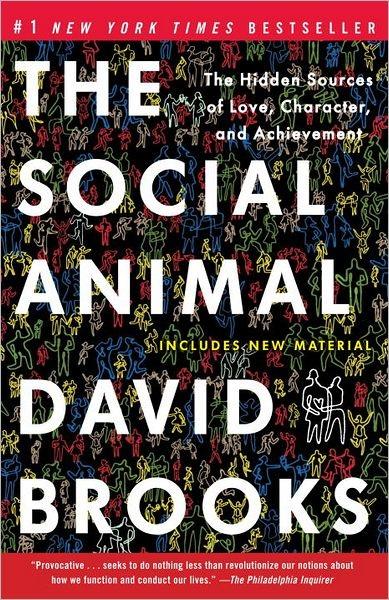
One of the books I enjoyed the most over spring break was David Brooks’ The Social Animal.  Brooks says lots of things, and most of them well, in the book.  He creates two characters and tracks their imaginary lives through the decisions they make.  A big part of his premise is that people are not primarily thinkers, that many decisions are made on a more subconscious level.  This, of course, was part of C. S. Lewis’ argument at the beginning of The Abolition of Man, that we create “men without chests” when we teach them thinking correctly without helping them feel correctly.

Below is a TED talk that Brooks gave a couple of years ago about the book.  Don’t let his humor throw you- he has a lot of good things to say.  One thing he doesn’t address in his talk that I found most helpful was his view on emergent systems, which is a thread I’ve started noticing in a number of places.  So if you’ve got 18 minutes to spare, give this guy a bit of your time.

I really like Brooks’ take on limerance.  It’s a word he seems to want to rehabilitate.  It doesn’t have the best original uses, I fear.

Tomorrow I’ll direct you to another TED talk by an author that has more to say about technology.  And at some point soon, I’ll get to what is becoming a transitional metaphor for me as I try to put things together.

Posted in Books, Internet | Tagged , , , | Leave a comment

David Foster Wallace and “This is Water”

David Foster Wallace has been popping up a lot lately, so much that I’m contemplating making 2013 the Summer of Infinite Jest.  We’ll see.

A few years ago, DFW gave a commencement address that has become quite the sensation.  A couple of years ago the speech became a nice gift book.  Then, just this past week, an abridged version of it became a YouTube hit.  “This Is Water” gives some great perspective not just on education, but on living life plain and simple.  There’s something sincere and true in what he says, something worth thinking about for a good, long while.

Tomorrow: another piece of my absent-mindul mix- something from David Brooks.

Posted in Books, Internet | Tagged , | Leave a comment

Absent-Mindfulness, Distance-Learning, Nicholas Carr, and the Internet

I wonder if anyone has tried to coin the term absent-mindful.   Absent because I haven’t been very present here lately (some might also not very present in other places, but more on that later).  Mindful because in my absence I’ve been trying to figure some things out.  I suppose it could be considered a different kind of distance learning: in this case it’s more about learning from things from distance-for-perspective instead of distance-as-geographical-reality.

And yet I’ve been doing a lot lately: teaching a full line, prepping and leading a couple of faculty meetings, writing a nice 900-word piece for the school paper, and reading a chunk of non-fiction about technology and habits and what in the world has been happening to our world without most of us thinking about it.  And while I don’t feel fully formed, and while it’s been more of a hill-top than a mountain-top experience for me, I’d like to think maybe I’ve got a few things to offer, a couple of fingers left to point in particular directions.

So let me direct your attention to this short video based on Nicholas Carr’s The Shallows.  It seems that it is possible for our context to change even if our geography remains the same.  This clip on “What the Internet is Doing to Our Brains” is a nice place to understand the shift.

I’ll be putting a few more pieces out here over the next few days, kind of like what Mitch Hurwitz is doing with the upcoming run of Arrested Development episodes on Netflix.  Tomorrow: that really cool video of David Foster Wallace’s Kenyon Commencement Address.

Posted in Books, Internet, Teaching | Tagged | Leave a comment

Proposing a Liturgical Tweak

Cathedral at SunsetWhatever shortcomings my non-liturgical self sees in liturgical services, the frequent and uneditorialized reading of Scripture is not one of them.  Over the last couple of years, I’ve tried to attend a local evensong service.  Psalms and songs, Old and New Testament readings: the thirty minutes is almost completely Scripture.

If I could change one thing about that short liturgy, it would be the sentence fragment that comes at the end of each Scripture reading and is followed by “thanks be to God.”

The fragment?  “The Word of the Lord.”

Instead I would say: “This is the story we are in.”

Why?  Isn’t the text the Word of the Lord?  Of course it is.  I have no problem with that.  What I do have a problem with is remembering that the story of the Bible locates me, acts as a sign and signal of my . . . of our . . . place in things.  So many stories every day to get sucked into, to tell and be told.  And all of those stories, good or bad, are parts of a larger story that draws us into it that we might live out of it.  A God who loves and rescues and reveals Himself so that we might live like Him.

“This is the story we are in.”

“Thanks be to God.”

Posted in Faith, The Long Story | Leave a comment

Being Mosby: Straight As of a Different Kind

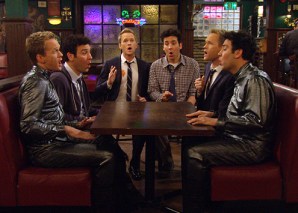
The Three Tenses from EW.comThe ending of last night’s How I Met Your Mother was brutal.  The show often uses Ted Mosby as a way to communicate something about the single life: it comes at it from almost every direction and isn’t afraid of going from humorous to heart-breaking in a moment.  If Ted got a report card for the episode, it would have given him all As, but not necessarily of the succeeding kind.

The crisis of the episode began when all of Ted’s friends Abandoned him for different life concerns.  Turns out that “Wrestlers versus Robots” wasn’t as high on everyone’s list of priorities when children and wedding plans are at play.  Life does that, of course, but knowing that doesn’t lessen Ted’s feeling of abandonment.  And because that abandonment is more systemic than personal (in a truly weird way- things change; his friends’ feeling for Ted don’t), it leads to a weird kind of Alienation.  It creates a kind of deficit that pushes Ted further away than his friends might even realize.  And yet that doesn’t mean that Ted is completely removed from everything from what has become his “previous” life.  He makes the rounds, visits all parties, tries to be present. The difference is that those around him demand his Attention without any hint of reciprocal Affection.  Those who have been a source for his sanity don’t have the emotional capacity to reach much beyond their present moment.  And so that leaves Ted feeling very, as imaginary Barney told him, Alone.  But it’s a tragic kind of alone (maybe a uniquely 30-something alone?) because as the episode ends you realize that Ted has become a victim of Abstraction: unable to be fully present to the moment at hand, Ted has found himself trapped in the world of ideas and imagination.  He’s having conversations within conversations, and all of them in his mind.  It’s almost the only way he can process what’s going on around and in him.

But Ted is a romantic, and so he doesn’t end the episode without a fight.  Unfortunately it’s an abstract fight, and one of the last things we see before the credits roll (and you get the Three Tenses [pictured above] singing) is Ted walking away, probably the most dejected he has been portrayed in a long while.

Abandonment. Alienation. Attention without Affection. Alone.  Abstraction.  Those are six As for sure.  They are marks that are never easy to take in life.  Ted handles them well, and we handle them well for him, because we know how his story ends.  But being alone in a world that has moved on, which is what last night’s episode captured perfectly, is no easy thing.  Believe me: I’ve been trying for the last year. So as difficult as an ending as it was to watch, it was also a knid of blessing.¹

For a more coherent and plausible review of the episode, this one over at Entertainment Weekly will suffice (plus the author adds another A term into the mix).

________________________________________________________________________________

¹  Thanks for to “White Blank Page” from Mumford & Sons for their connection of affection and attention.


Posted in Television, The Importance of Being Mosby | Tagged | Leave a comment

Spring Break Reading Detour

Social Animal by David BrooksSpring break starts for me in less than 24 hours.  And while I’ll probably take my time getting my grades done and will even go work in my classroom some over break, it’s the fact and the feeling of a kind of freedom that’s so exciting.

A few days ago I mentioned my spring break reading list: a nice and tidy collection of novel, sociological-ish, and educational stuff.  I even had a movie on order.  Well, that list has grown some, and all thanks to what Alan Jacobs calls “reading upstream.”  And so now I’ve also started on Brooks’ The Social Animal and Turkle’s Alone Together.  I’m already a good chunk into both, and both are fascinating and strangely convicting.  I’ve even added a second movie to the mix: Bright Star.  It’s about a writer, John Keats, but it’s also unabashedly romantic, which will be out of my zone.  But it got name-dropped in something I was reading and was also on sale and Barnes & Noble, so there you go.

I’m oddly excited about break.  It looks to be the only break this year where I don’t travel, so I’m hoping to get a good routine down quickly.  I’ve been getting through a cold all week, which has also made tomorrow’s “light at the end of the tunnel” more exciting.  I’d love to wake up soon and be done with the sniffling and sneezing.

Money quote from the mind of Donald Miller: “I used to think I needed stuff and status to be content.  But all I needed was faith, a good project, and a loving friend.”

Let the break begin!

Posted in Books, Faith, Movies, Teaching | Leave a comment