Narcotics, Chesterton, and Two Reasons for Repeating

Daisies from Public Domain PicturesI recently sat through a meeting I am sure I have had at least two times before . . . and almost nothing seemed to have changed in the intervening years.  It was a sad and frustrating moment that left me thinking about the repetitive things in life.

I believe there are two reasons why we repeat things: dysfunction and delight.

I had not heard “insanity is doing the same thing, over and over again, but expecting different results” until a few years ago.  Einstein gets credit for it, as does an author named Rita Mae Brown.  Turns out that it’s probably a quote from a Narcotics Anonymous handbook, which makes perfect sense.  Sometimes in life we repeat things because of some dysfunction: a problem in the system or the personality.  We may think we have done something about it until we realize oh no, we have not.  It creeps back in, forces us to wrestle, steals any joy we may have, and then slinks away until another inopportune time.

The other, and superior, option is delight.  G. K. Chesterton said it best in Orthodoxy:

A child kicks his legs rhythmically through excess, not absence, of life.  Because children have abounding vitality, because they are in spirit fierce and free, therefore they want things repeated and unchanged.  They always says “Do it again”; and the grown-up person does it again until he is nearly dead.  For grown-up people are not strong enough to exult in monotony.  But perhaps God is . . . It is possible that God says every morning “Do it again” to the sun; and every evening, “Do it again” to the moon.  It may not be automatic necessity that makes all daisies alike; it may be that God makes every daisy separately, but has never got tired of making them.  It may be that He has the eternal appetite of infancy; for we have sinned and grown old, and our Father is younger than we.

I suppose much of life lands somewhere in between the poles of dysfunction and delight.  I’d like to think that the repetition that I have built into my life is rooted in delight, in things that bring joy and a kind of peace but also a kind of excitement.  Take a moment today and think on the recurring things in life: conversations and conflicts, actions and reactions, and see what side of the spectrum they fall on.  Heaven help us to fill our lives with the repetition of delight, moments precious like the making of each daisy.

Posted in Books, Faith, Teaching | Tagged , | Leave a comment

Miller and the Question of Contentment

Downsize from the Seattle TimesLately I’ve been spending a lot more time at home. I still make it to the gym and get to church a couple of times a week and enjoy talking to my students and neighbor, but for the most part, I’m spending time at home, brewing and drinking coffee, reading, writing, and walking in the neighborhood (when the rain’s not falling in the valley). Part of this is because I am grieving the end of a particular period in my life here in Hawaii. Part of it is because I’m trying to live a more disciplined life. And part of it is a real attempt at re-embracing contentment.

Donald Miller wrote about contentment a couple of weeks ago. His perspective was from “the downsized life.” Turns out he’s put most of his stuff in storage, bought a camping van, and is now living in DC for half a year living a simpler life and working. And while I appreciate the impulse in general, he wrote one phrase about his situation that almost yelled at me from my computer screen:

For me, downsizing was about no longer buying the stuff I thought would make me content. I realize now it really won’t. In fact, getting rid of the clutter and square feet made the “pursuit of happiness” that much easier. There was less false hope around.

And while that may not be the case for all of us in search of something, it is a strange version of the case for me. I already live a relatively simple life: my life is almost a closed circuit of simplicity. But my great area of discontent hasn’t been in possessions; it has been in relationships. Over the last year or so, an unexpected relational simplicity has been all but forced on me, and I have not been able to see that for what it was: a way of refocusing me hope.

I encourage you to check out Miller’s post on contentment here. I especially like his list for being content in life. Even if your list is different, it’s nice to think through.

Posted in Faith, The Long Story | Tagged , | Leave a comment

October 19th is Finally Here!

Community Season FourFor many of us, today has been at least 3 months in the waiting.  NBC has been trying to figure out what to do with its current Thursday night line-up for some time now.  Lots of half-seasons and strange season premiere dates and double-shipping of episodes.  And somewhere in the final seasons of 30 Rock (RIP) and The Office (how is that going to end) and trying to get other shows to work, critically-acclaimed but sorely under-watched Community has been lost and finally found.

The rub, of course, is that the show lost its show-runner at the end of last season.  With the loss of Dan Harmon, I can’t help but be a little concerned for tonight’s season premiere.  Say what you will about him, the guy knew how to create an unrepeatable show that demands repeated viewings.

Andy Greenwald, who I mention often on this site, posted a perspective on the show after following it last season and seeing the first two episodes of this new, shorter season.  In it, he confirms some of my fears.  Of course the show will feel different; the question becomes a matter of how different.  Maybe a show without Harmon is like Saved by the Bell without Zack and Kelly, ER without Edwards and Clooney, and The Office without Steve Carell.  Check out the article here.  It’s very well-done and makes many nods to the best the show had to offer in its first three seasons.

I’ll be hopeful tonight; I’m looking forward to seeing the study group and where the show goes in whatever time it has left.  If there’s one thing for certain, it’s that Community can always surprise you.

Posted in Television | Tagged , | Leave a comment

Keller and the Collective Heart

New York City from Trip AdvisorI’ve not read much by Tim Keller, pastor of the Redeemer Church in New York, but I am definitely a fan of his most recent blog entry, “Preaching to the Collective Heart.”

In the entry, Keller writes about how some have taken his use of culture references as a way of “engaging culture” through his preaching.  While I’ve never preached to a crowd like Keller, I have tried to engage people (primarily students) through the use of cultural touchpoints.  It’s not something I see or experience anymore: I live in a religious culture entrenched in local culture and “safe for the whole family” Christian culture.  And while those things are culture, they are not things that connect with me much.

According to Keller, preachers are to “preach the truth, preach the news, and preach to make the truth real to the heart.”  Whatever cultural references he uses, he says he uses them as part of his “effort to reach the heart.”  And by heart he means going “right for the commanding commitments of people’s lives that drive their desires, thinking, feeling, and action.”  Mix that with his definition of culture, a collective heart, and you’ve got an interesting way of looking at the task of preaching to those both Christian and not.

I don’t want to steal Keller’s thunder by quoting it all here; I encourage you to read the whole article (check out the link at the top of this entry).  The final nugget, though: I seek to make plain the foundations of our city’s culture in order to help people understand themselves more fully and imagine what it means (or would mean) to live a Christian life here.

God, give our preachers hearts that can speak to the heart, and make our hearts open and ready to respond.

Posted in Faith, Internet, Teaching | Tagged | Leave a comment

Nouwen and the “Real Life” Fallacy

The Real World Logo from the MM AgencyOne of the phrases that frustrates me most as a teacher always starts “but in the real world. . .”  I understand the idea, that you want to expose students to situations and problems that they will come across once they enter college or the world of work.  At the same time, I’ve always felt that such language actually diminishes the importance of what is being learned in high school, that “the world you’re living in now isn’t quite as real as the one you’ll get to when you graduate.”

Turns out that Henri Nouwen dealt with some of this in his book, Creative Ministry.  In his section on teaching, Nouwen asserts that such “real life” language and the culture it inadvertently creates is

. . . alienating because the eyes of the student are directed outwards, away from himself and his direct relationships into the future where real things are supposed to happen to him.  School, then, comes to be seen as only a preparation for later life, for the “real” life.  One day the classroom will at last be left behind, the books be closed, the teacher forgotten, and life can begin . . . It is not surprising, therefore, that many students are bored and tired during class and are killing time by anxiously waiting until the bell rings and they can start doing their own thing . . . [in such a setting students and teachers] have been pulled away from their own experiences; they are staring into the horizon expecting something to appear there, while at the same time they have become blind to what is happening right in front of them.

Imagine that and add in the ubiquity of the internet and texting and a 24-hour news cycle culture that says life is always going on without you.  Sobering thought.

I refuse to believe that teaching has to be this way, but I can’t help but believe that school’s are shooting themselves in the foot by using such language and creating such a culture.  It diminishes our teachers and short-changes our students.  The walk across the graduation stage does not have to be the shaking of the Etch-a-sketch or the rebooting of an operating system.  It has the potential to be so much more, a place of generation more than of alienation. It is a culture that Nouwen calls redemptive and actualizing.   That is a good hope, one I believe is worth pursuing.

Posted in Books, Faith, Teaching | Tagged , | Leave a comment

The Narrative Hope of Little Inferno

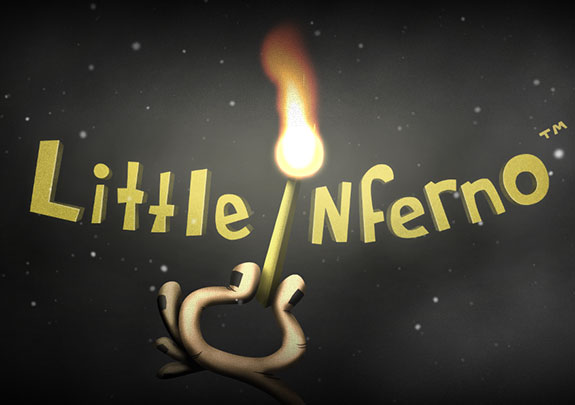
Little Inferno from The Tomorrow CorporationI entered the Tomorrow Corporation’s World of Goo on the word of Tom Bissell in this Grantland article on iPad games.  I found it to be everything that Bissell said it was: “a more beautiful, involving, and enchanting puzzler” than anything Angry Birds could hope to be.  I remember and now agree with another review that called Goo a strangely “moral” game.  It’s the kind of game that seems simple (make constructs out of balls of goo) but subversively catches you in a web of significant narrative.  Why?  Because even though it’s all about goo balls, something bigger is at stake.

Which means that I have high hopes for TTC’s Little Inferno, a new iPad game that recently dropped in the iTunes store.  This time around, the premise is even weirder: you buy different objects only to set them on fire in your house’s “little furnace.”  The premise was strange enough that I almost didn’t purchase the game.  But then I did, and I’ve been burning toys and knick-knacks ever since.  And once again, a strange and subversive narrative has slowly taken over.  I’ve made my way through most of the game at this point and have lost at least one character of significance and seen hints of some “meta-narrative” that could be a roundabout environmental message or could be a critique of gaming culture or a commentary on the difficulty of communication in a world of meaningless gadgets.  For all I know, it will be “about” all of the above and also about nothing.

That’s one of the beauties of stories, I suppose.  Good ones catch you off guard, draw you in with strange and subtle overtures until you realize something greater, something slightly and necessarily elusive.  Like a tiny match that eventually sets imaginations ablaze.

Posted in Internet | Leave a comment

On Ents and Trees

Treebeard from TheOneRing.netI’ve been turning something over in my mind lately, like a diamond in the light, trying to see something. Something about life and story and speaking into and out of both of them. In the midst of this my mind turned to something else: something about the difference between Ents and Trees. Consider the words of Treebeard from The Two Towers:

There are Ents and Ents, you know; or there are Ents and things that look like Ents but ain’t, as you might say . . . Some of us are still true Ents, and lively enough in our fashion, but many are growing sleepy, going tree-ish, as you might say. Most of the trees are just trees, of course; but many are half-awake. Some are quite wide awake, and a few are, well, ah, well getting Entish. That is going on all the time . . . Some of my kin look just like trees now, and need something great to rouse them; and they speak only in whispers. But some of my trees are limb-lithe, and many can talk to me. Elves began it, of course, waking trees up and teaching them to speak and learning their tree-talk. . . . It was the Elves that cured us of dumbness long ago, and that was a great gift that cannot be forgotten. . .

Speaking, the saying of things, is a gift, something you can learn and something you can lose. And while Tolkien didn’t write stories as allegories, you can definitely hear an echo of truth. As I think over life and story and speaking, I draw this conclusion: either we are trees who learn to speak like Ents or we are Ents who lose our voices and become dumb like trees. I’m not sure about you, but I would prefer being one who speaks and is spoken to, not one dumb (in the old sense of the word) and unresponsive.

I must confess to a certain loss of speech over these last few months. Evidence of that can be found all through this blog, where I’ve been content to deal more with the story of others than with my own, which is both slippery slope and shallow soil, a practice of the voice with limited range. I think it’s time to try a little harder, to rouse myself a little more, to the saying of more and better things. I’d like to be more Ent than Tree. Maybe you feel the same way, too.

Posted in Books, Faith, The Long Story | Tagged , | Leave a comment

30 Rock -30-

IT’S NOT OVER until Andy Greenwald writes about it.  At least that’s how I feel about NBC’s Thursday night comedy For most of 2012, Greenwald wrote about 30 Rock, The Office, Parks and Recreation, and Community; I shared many of his opinions on things.  So I knew that I wouldn’t be done thinking about Tina Fey’s seven-season series until I read what he had to say.  He posted it during the day Friday, and it is everything I’d hoped it would be.  Full of Wikipedia and YouTube links, Greenwald’s autopsy of the show hits on some of the moments I liked best in the finale (and the series as a whole).  Money quote: Liz’s comment about the heart and the head while saying goodbye to Tracy.

I highly recommend you check out the article here.  And, just for old time’s sake, below is an extended clip from the finale.

And in case you weren’t near the internet when the finale aired, here‘s the video clip that Jack mentioned.  Heh.

Posted in Television | Tagged | Leave a comment

Remembering 30 Rock (The Series that Reaganed)

NBC’S 30 ROCK wrapped up a seven-season run last night.  It’s been one of my favorite shows for most of my time in Hawaii, and I’m sad to see it go.  There’s been a lot of reflecting on the series, so I thought I’d put the links to various articles in one place.

Here’s one from Relevant Magazine about “3 lessons from the best sitcom on television.”

Grantland posted an interesting look at the show and race here.  They also posted an appreciative article on Jenna Maroney, one of the show’s funniest characters here (including some of her best lines in pics).

You can check out NPR‘s look at the seven-season series and “what it meant for women on television” here.

Even the folks at Christianity Today got into the act through their her.meneutics site here.

And here’s one of my favorite moments from one of my favorite episodes, the one where Liz has to go to the bad side of town to get back her cell phone, which she left in a cab.  Ah, the stories she fabricated . . .

I’ll miss the cast of TGS, but I’m glad I’ll get to revisit them in reruns.  A show ahead of its time and in spite of its time, indeed.

Posted in Internet, Television | Tagged , | Leave a comment

Paperman! See All About It!

MISSING DISNEY’S WRECK-IT RALPH means you also (probably) missed Paperman, the preceding animated short.  That’s a shame, and not just because Wreck-It Ralph was series of character twists and emotional turns.  Paperman was everything most Pixar shorts are and more, which means it was extremely thoughtful but also a different kind of animation style.  Disney has posted Paperman to the web in full.  I encourage you to take a look below.

Posted in Internet, Movies | Tagged | 1 Comment