Questionable Collaboration

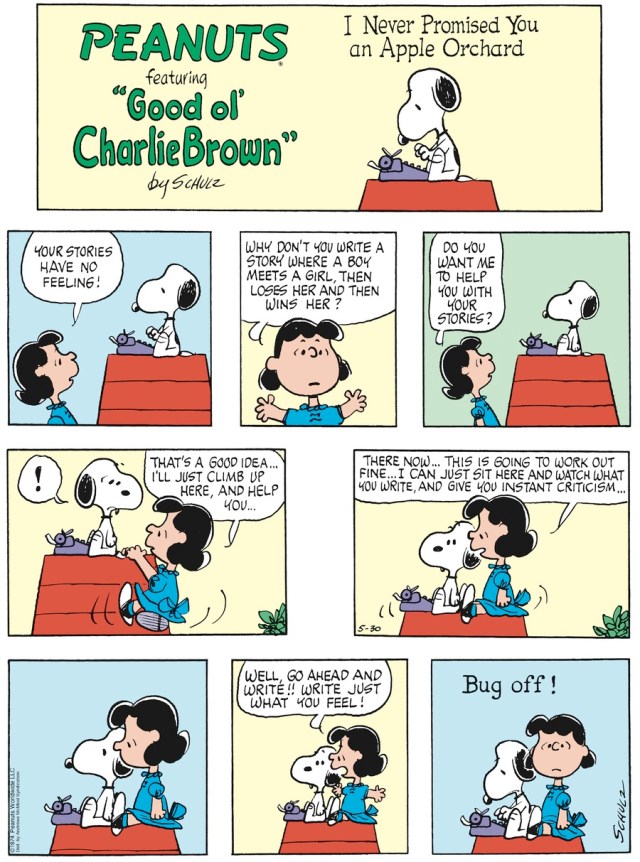
Like it or not, collaboration has become a mainstay in most workplaces and ministries.  In many ways, this is a good thing.  But then something like this happens:

Peanuts Questionable CollaborationPoints to Snoopy, who reminds us about the connection between the medium and the message (if not the method).

(image from gocomics.com)

Posted in Uncategorized | Leave a comment

What We Hear before We See

Wind in the Willows CoverI’m about halfway through Kenneth Grahame’s The Wind in the Willows.  I’ve spent most of my life with a vague sense of the story.  The title has been popping up here and there these last few years, including a recent mention on Twitter, so I thought I’d finally check it out.

This morning I finished what is supposedly the most controversial chapter of the children’s class: “The Piper at the Gates of Dawn.”  Up until that chapter, there had been hints of something deeper in the wide world of Mole and Rat.  Badger is a kind of hint in that direction (almost in a Chestertonian way).  The strongest hint came in Mole’s unexpected return to his long-forgotten home.  And then you get “the Piper.”  It’s a chapter, I have since learned, that sometimes gets removed from copies of the book.  It’s likely as much because it could be easily removed from the greater story.  Plus there’s an appearance of Pan.  People obviously respond differently to any kind of god or demigod showing up in a children’s story.  One site I visited mentioned the idea of the “numinous,” which is something that Lewis mentions a number of times when writing about God and the religious impulse.

It’s a beautiful chapter, particularly when juxtaposed with the chapter about Mole’s home.  Because the world is deeper and wider than we often imagine it to be.  Or at least we forget that fact (which is, it turns out, also part of the story for Mole and Rat).  I suppose I’ll pick the story up again soon enough with Toad in jail.  And we’ll see where things go from there.

+ + + + + + +

I think I’ve found a workable routine for summer break when I return from my trip.  Today I had lunch a new place downtown (new to me, at least).  They served a massive Cubano sandwich, much more than I was anticipating.

Beyond that, I spent the afternoon processing the news concerning Russell Moore and the Southern Baptist Convention.  One of the blessings/curses of living in the middle of the Pacific Ocean is that certain things either travel slowly or just don’t seem to make it over the water.  But this news is heart-breaking, and on multiple levels.  This just adds another level of “what comes next?” to life (though obviously on a less-immediate scale for me).  But as a member of a Southern Baptist church and a teacher teacher at a school with necessary Southern Baptist ties (and as a graduate of a Southern Baptist college and seminary), I feel a not-negligible sense of concern for things.  I suppose I should have known better.

(image from amazon.com)

Posted in Books, Faith | Leave a comment

Start of Summer Words

Thanks to extra concurrent-learning prep during fall break 2020, the summer vacation has started earlier for me and my co-workers.  Our last official day of work was this past Friday, and that was mostly meetings and planning for said meetings.  Saturday was graduation.  And, for the most part, that’s all she wrote for the 2020-2021 school year.  While I’ve got a few things to take care of here and there, I am hopeful that most of June will be a school-free zone for me.

It’s odd, not having vague but certain things hanging over my head just out of sight.  I’ve had it easier than some, but the last school year has felt like there was always something to write or to record or to report or to work into place.  Many teachers that I’ve spoken to are deeply excited about having something close to a “normal” summer.  Same for me.  Yesterday was Memorial Day, which was low-key for me (the highlight was a win at cards after a short set of losses).  Today has been for trying out a new summer routine, an attempt to see if the gym would be as viable in the morning as in the afternoon and whether or not I could carve out some time to get some reading and writing done later in the day.  It’s an attempt at something new because I’ll be flying out in a few days.  But if I can have a sketch of a routing for mid-June to late-July, I would be very happy.

So June is mostly responsibility-free (sounds odd to put it that way, I know).  I’ll be preaching three times in July, pulpit supply since our pastor recently resigned.  And then school starts back the last full week of July.  I’ll start back earlier than that because I help plan out that first week back.

+ + + + + + +

Years ago, when I first stepped into what I called my “temporary vocational stretch,” I thought a good bit about destabilization- how things were kind of wobbly because of added responsibilities.  Covidtide has added to that.  And so part of my hopes for this summer is to do some re-stabilization.  Reconsider some commitments.  Pray through some dispositions.  Ask God for a sense of renewal in some things and a sense of finality for others.  I’ve tried to make it clear that my intent for 2021-2022 is to NOT do things the way that I’ve always/often done them.  I’m keeping that in mind as I think through some of those “first week back” responsibilities.

+ + + + + + +

Church was interesting this past Sunday.  It was our first without our pastor, who had been with us for just short of two years.  Our worship leader was also out.  It was good to hear people from the front acknowledge our new/current situation.  I imagine this will just be one more punch that we roll with.  I believe that God has some things to show us and teach us over these next few weeks.  I hope I am able to listen and able to allow for more than just confirmation bias.

+ + + + + + +

At the last faculty meeting of the year, I reiterated the gratitude for our faculty and staff that others had shared.  I also reiterated encouragement for people to take a real break.  And then I said something about taking time to process and pray through your emotions, because there are always emotions just beneath the surface of year-end excitement.  I had a co-worker ask me about it later, which I found encouraging.  I think I couched it in “don’t come back in the same shape you are leaving” (though less harsh).  Because fatigue works itself out in lots of ways over a longer period of time, so glossing over things (though easy) shouldn’t be an option.

I’ve got two “professional development” opportunities lined up for this summer.  I put PD in air quotes because it’s not so much about professional development as it is nurturing some pre-existing learning.  Next week I’ll get to “attend” a virtual classroom about Augustine and preaching put on by New City Press: Preaching the Gospel of John with Saint Augustine: A Master Class with Rowan Williams and John Cavadini.  I read a collection of essays by Cavadini a couple of years ago (Jamie Smith had mentioned the collection).  I just recently finished a book about monasticism by Williams that I quite liked, too.  So I’m hopeful.  Then, later in June, I’m starting a six-week series called “Religion and the Spiritual Crisis” with Andrew Root and Tripp Fuller.  I’ve read more Root than probably any other author in the last two years (besides maybe Ben Aaaronovich and his Rivers of London novels).  While I don’t agree with everything Root asserts, he has been deeply beneficial in thinking about Our Current Moment, particularly from a youth ministry perspective.  So I’ve got to read some more Charles Taylor for the course (just selections from A Secular Age along with a couple of chapters of a shorter book of his that I’ve already read) along with a bit of Hartmut Rosa, who book on uncontrollability I read at the same time as Williams’ monastic book.  And that will take me to the beginning of the school year.

Posted in Books, Faith, Notes for a World's End, Teaching | Tagged | Leave a comment

Learning from a Vocational Tale

I recently got around to reading James K. A. Smith’s essay on how his sense of vocation has been changing over these last couple of years.  He wrote it for Christian Century for their “How my mind has changed” topic.  Probably something all of us could write about these days.

“I’m a philosopher.  We can’t think our way out of this mess.”  Quite the punchy title.  It’s at the top of a wonderfully personal reflection that traces Smith’s journey of faith from conversion until today.  It is necessarily broad but oddly specific.  It’s a picture of growing older, of ministry and teaching and writing, of how some things change but other things don’t.  Smith has been formative for me (he’s probably why I know the word formative, really). He has been since 2009, which feels like a whole other world at this point.  Over these last few years, as he wrestled with understanding ministry, work, and depression, Smith found himself at something of a loss:

As a young Christian philosopher, I wanted to be the confident, heresy-hunting Augustine, vanquishing the pagans with brilliance, fending off the Manichaeans and Pelagians with ironclad arguments. As a middle-aged man, I dream of being Mr. Rogers. When you’re young, it’s easy to confuse strength with dominance; when you’re older, you realize the feat of character it takes to be meek. I used to imagine my calling was to defend the Truth. Now I’m just trying to figure out how to love.

It’s not that I’ve given up on truth. It’s just that I’m less confident we’ll think our way out of the morass and malaise in which we find ourselves. Analysis won’t save us. And the truth of the gospel is less a message to be taught than a mystery enacted. Love won’t save us either, of course. But I’ve come to believe that the grace of God that will save us is more powerfully manifest in beloved community than in rational enlightenment. Or, as Hans Urs von Balthasar has put it, “Love alone is credible; nothing else can be believed, and nothing else ought to be believed.”

I appreciate the line he’s walking here.  It can sound a bit like a cop out (as an appeal to love often feels).  But it also lines up with his previous work: that we aren’t just brains in jars.  Granted, we need analysis.  Good analysis.  But we also need other skills and mechanisms that can work with the analysis.  And love, of course, is the answer.  But it is also our most-co-opted cultural liturgy.

Smith also mentions Augustine and the role he has played in Smith’s life these last few years.  I have to thank Smith a great deal for helping me latch on to this church father even if only a little bit.  Smith writes:

Drawing on the poetry of the scriptures, Augustine doesn’t just convey a truth, he pictures it. The very metaphor is an irreducible invitation, and extending it is an act of epistemic solidarity that no argument could accomplish. “As long as we are in this life, it is night for us,” Augustine recognizes. But even the night is illumined “by Christ’s descent into the night. Christ took flesh from this world and lit up the night for us.”

There’s a lot more to the essay.  But there’s one more thing that stand out as resonant between Smith’s current disposition and my own:

If I try to crystallize the change of mind I’m experiencing midlife and mid-career, it is some version of this question: How can I write to light up the night? If there is a pivot I’m still working through, it’s the reverberating effects of absorbing the distinct power of metaphor I see at work in Augustine’s preaching. It’s a conviction about communication, a sense of calling to be a very different kind of writer—not simply a philosopher with ideas to teach but a co-pilgrim alongside my neighbors, all of us wondering if the darkness will overwhelm us. I want to string together words that bear witness to the light in a way that people don’t just understand but can stake their hope upon.

“It’s a conviction about communication, a sense of calling to be a different kind of writer . . .” [emphasis mine]

Communication has been key for all of us these last 15 months.  A lot of it has been communication as content, whether as sermons or lessons as videos or slides.  It has forced (or empowered) a weird relationship with mass communication tools (because of necessity) even as we really needed to think smaller (like conversation).  And so while I’m not thinking in the same terms as Smith about book-writing, I do want to think about it in terms of chapel talks, sermons, and class lessons.  And also in how I read and talk about books.

Because it’s not just about minds; it’s about hearts.  And it’s about bodies.  And it’s about the spirits of people.  And it’s easy to emphasize one (or even two) to the detriment of the others.  And whatever else God was communicating to the people of Israel, and whatever else Jesus was saying about loving God and neighbor, a sense of wholeness is essential and baked-in to a real love of God.

Posted in Books, Faith, Teaching | Tagged | Leave a comment

A Quieter Place

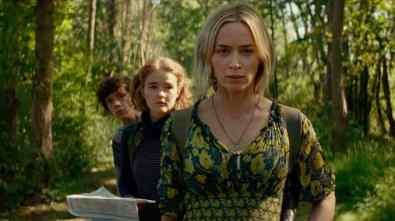
Quiet Place Part TwoIf there’s anything that The Lord of the Rings has taught us, it’s that “Point A to Point B” stories are rarely as easy as they should be.  What’s true in LOTR on the grand scale is ultimately true in A Quiet Place Part Two on a much smaller scale, where really it feels like you’re just trying to get across town or across a few fields without being pummeled by an alien.  Which makes the story of the Abbott family that much more engaging.  It’s a story grounded in the adult actors but one that moves forward because of the kids.  And because of how things turned out in the first movie, you just never know who’s not going to make it from Point A to Point B.

A Quiet Place Part Two was my shy-of-triumphant return to Regal Cinemas at Dole Cannery.  I’ve been going to movies elsewhere in town since late last fall, but Dole has been closed this whole time.  I was surprised to find that little had changed, as they were starting major renovations just prior to the pandemic.  There were two big changes, alas: paper straws (which I should have seen coming) and Pepsi products instead of Coca-Cola (which might be unforgivable).  The seating was still stadium but wasn’t recliner-seating yet, which has its own charm (though a little less in pandemic days).  But it was still nice to get back to a place I had loved for so long.

And the movie was great.  Terse.  Taut.  To the point.  There was no fluff in the story.  Spoiler: you do get one flashback early in the movie, which is good and shows me something that I love most in disaster/horror movies: how things get started (even if they don’t get much explanation).  The rest of the movie is about moving from here to there and all that can happen in between.

A Quiet Place Part Two really is the cinema at its best.  I’m not sure I would have been as invested if I had a remote control in one hand and my cell phone in the other.  But there with the big screen and the immersive sound: it was the best movie-going experience I’d had in a long while.  It makes me more hopeful for the summer movie season.  And even though it was a year late, A Quiet Place Part Two was worth the wait.

(image from cnbc.com)

Posted in Movies | Leave a comment

The Force and the Return

I don’t do remixes often, but yesterday I came across this musical remix for the big moment at the end of The Mandalorian season two (so: spoilers).  Such a great weaving together of themes.

That ending is something that a child of the 80s waited decades for: Luke doing something cinematic after Return of the Jedi.  I’m grateful that this version of the clip fades to black when it does, too.

Posted in Movies, Television | Tagged | Leave a comment

Last Words, First Words

Sunday was our current pastor’s last Sunday at our church.  It’s been interesting, watching someone of that position leave, watching them transition from one place of living to another.  Sunday was also the day of his last sermon, an exposition of Philippians 1:1-10.  Funny enough, that was also the text that I worked with for my last chapel talk of the year.

First and last words are always interesting, probably both more and less telling than we intend them to be.  The same can be said for sermons.  In my chapel talk, which clocked in as shorter than usual, I was fortunate that Paul’s initial greeting to the Philippian church touched on four images and ideas that had shown up over the last year.  For my out-going pastor, it was a chance to try and encourage the church in their love for one another.

As I sat there listening, I decided that the sermon would make a great “first sermon” at his next church.  Because that’s kind of what leadership is: having a sense of where people need to go and shepherding them in that direction.  Or, in teacher talk, it would be “understanding by design” and “planning with the end in mind.”  To start that way helps people understand not just where you are starting from, but also where you hope to go.  And that’s no small thing in a transient, always transitioning culture like ours today.

Posted in Notes for a World's End | Leave a comment

Question to Questions

I ended yesterday’s post with a question: what’s a leader for?  It’s more of a thought-question, really, as I think that leaders are important, vital.  At the same time, how things play out when leaders aren’t around can be quite telling.

Four years ago, when I started in on what has become a much longer-than-expected vocational stretch, I thought it best to be a steward and not a change-agent.  Since it was temporary, we would work to hold things together, keep things moving, as we waited for the position to be filled.  And for four years we’ve done that.  As I considered what to do about an obvious “year five,” I came to some conclusions.  First, that year five would also be my last year.  And second, that we needed to try to take some of what we think we had been learning and and put it into practice.  Things continue on when even in the absence of leaders.  The work is potentially harder because “lay people” usually have other tasks to work on.  And even if change is possible in such circumstances, such circumstances make change even slower.

Or consider a church staff that spends more than a year in that interim period between pastors.  You’ve got staff divvying things up. You’ll also got deacons and other church leaders stepping in.  And then the interim steps in for things, too (at different intervals and levels of involvement).  It’s likely unsustainable and unhealthy in the long run.  But it’s also a real learning experience for everyone. (And likely why congregations stand in applause when a new pastor has been found).

So let’s say that you are an organization that has a strong mid-level bench, that steps up to the plate and learns and adapts well.  And the leader of the group, whatever it is, moves on.  Do you (a) hire someone who helps keep the machine running smoothly even if it means a little less obvious “leading” from the front or (b) do you hire someone to “take it to the next level” even if that means working at odds with those who had held things together in the interim?

It’s probably a false distinction, not likely to be such an “either-or.”  But that’s why it’s a thought experiment.  I totally understand the impulse for good, up front leadership.  But I also understand the realities of wisdom and competence on multiple levels.  It definitely shapes the kind of questions to ask of those looking to step in.

Posted in Notes for a World's End, The Long Story | Leave a comment

Twice Bitten, Thrice Shy?

Two years ago, I was serving on two search committees.  One was for our high school’s Christian Ministries coordinator, a position that had been vacant for two years and that I had helped step in to partly fill.  The other was for our church’s senior pastor position.  At that point we had had an interim for a good while (after a series of shorter interim preachers).  As the school year turned to a close, both positions were filled.  The CMC would be coming in from one of the Carolinas.  The pastor would be coming in from Texas.  If nothing else, I was glad to have the positions filled with people who were competent and spoke well of the faith.  By that November, our Christian Ministries coordinator had called it quits.  This past Sunday, a couple of months shy of two full years, our pastor announced he would be going to the mainland in view of a call.

Turns out I don’t have a great track record with search committees.

And so second verse same as the first.  We’re still without a Christian Ministries coordinator at the high school.  I’m doing what I can to hold onto my teaching line while adding a faith integration assignment while also working with the chapel team each week.  I assume the next few weeks will bring some kind of “wrap up” to our current pastor’s time on the island.

There is one difference this time around, something at play that wasn’t on the radar two years ago: our high school’s principal is also moving on.  That’s a good thing, first for her.  She’s been at it for a long time and has more than earned an opportunity to rest and redirect.  I have often joked that when she retires, I retire.  Either way, it adds an interesting twist to my own current situation.  I did, a couple of months ago, let the powers-that-be know that I was not planning on continuing in the “5-year vocational stretch” with Christian Ministries beyond the 2021-2022 school year.  Five years is a long time for something so significant to be so temporary.  And so, if anything, this next year will hopefully be about putting “things learned” into practice.

It’s odd.  After last week’s announcement at church, it felt a bit like a story that had stalled was moving again.  That’s true on multiple levels and is more of an observation than a judgment.  What’s odd is that it’s coming so quickly.

And so a summer pastor-less, with a principal in transition, continuing a long-term temporary task.  If nothing else, it is a time where God can continue to show His faithfulness.  I definitely have questions for Him.  And I’m glad He is with me, with us, at all times and not just in times like these.  It’s a real reminder of where hope should reside.  And it is also a very powerful reminder of the significance of this question: what’s a leader for?

Posted in Faith, Notes for a World's End, Teaching, The Long Story | Leave a comment

Saturday at the Cinema

Life is slowly but surely returning to the movie theaters.  Last week it was Tom & Jerry (not for me) that brought back some families.  This week there was a new Disney animated feature, Raya and the Last Dragon, and a new sci-fi adventure starring Peter Parker and Rey Skywalker.  That’s where I landed this morning.

Chaos Walking has one interesting thing going for it: the action takes place on a planet where men’s thoughts are mysteriously vocalized and sort of animated.  The quirk is never really explained.  It makes for an interesting visual while also allowing for some real humor.  If there’s one other thing the movie has going for it, it’s Daisy Ridley and Tom Holland at their young-adult prime.  They bring a lot of goodwill with them, I think, which is good, because you never know how long young actors will stick around.  So this really is a right time, right place movie for both of them.  It’s a quest movie, of sorts.  It’s got some social commentary (which gets revealed in an interestingly sad way).  And it’s got some great action scenes with some good twists.  And spoiler: it’s probably the closest Holland will ever get to a real “Uncle Ben” scene.

I wonder about movies like this in these cinematic days.  Were movie-makers expecting this to be a big hit (or potentially a big flop) in pre-Covid days?  One of the nice realities of the movie theater right now is that nothing feels like much of a hit . . . which can be a good thing as much as it can be a bad thing.  And while, like last week’s Crisis, this is a movie with an unfortunate name, Chaos Walking does a good job entertaining without being too bold, too brash, or too boring.  Here’s the trailer if you’re interested.

Posted in Movies | Leave a comment