Go for the Landscape, Stay for the Landscape

One of the side-effects of lockdown has been the transformation of my Twitter feed into a running journal of hiking through the Lake District and the highlands of Scotland.  Which means I’m pretty excited about All Creatures Great and Small starting up on PBS this weekend.  I imagine it will be light on the drama and heavy on the beautiful landscape shots of Yorkshire, which sounds great to me.

Posted in Television, Travel | Leave a comment

We Are Not Stretch Armstrong

stretchToday was the first day of the week that I didn’t go home nursing a headache.  Each day has been packed.  Things came to a bit of a respite today now that my chapel talk for next week has been recorded.  I can at least go to school tomorrow morning not worrying about an assembly or a professional development meeting.

Years ago (in the last century, even) Jewel had a song that posed the question “Who’s Will Save Your Soul?”  This afternoon I find myself asking another question: who’s going to shape your soul?  Blame it on my recent re-read of The Screwtape Letters, but it’s clear to me that even as a Christian there are forces at work (both aware and not) that are constantly pushing and pulling us into this direction or that.  Covidtide has been a powerful force in this as well, often amplifying already-difficult tasks and relationships.  Do we end up feeling like metal folding chairs that a weightlifter threw against the wall?  Or do we think that we’re Stretch Armstrong, able to be pulled in every direction and still able to retain some kind of basic (unhappy looking) shape?

It’s worth thinking about, and not because you want to lay blame on those who may or may not be doing the shaping.  We have ourselves to blame for our misshapen selves, too.  But it is another opportunity to check ourselves, our situations, as we move forward into what could be a very “unknown” 2021.  Weeks like this one remind me that I’m not Stretch Armstrong, no matter how flexible I might seem.  And I really don’t want to be the metal folding chair left to rust after being thrown against the wall.  We need to be mindful of what is shaping us.

(image from Walmart.com)

Posted in Notes for a World's End, Teaching | Leave a comment

A Bit on Meaning

I’ve been thinking a lot about  meaning these last few weeks, these last few days in particular.  It seems to me that meaning comes from many different sources: God, family, friendship, and work, to name a few.  It also seems to me that meaning is tied to frequency.  That’s something that the Old Testament book of Ecclesiastes seems to be pointing to, how the ocean never has its fill of water.

Different sources of meaning might carry different weights depending on time and frequency.  As a young teacher, much of my meaning came from the students that I had know for years, that had seen me at my worst and inspired me to my best.  Now, though. these many years on, I seem to be looking to co-workers for more meaning at work.  That can be tricky because I’m not whether or not most adults look to work for meaning.  In fact, they may be actively told NOT to look for meaning there.  I understand the warning.  But if that’s the case, work or vocation or calling is almost evacuated of all meaning on a necessarily professional level.  It’s not God, nor is it family, therefore it is just a means to an end.  That sounds a little scary to me (and more than a little sad).  That’s a sobering thought when you think that you might have two more decades of work ahead of you.

Posted in Teaching, The Long Story | Leave a comment

On the Twelfth Night

Today is the twelfth, and final, day of Christmas.  The older I get, the more I like the idea of twelve days of Christmas following the season of Advent, and not just because it “prolongs” things.  There’s almost no way of keeping Christmas from seeping into Advent.  But once Christmas is “done,” it’s done.  People are ready to take down trees and clean up sanctuaries and to get on with things (and no real decorations until next year!).  Twelve days allows the truth of things to linger.

+ + + + + + +

I haven’t written much about the beginning of the liturgical calendar except for at the beginning of Advent.  I think it’s because I “feel” my way through Advent (and maybe even Christmas) a little differently than others, even my more liturgical friends.  Advent is about longing: putting ourselves in the place of those who longed for God’s covenant promise fulfilled so that we may better long for Jesus’ return at the consummation of history.  And I’ve come to believe that even the most basic longing, on some level, is rooted in the lack of fulfillment of the greater longing.  And for whatever it is good at, the church doesn’t have much to say about longing.  And yet it’s there, at the very heart of the human condition and the stories of history.  And if we can’t talk about longing well, how in the world should we be able to say something good about hope fulfilled, which is the great turn of Christmas?

But say it we do.  And we mean what we say.  But I can’t help but think that a depth of lasting joy  might reveal our depth of genuine longing.  And a big part of church is how we learn to communicate those things to one another in the framework of faith, which is another reason why it is good that we revisit not just the themes but the stories rooted in Advent and Christmas.

And, thankfully, the church calendar doesn’t simply leave us there.  Next is the day of Epiphany, something that many of us (particularly Baptists) don’t really know what to do with.  But it is the reminder that the story of Christmas continues on beyond the shepherds and the wise men, and that is a good thing.  Because even there, as the stories and writings of the New Testament are true, longing rumbles just beneath the surface of things.  And with that longing, hope.

Happy Twelfth Night, everyone!

Posted in Faith | Leave a comment

Christmastide’s End

The twelve days of Christmas are coming to an end.  And while I do have some reflections on the season, I thought I’d share one more song clip before the clock marks the end of the first day of the semester.

Last week, when I discovered the clip of U2’s Bono and the Edge singing “Walk On,” I also found the following clip of the pair busking “Oh Holy Night.”  As with “Walk On,” the song really picks up when the harmonies kick in.  And then, as with any U2 song, things move to another level when the crowd starts singing along.  Even (maybe especially) off-key, it’s almost like being there.

Posted in Faith, Music | Tagged | Leave a comment

“Upon Further Reflection”

This time last week I was wrapping up a mini-retreat at a hotel a little closer to the water.  It’s the second time that I’d done it this year.  The first was earlier in the school year, when I was feeling a good amount of pressure from things.  Then it was nice to decompress and read and go for some walks in what was still a relatively locked-down state.  This time I “retreated” with a more specific goal in mind: reflecting on 2020 with hopes of giving some direction to 2021.

One of the odd realizations from 2020 has been that it feels like no one really knows what they are doing (myself included) or that they DO know what they are doing and don’t care or understand how it affects the world around them (hopefully not included here).  Good, honest, and coherent reflection can be difficult when there isn’t some kind of wisdom in the picture.  So I was grateful to come across a mechanism to do some reflection that could be tied into some of my already-at-play practices and routines. And it was different enough from my regular conversations with others.

It was a good time.  The first chunk, completed on night one, was all about big picture life goals (and those were divided between being/doing and becoming).  The framework I used was rooted in the idea that productivity tends to crowd out anything genuinely personal, which has definitely been the trend in 2020, when everything was turned towards content creation and digital dissemination.  It was good to revisit things that I really hadn’t had time to think about in a while (things that really don’t come up in conversation all that often when the goal has been lowered to simple survival).  It was encouraging to see how I had opportunity to weave in things in 2020 that related to my big picture hopes regardless (case in point: my series on friendship in chapel in the fall).

The second chunk of reflection cam with the first morning.  The prompts in this part of the framework were designed for looking back at the last twelve months to document changes that had been made and what areas of success, frustration, and struggle were evident.  As a reader, I’m already always doing some form of self-assessment, but it was nice to get “in writing” things that should show up in conversations but don’t.

I spread out the third and fourth chunks of reflection throughout the rest of that day (saving the second morning for sleeping in and getting ready to return to daily life).  In these final chunks, I was encouraged to reflect on role models who embody some of the goals I have for the new year.  Then I fleshed out four “being” goals and four “doing” goals and thinking through reasoning and possible roadblocks.

Within two hours of getting back to daily life, I found the peaceful reflection of the retreat challenged.  Within a couple of days, my “goals” seemed so far removed from my day-to-day experience that it felt like a kind of whiplash.  All of this served as a clear reminder that what I tried to do during the retreat was absolutely necessary.  We do not live in a culture geared toward self-reflection.  And when we talk about goals and hopes, the conversation often ends up being about productivity more than anything else.  But as a follower of Jesus, I am reminded of Paul’s words to the church in Ephesus:

15 Be very careful, then, how you live—not as unwise but as wise, 16 making the most of every opportunity, because the days are evil. 17 Therefore do not be foolish, but understand what the Lord’s will is. 18 Do not get drunk on wine, which leads to debauchery. Instead, be filled with the Spirit, 19 speaking to one another with psalms, hymns, and songs from the Spirit. Sing and make music from your heart to the Lord, 20 always giving thanks to God the Father for everything, in the name of our Lord Jesus Christ.

As I look back on 2020, I am grateful for the people who helped me stay engaged with things beyond just “getting the job done” (and they were many and they were necessary).  I am also grateful for habits and practices that carried me when momentum was low and my heart wasn’t always in it.  I was glad to be able to get away the week before New Year’s Day.  True, it led to some whiplash, but it’s also given me some time to reflect on the hopes and plans that I have for being and doing in 2021.   Over the next few days I’ll be sharing some of those 2021 ideas.  I wouldn’t necessarily call them goals.  They are more like commitments than anything else.  I’ve also got a few articles from the last few months that I need to get around to writing about.

+ + + + + + +

On Sunday I mentioned that the good Sunday funnies were plentiful with New Year reflection.  Here’s the Nancy Sunday strip by Olivia Jaimes.
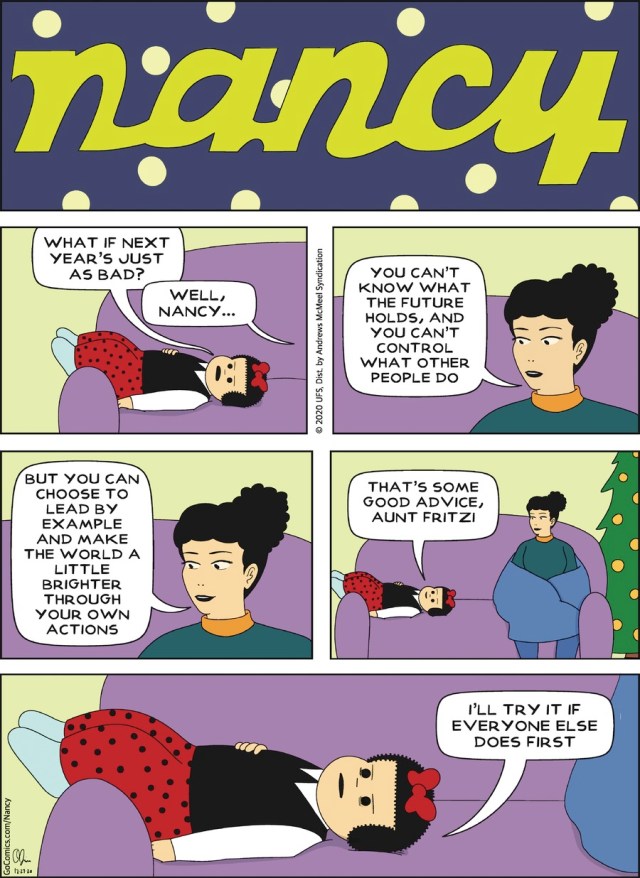
Nancy Does it First(image from gocomics.com)

Posted in Uncategorized | Leave a comment

“You Can Only Take So Much”

“Walk On” has been one of my favorite U2 songs for two decades now.  So it was a bit of a surprise when I came across this recent rendition of the song by Bono and the Edge and heard the song in a way that caught me off guard.  The harmonies are great and the ending is a great riff on the album version.  A great song for the turn of one year into another.

Posted in Music, Notes for a World's End | Tagged | Leave a comment

Screwtape and the Spiritual Life

I’ve been on a C. S. Lewis kick these last couple of months.  It started with finally getting around to reading his Reflections on the Psalms.  Definitely not the book I thought it would be, but brilliant nonetheless.  Then I reread The Four Loves as part of prepping for my series on Cultivating Friendship for chapel.  Then I felt the urge to reread The Screwtape Letters, which I have not read in years, maybe even over a decade.

I thought about rereading Screwtape because its content approaches the spiritual life in a way that we don’t often talk much of anymore.  Sure, there’s the demon thing.  But it’s more than that.  For years I’ve been trying to make sense of how we do (and don’t) talk about the spiritual life at church or in school or even in regular conversation between Christian friends.  I’m convinced that we approach the spiritual life close to the way Lewis saw people approaching the topic of demons:

There are two equal and opposite errors into which our race can fall about the devils.  One is to disbelieve in their existence.  The other is to believe, and to feel an excessive and unhealthy interest in them.  They themselves are equally pleased by both errors and hail a materialist or a magician with the same delight.

On the one hand you have the “materialists” who think little to nothing of a “spiritual life.”  Perhaps church and worship and fellowship are these things that we do out of duty, and perhaps some delight, but that ultimately have little do with the indwelling Spirit of God or walking in step with the Spirit in a way that could be called dynamic.  For others, the magicians, the spiritual life is everything, to topic of every conversation, the fine-toothed comb that get applied to even the smallest of topics.  In this instance, worship and fellowship are tools for the magician (really an apprentice) to see tree after tree but never the forest of someone’s life.  The former approach is dull and defeating.  The latter is exhausting and defeating.  Which is probably why we don’t talk about the spiritual life at all unless things are falling apart or unless things at church are so dull that we need some kind of “renewal.”

Which brings me back to yesterday’s topic of the church calendar and the beginning of Advent.  All of these things, our habits and practices and calendars, are meant to help nurture the life of the Spirit within us.  Yes, an order of worship.  Yes, a way to celebrate in the home.  But not to the neglect of Jesus Himself.  In Ancient-Future Time, Webber asserts that:

the historical understanding of the Christian year [is] life lived in the pattern of death and resurrection with Christ.

It is not this thing observed from the outside.  And it’s not just a set of moments and motions that are simply hoops through which to jump.  Paraphrasing Webber quoting Saint Leo: what we retell we ought not simply “venerate,” we also “receive and imitate.”  And that’s not just the actions themselves or certain feelings alone.  They are both.

I would like to make it through this Advent season not just with an appreciation for the four candles or the songs song.  I do not want simply to hear the stories but to live within them, to live out of them in such a way that the reality is clear: clearly known, but also clearly felt.  And in the being known and felt, also clearly experienced as “a habitation of the Spirit” that is more than pietistic motions simply gone through.  We are neither materialists nor magicians when understanding the life of the Spirit.

Posted in Books, Faith, Life in the Fifth Act, Scripture, Uncategorized | Tagged | 1 Comment

The Times of Your Life

Yesterday was “Christ the King” Sunday in many churches across the world (though many other churches across America probably celebrated Thanksgiving early instead).  As I understand it, the day is a comparatively recent addition to the liturgical calendar.  The Sunday wraps up the church year with a reminder of Christ’s sovereignty.  From Sunday morning’s psalm (145 in the ESV):

10 All your works shall give thanks to you, O Lord,
and all your saints shall bless you!
11 They shall speak of the glory of your kingdom
and tell of your power,
12 to make known to the children of man your mighty deeds,
and the glorious splendor of your kingdom.
13 Your kingdom is an everlasting kingdom,
and your dominion endures throughout all generations.

I remember reading that passage at the beginning of the school year and finding great comfort in it.  I am grateful that it comes back around every few weeks.

Calendar TurningThis coming Sunday is the beginning of Advent.  I often start off the Advent season hopeful.  Much like the beginning of the calendar year or the school year, the beginning of the liturgical year reminds me that there can be a shape to things beyond our own whims.  And while the Sundays of the season are a big deal (at varying degrees depending on your church), it’s really the day-to-day that carries it.  Unfortunately (and this will come up later in the week), it’s the solitary nature of the day-to-day that serves as the leak from which hope tends to leave.

As such, this is the time of year that I always break out Robert Webber’s Ancient-Future Time.  The book is a kind of primer on the Christian year, it’s traditions and practices.  It begins with a nice chapter on “ordering your spiritual life.”  The cover of the book has a subtitle on “forming spirituality throughout the Christian year.”  I bring that up because the chapter is good and because it reminds me of a chapter in N. T. Wright’s latest book, Broken Signposts.   In Wright’s estimation, “spirituality” is one of seven signposts that point us back to God and to Jesus. From the beginning of Wright’s book:

Human beings regularly experience the world as a whole as something that ought to make sense.  There are several signs, clues if you like, of the sort of sense it ought to make.  But things don’t work out the way they seem to suggest.

Wright then couches his discussion of “spirituality” with his own experience of the cultural revolution of the 1960s and the popular move from specific religion to vague “spirituality” (which is why many Christians bristle at the word).  “Spiritual but not religious” is the way it gets articulated these days.  Wright beats a familiar drum in this part of the book, bringing philosophies like Epicureanism, Stoicism, and Gnosticism into the conversation.  Many people today probably move through all three of these on a regular basis, I imagine.  “As long as it’s not Christian,” Wright reminds us (and as much of the world nods).  Spirituality is about making sense of the world via our “religious impulse” with the religious sucked out.

Webber also couches his discussion of spirituality in the personal.  He recounts some of his own movement through college and graduate school that mirrored moral and intellectual engagement with the Gospel.  He brings in the idea of worldview, too.  And then he adds:

But I still looked for more, much more.  What I longed for was something that went deeper than pious ideas on morality or intellectually stimulating thoughts about the meaning of human existence, as good as these were.  I wanted something that actualized the pattern of being in Christ.  I wanted something that worked in my life, something that brought a realistic spirituality into being.  I wanted something that ordered my life into the patterns of Christ’s life, death, resurrection, and coming again.  (emphasis mine)

Which sounds a lot like the Paul writing to the church in Philippi concerning what was gain to him and what was rubbish.

(image from depositphotos.com)

Posted in Books, Faith, Scripture, The Long Story | Tagged | Leave a comment

“Though the Fig Tree…”

It’s just Tuesday, but boy has it been a week.  I found good comfort in today’s reading from the Old Testament book of Habakkuk.  The minor prophet had this to say as his book drew to a close with its third chapter (ESV):

17 Though the fig tree should not blossom,
nor fruit be on the vines,
the produce of the olive fail
and the fields yield no food,
the flock be cut off from the fold
and there be no herd in the stalls,
18 yet I will rejoice in the Lord;
I will take joy in the God of my salvation.
19 God, the Lord, is my strength;
he makes my feet like the deer’s;
he makes me tread on my high places.

I also really liked this selection from Psalm 94, mostly because it almost feels like some kind of gloss on the teleological argument:

Understand, O dullest of the people!
Fools, when will you be wise?
He who planted the ear, does he not hear?
He who formed the eye, does he not see?
10 He who disciplines the nations, does he not rebuke?
He who teaches man knowledge—
11 the Lord—knows the thoughts of man,
that they are but a breath.

And then the Gospel reading from Luke 17 was one you don’t hear much of (but that someone like me probably needs to hear more often as a simple reminder for gratitude):

“Will any one of you who has a servant plowing or keeping sheep say to him when he has come in from the field, ‘Come at once and recline at table’? Will he not rather say to him, ‘Prepare supper for me, and dress properly, and serve me while I eat and drink, and afterward you will eat and drink’? Does he thank the servant because he did what was commanded? 10 So you also, when you have done all that you were commanded, say, ‘We are unworthy servants; we have only done what was our duty.’”

Which isn’t about false humility at all.  Our duty, yes.  But also our grateful duty.

Posted in Scripture, Teaching | Leave a comment