Sunday’s Best: Is This the Way?

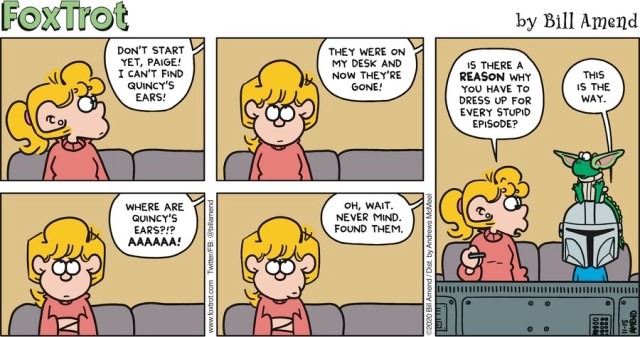
It’s been a good day for new comics in the Sunday paper.  I’ll get around to sharing a couple of other examples throughout the week, but I thought this week’s FoxTrot was definitely worth sharing today.

We don’t really get weekly “previews” of The Mandalorian from Disney+, which is probably a good thing.  I find the show a bit too formulaic, which means it has to grab me in other ways.  Last week it was the ice spiders.  This week?  Well, you should just watch it if you can.

It’s fun seeing Jason’s reaction to the show.  And it’s a great use of Quincy.

FoxTrot Mandalorian(image from gocomics.com)

Posted in Uncategorized | Leave a comment

The Force of the Holidays

It’s not much of a struggle for me to hold off on Christmas stuff until after Thanksgiving, but this one might sneak in sooner rather than later.  I’ll be curious to see whether or not it picks up after The Rise of Skywalker.

Posted in Movies | Tagged | Leave a comment

Midweek Moment

Veterans’ Day was yesterday, which made for an interesting break in the middle of the week.  It often feels like normal work weeks are hard to come by, but a midweek day off feels a bit like a mid-week weekend (if that makes any sense): it keeps the week in two complete chunks.

Tuesday was a weird one for me: classes went well, but other parts of the day distracted and discouraged me a bit.  So I decided to take the day Wednesday to stay away from email and relax.  So I slept in (until about 6:30) and then made my way to Zippy’s, where I usually eat breakfast on Sunday.  It was a different experience, the midweek crew.  But it was nice to sit and read and write with a good cup of coffee and a warm breakfast.  The rest of the day involved, more reading, groceries, and a trip to the Pali Lookout, which just reopened a few days ago.  The weather matched the location perfectly, as the whole day has been blustery and overcast.

Today I finally finished my reread of The Four Loves by C. S. Lewis.  I started rereading it (for the first time in many years) because of series on cultivating friendship for chapel.  It’s such a great book.  I feel like I underlined at least one sentence per paragraph.  I think I’ve probably internalized a lot of Lewis’ thinking about the world and faith, and this reread was a reminder of that.  The book almost reads like a journey, starting with the big picture and then moving through affection, friendship, and eros until finally arriving at charity.  And that final chapter on charity is actually shorter than you expect, which is okay because the whole book hints all around it.  And even though the Augustinian connection near the end of the book is more of a negative example, there’s a lot about the ordering of love to mull over.

That makes two Lewis books over the last couple of months.  Just prior to Loves I read his Reflections on the Psalms (for the first time).  It took an approach to the Old Testament poetry that I found both surprising and refreshing.  I’m glad to have his voice in the mix of my life.

Posted in Uncategorized | Leave a comment

Missing the Turn

This past Friday I went out to dinner with my neighbors.  We decided to grab a bite down at Ala Moana Center.  I’m a regular there, eating breakfast at a local diner there at least once a week whenever things are opened back up.  When we got there, the upper parking lot was full.  We went from restaurant to restaurant trying to find a place that would seat us together in a timely manner.  I have to admit, it was a little jarring.  It’s been a long time since I’ve been around that many strangers.  The good was great, and the company was wonderful.  But it was also a real reminder of how things can change for you psychologically even when so much of life is screaming to go back to “normal.”

+ + + + + + +

I think that’s a big part of a conversation that people should be having but aren’t.  After a long parenthetical existence, what does “returning to normal” look like?  And is going back to “the way things were” the best thing to do?  Now that there is rumor of a 90% effective vaccine, there’s talk of a return to “normal” even earlier than expected (and this as cases continue to rise).  How do you determine what’s worth holding on to and what is worth letting go?  I’ve been thinking about this kind of thing for a while, even before Covid, because of commitments and sunk costs.

I often think of the Alasdair MacIntyre quote from After Virtue that “inspired” Rod Dreher’s “Benedict Option” and Saint Benedict.  (This post isn’t about the BenOp, just so you know.  At least not totally.)

A crucial turning point in that earlier history occurred when men and women of goodwill turned aside from the task of shoring up the Roman imperium and ceased to identify the continuation of civility and moral community with the maintenance of that imperium.  What they set themselves to achieve instead– often not recognizing fully what they were doing– was the construction of new forms of community within which the moral life could be sustained.

First there is the “shoring up.”  Granted, the imperium died a slow death.  But what about the lifespan of things in our accelerated culture?  How do you determine healthy traditions and habits as opposed to fads and novelties?  When is maintenance no longer “worth it” with something?  Then there is what the maintenance signifies (they why that necessitates the continuation in the first place).  This is more than a case of losing face, I believe.  There is something about goodwill and morality and civility at play here.  Such a community finds itself immersed in “new forms” of what is most vital, forms that will allow for sustenance over time.  And that’s no small thing.

One of the potential lessons of Our Current Moment has been the realization that bigger is not always better.  And just because it might be better doesn’t mean it is actually sustainable.  This can be a difficult pill for our culture to swallow.  One of the correlations of acceleration is growth of the exponential kind.  To reject the notion of exponential growth is to reject the contemporary mindset of success.

There are no easy answers to these questions that we should be asking.  And I suspect that most of us will do our best to avoid the questions and simply jump back into the way things were as quickly as possible.  I hope not.  This is a good time for necessary conversations.  We’ll see if they can happen.

Posted in Faith, Notes for a World's End, Teaching | Leave a comment

On a Break

So I inadvertently took a break from posting for most of last week.  Last Wednesday was packed.  Classes, meetings, mainland phone calls, groceries, yard work, helping move furniture: by the time I was done with the day, posting an entry was the farthest thing from my mind.  When I realized it the next day, I felt a bit of relief (and a bit of sadness).  I also felt like taking another day or two away from the site.  It’s been too many comics and YouTube clips, I’m afraid.  So I’m hoping the rest did me some good.  We’ll see over the next week or so (thought the comics and the videos will still be there).

Habits and routines have been difficult for me lately.  Too often they are done in rush in a void, so they don’t have as much root as I would like and they aren’t tied to the fruit that comes from community.  I think about that kind of stuff all of the time, especially on days where I want to be with people talking about a Christian life that isn’t just habits and routines but are real “habitations of the Spirit.”  This is going to come to a head for me at some point, I think.

I’ve got a few weeks “off” from chapel, though I’m still prepping short videos and slides to go with things.  I’ll have a two-week window between Thanksgiving and Christmas chapels to plan for.  Part of me wants to do a short sequel to the “Cultivating Friendship” series from earlier in the semester.  We’ll see.  We have a number of other activities kicking in over the next few weeks, so I need to plan wisely.  Beyond that, class will be interesting because we’ve got group presentations to run (and all while concurrent!).

A few days ago I finished Wright’s Broken Signposts.  I hope to write a few things about it over the next week or two.  There’s at least one thing that Wright does really well for me.  Reading has gotten really slow for me lately, and not because I’m being deliberate.  It’s almost like it can only happen on the weekends.  I’ve still got a ways to go to finish my reread of The Four Loves by Lewis.  I’ve also started Apollo’s Arrow by Nicholas Christakis.  It’s a book about Covid-19.  I don’t think it’s propaganda (though who can tell?).  I do know that I’m about 70 pages in and it’s totally fascinating.  As he recounts the events of late 2019-early 2020, it feels like I’m watching a movie. I’m also learning a lot.  Hopefully I can finish the book in good time.

Posted in Uncategorized | Leave a comment

From Luke for These Days

The Gospel readings have been Luke for these last few weeks.  These last two days of readings have felt oddly appropriate for these days.  From chapter twelve in the ESV:

54 He also said to the crowds, “When you see a cloud rising in the west, you say at once, ‘A shower is coming.’ And so it happens. 55 And when you see the south wind blowing, you say, ‘There will be scorching heat,’ and it happens. 56 You hypocrites! You know how to interpret the appearance of earth and sky, but why do you not know how to interpret the present time?

57 “And why do you not judge for yourselves what is right? 58 As you go with your accuser before the magistrate, make an effort to settle with him on the way, lest he drag you to the judge, and the judge hand you over to the officer, and the officer put you in prison. 59 I tell you, you will never get out until you have paid the very last penny.”

And then from chapter 13:

There were some present at that very time who told him about the Galileans whose blood Pilate had mingled with their sacrifices. And he answered them, “Do you think that these Galileans were worse sinners than all the other Galileans, because they suffered in this way? No, I tell you; but unless you repent, you will all likewise perish. Or those eighteen on whom the tower in Siloam fell and killed them: do you think that they were worse offenders than all the others who lived in Jerusalem? No, I tell you; but unless you repent, you will all likewise perish.”

And he told this parable: “A man had a fig tree planted in his vineyard, and he came seeking fruit on it and found none. And he said to the vinedresser, ‘Look, for three years now I have come seeking fruit on this fig tree, and I find none. Cut it down. Why should it use up the ground?’ And he answered him, ‘Sir, let it alone this year also, until I dig around it and put on manure. Then if it should bear fruit next year, well and good; but if not, you can cut it down.’”

Posted in Faith, Scripture | Leave a comment

A Song for the Week

Today I had the interestingly political conversation that I’ve had in some time.  Those kinds of conversations can be hard to come by in Our Current Moment.  But good, honest conversations can by humbling and illuminating at the same time.

As I think about tomorrow, this classic song from Rich Mullins came to mind.  It’s a rendition by Andrew Peterson and friends from the Behold the Lamb of God tour back in 2016 (thus the Christmas decorations).  It’s good to listen and then to lift up a prayer for the next few days.

Posted in Faith, Music | Tagged , | Leave a comment

Reformation Post

It’s always interesting when a Baptist writer makes his way into a particularly Catholic journal.  First Things, for all its possible faults, does find space to bring in others from beyond their tradition.  This time around it was Bruce Ashford, a professor at Southeastern Baptist Theological Seminary writing about Baptists and the Reformation, particularly about the importance of Scripture.

Central to the Reformation was the belief that Scripture should be the primary source and supreme norm for Christian theology and for the Christian life. Southern Baptists such as I are grateful for the high view of Scripture that catalyzed the Reformers and that informs most Baptists today.

We Baptists believe that Scripture is the written word of God; read and heard correctly, it presents the living words of a living Lord. Through our missionary efforts, it should be made accessible to everybody, in one way or another—to those who can read and those who cannot read. Indeed, Scripture is the primary way God invites humans into the drama of redemption, calling them to know him and love him and join him on his mission.

Ashford goes on to say more about Baptists and Scripture.  He does acknowledge the strain of Baptist history that wasn’t so much about “want[ing] to reform the Catholic Church so much as subvert it and start afresh.”  But he also does a good job reminding readers that Baptists have always considered themselves “people of the Book” in good and significant ways.  You can read the whole article here.

Posted in Faith, Scripture | Leave a comment

Systems and Sunk Costs

There was a time that I regularly visited Seth Godin’s blog for some wisdom about the way the world works.  A few years ago I just kind of stopped, though I drop in once in a blue moon.  There have been two posts by Godin over the last few weeks that have stood out to me.

The first dropped back at the end of September.  “What Can We Say about Our Systems?” dropped at a time when many of us, I imagine the whole world over, were wondering about the systems we had invested in and the inability of those systems to make better sense of Our Current Moment.   After a brief list of situations and questions, Godin writes this about systems and “normal”:

In a crisis, there’s maximum attention. And in a crisis, we often discard any pretense of caring about systems and resilience and focus only on how to get back to normal. This is precisely why normal is what normal is, because we fight to get back to it.

And that’s a big part of how most of us feel most of the time: clawing back to normal with work and the movies and eating out (looking in the mirror here).

A few days ago, Godin also wrote about “sunk costs.”  Sunk costs is something that Alan Jacobs writes about in How to Think, which I read with some students each autumn.  Godin frames his thought with a tough situation:

Tomorrow is another opportunity.

There are thirty people over there who are just waiting for you to help connect them, lead them or make things better. But if you’re still defending the stuck project over here, the one you put so much into, you won’t be able to show up for them.

What do you do?  Again, I imagine a number of people feel this way these days.  And no easy answer exists, I think.  There are reasons that we’ve invested in things, even if they are stuck.  And yet . . .

Posted in Books, Notes for a World's End | Tagged , | Leave a comment

No Getting Out

The days are just packed this week.  The school days, that is.  While things are slowing down for me some temporarily with chapel, things are picking up in other areas.  Tomorrow I’m leading a faculty workshop with our elementary faculty.  Then, on Thursday, I do a version of the same with our middle school and high school faculties.  Most of it is laid out, there are just some variations for each group to work through.  The topic is the continuing integration of faith and learning.  Beyond that, though, it’s a grade-check week and a transition week between units.  That means there are lots of little loose ends as we move from one topic to the next.  So lots of spinning plates, and that’s just at work.

+ + + + + + +

Over the last couple of weeks I’ve been posting some of the remastered videos that are coming with the 20th anniversary of U2’s All That You Can’t Leave Behind.  They just released a cleaned up version of “Stuck in a Moment.”  It’s a great song.  And it’s always fun to get the sense of a music video as a time capsule.

Posted in Music, Teaching | Leave a comment