
2019 was an interesting year in reading for me. I continued to try and find points of connection between faith and learning. I tried to revisit favorites like Lewis and Tolkien while also diving a little deeper with thinkers like Smith and McLuhan. I discovered the work of Andrew Root, which kind of demands some quality reflection over Christmas break. And I found a great thread of fiction: the Rivers of London novels by Ben Aaronovitch. Seven novels and two novellas over the course of the year. All of them British editions (a small but cool thing for me), with three of them bought while traveling abroad (the two novellas and the most recent novel).
2020 is just around the corner, and there are four books that I’m particularly interested in reading as they drop over the next few months.
 Steven Garber’s A Seamless Life has a January release date, though I’m hoping to get a copy in late December. Garber’s The Fabric of Faithfulness has been one of the most providential books of my life. I read it in college on a lark as I was “delivering” it from one faculty member to another. His Visions of Vocation has also been a significant read for me . . . and was a book that I gifted quite a bit a few years ago. A Seamless Life is more of a collection of different pieces than it is a total work. If nothing else, that will make it a different kind of read.
 Late January will see the release of Yuval Levin’s A Time to Build. I read Levin’s Fractured Republic a few years ago based on recommendations and found it to be a thoughtful, sincere read. Levin, the editor of National Affairs, has a good sense of what is best about the American Experiment and remains hopeful even seeing what he sees happening in the world around us. A Time to Build looks to be about recommitting to and rebuilding our basic cultural institutions.
 Ross Douthat’s The Decadent Society: How We Became Victims of our Own Success will be available at the end of February. His last two books, Bad Religion and To Change the Church, were both significant reads for me. Bad Religion served as a great catalogue of religious thought in America for me. To Change the Church was a great way for me to engage in thinking about the Catholic church and Pope Francis, who has been something of an enigma all around. I appreciate Douthat’s humor as well as his incisive observations about the way the world seems to be working. I imagine it will be a good companion to Levin’s book, too.
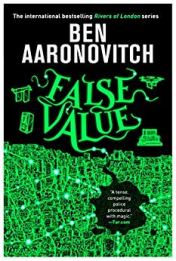 And then there’s the promise of a new Rivers of London novel at the end of February, too. Now that I’m all caught up, it’s a hardback buy for me. I can’t say too much without giving away spoilers of one kind or another. I will say that the last novel, Lies Sleeping, brought a number of plotlines to decent conclusions. And the most recent novella, The October Man, did a nice job of opening up the world beyond England. So I’m curious to see where Aaronovitch takes Peter Grant next. I’m doing my best to avoid spoilers for False Value, though I am pretty excited that this is my first Rivers of London novel to drop that I can buy on release day. It’s the little things, I suppose.
I think that’s a pretty good way to start the year. It’s nice to have books in mind like this. Beyond simply having something to read, it’s good to have the promise of interesting intellectual engagement with the bigger world.
 Yesterday marked the beginning of the second week of Advent. Different churches mark the weeks differently, some leaning into themes like hope and love but in different orders, others revisiting key moments in the biblical story. I like the approach that roots the time in expectation not just of the Christmas season but of the second coming of Christ, the event that will bring this part of the biblical story to an end.
 November started with
  The second week of November brought Taika Waititi’s latest satire to the silver screen. Jojo Rabbit is the awkwardly funny, ultimately heart-breaking story of a young boy in Nazi Germany who has a comedic version of Hitler as his imaginary best friend. The movie feels a lot like a Wes Anderson flick, as there’s something slightly magical and farcical about the proceedings. Waititi plays Hitler to much effect, which is part of what makes the experience awkward. But then, as needed, the movie turns dark and sobering. A number of well-known actors take part in the story, including Scarlet Johansson, Rebel Wilson, and Sam Rockwell. Thankfully, none of them “take you out of” the movie, which can easily happen in this kind of piece.
 The third quality movie in the month of November for me was Ford v. Ferrari starring Matt Damon and Christian Bale. Racing isn’t really my form of entertainment, but the reviews were good and the actors and director had earned my trust, so I gave it a try. It was quite brilliant, a great picture of people who are passionate about things and who don’t quite know how to navigate the world between work and people all that well. I found myself tearing up a little at odd places, moments that weren’t particularly telegraphed to evoke emotion. And when you finally get to the moments that do want to evoke something? Yeah. Beyond that, FvF is a period piece of a kind, too, one that is just out of reach for many of us. Bale, as always, is brilliant. And Damon, as is often the case, plays someone you’re not sure you should feel much sympathy for, and yet he gets it out of you yet again.
 While I was in Victoria for Thanksgiving break, I took at an afternoon to see Rian Johnson’s Knives Out at the local Odean theater. I’m so used to a certain kind of cinema seating that it’s always a little jarring to have nice seats that don’t shoot up steep like a mountainside. Still, the experience was good . . . mostly because the story is so well-told. It’s a who-dun-it story that is just enough Clue the Movie to keep it light while still treading in some heavy moments. It’s the kind of story that gives you just enough but doesn’t tell you what to do with it. Because even if you know the who, you’re still not quite sure about the dun-it. Knives Out is a great late autumn/early winter movie, as it evokes a kind of place and time that is both cozy and obviously dangerous.
 We’re a few days into the Advent season. I think maybe it’s my favorite season of the church calendar, as it’s a kind of mellow, reflective time that looks forward to something amazing breaking into history not once but twice. I also love the Scripture read throughout the season.
 While in England, we spent a couple of days in the Lake District, the stomping grounds of William Wordsworth. We spent some time at his house, Rydal Mount, and then walked the Coffin Trail down into Grasmere. We also spent some time in a little town with a big castle called Skipton. While there, I found a “Everyman’s Poetry” edition of Wordsworth’s poetry. I’ve not spent much time with Wordsworth since college (probably a survey class, maybe in my Romanticism class), so it’s been interesting to revisit some of his works. Here’s “Old Man Traveling,” the first poem from the collection, which has a nice but sobering turn at the end.
 Yesterday I made note of my favorite “King John” moment from Shakespeare’s King John. There was one other scene in the first plays first half (as presented by the Royal Shakespeare Company) that has stuck with me. In the previously mentioned scene, King John tasks Hubert with dispatching Arthur, a rival to the throne. In this scene, Arthur’s mother Constance (played wonderfully by Charlotte Randle in the RSC production), is grieving the loss of her son. Earlier in the play, Constance’s presence is played to almost comic effect, which makes this scene that much more powerful, a real picture of grief and loss. It’s the kind of scene that would shock and surprise if done for a Shakespeare presentation.
 While in Stratford over break, we had the opportunity to see the Royal Shakespeare Company’s version of King John. KJ is not that well-known a play, of course, and I can imagine that there are many reasons why. Where it shines, it burns. When it doesn’t shine, it’s dense and forgettable. The RSC made good work of the play, though, particularly the first half. They took two creative turns. First, they cast King John as a woman (played admirably by Rosie Sheehy). Second, they placed the play in what felt like a 1960s-era spy genre (think the British Avengers series). That turn was most effective in the first half of the play, where there were a number of creative flourishes (dance numbers, boxing scenes) that served as spoonfuls of sugar to help the medicine. By the beginning of the second half, that creative flourish was gone (and the overall play the lesser for it).


 Space Enough, and Time