Gideon’s “Ring”

Today’s Old Testament reading was one that caught me by surprise.  I suppose it was one of those stories that stands out some years, some readings, more than others.  After a major victory in Judges 8, this happens to Gideon:

22 Then the men of Israel said to Gideon, “Rule over us, you and your son and your grandson also, for you have saved us from the hand of Midian.”

Which should raise lots of red flags . . . for us, and for Gideon.  I guess I was surprised at how blatant-yet-predictable their request was.  This is particularly potent for its place in the biblical narrative, between Moses and David.  Gideon’s response is brilliant:

23 Gideon said to them, “I will not rule over you, and my son will not rule over you; the Lord will rule over you.”

You really want to cheer for the guy, let him know that he answered wisely.  If only that moment lasted a little longer.  Because this happened next:

24 And Gideon said to them, “Let me make a request of you: every one of you give me the earrings from his spoil.” (For they had golden earrings, because they were Ishmaelites.) 25 And they answered, “We will willingly give them.” And they spread a cloak, and every man threw in it the earrings of his spoil. 26 And the weight of the golden earrings that he requested was 1,700 shekels of gold, besides the crescent ornaments and the pendants and the purple garments worn by the kings of Midian, and besides the collars that were around the necks of their camels. 27 And Gideon made an ephod of it and put it in his city, in Ophrah. And all Israel whored after it there, and it became a snare to Gideon and to his family.28 So Midian was subdued before the people of Israel, and they raised their heads no more. And the land had rest forty years in the days of Gideon.

Argh!  It’s like a scene out of a Tolkien story: the right kind of victory followed by the subtlest and saddest of defeats!  How easy it can be to win a great victory and then get tripped up in a snare of our own making!

(Scripture from the English Standard Version)

Posted in Scripture | Leave a comment

From Non-Stop to Nothing

Today was the first chapel day of the year.  The arrival of chapel means that I’ve been through a full “cycle” of the new school week (even though we’ve only been in school four days).  So now I have a real opportunity to work on the rhythm of my week (more or less).

Over the last couple of weeks I’ve found myself working in two gears: non-stop or nothing.  Either I’ve got a lot of things to do and and trying to get things done or I am vegging out (mostly alone, sometimes with the neighbors).  It’s a bit of a whiplash thing for me, a transition that I don’t handle all that well.  Such a dynamic is one of the reasons why people occasionally speak of “third spaces,” places like a gym or a coffee shop or some other place that exists between work and home.  It’s a great concept, one that I embrace most days.  What’s interesting is that those “third spaces” can be just as lonely as the other two.  As such, there is no restorative promise attached, just distraction and a pinch of procrastination.

+ + + + + + +

So here’s to learning more about myself, how to healthily navigate the spaces and relationships that mark each day.  I would like a happy medium, where good-but-not-frantic work gets done with and in the presence of others, work that is in many ways more restorative than simply zoning out at the end of a long day.  I think that’s one way we can learn to “spur one another on to love and good deeds.”  And that doesn’t mean weaponizing or instrumentalizing those “third spaces.”  It means finding good ways to do the right kind of thing together.

Posted in Teaching | 1 Comment

Hope but “No Open Highway”

Finding and SeekingBeyond the Bible, my most faithful summer traveling companion was the writings of Anglican theological Oliver O’Donovan.  I made relatively quick work of his Self, World, and Time back in June.  When I left the island, I took the second volume of O’Donovan’s “Ethics as Theology” series, Finding and Seeking.  While it’s basically twice as kong as SWT, it’s taken me a lot longer to get through.  That’s not a bad thing, though.  It’s quite the encouraging read.  His style is a little odd to me.  There’s something truly down-to-earth about his approach  . . . and yet it feels totally abstracted.  And while it’s clear that O’Donovan knows what he’s doing and where he’s going, he moves forward page-to-page without recapitulating much, which would be nice even if it isn’t his style.

I recently got to the chapter on hope and anticipation (O’Donovan sees “Christian” ethics as tied closely to faith, love, and hope . . . in that order . . . which is both predictable and not).  I quite liked this passage:

Hope may, and often must, look through a different window.  It has its independent ground, not formed from anticipations, not even from the most probable or universally proven ones, let alone the most far-reaching and ambitious.  The resurrection of Jesus from the dead authorizes hope, validates promise, points to the future of God’s kingdom. That does not mean it sets a trend which history will always thereafter follow.  Since the resurrection, we are told, “your life is hid with Christ in God” (Col. 3:3).  The path that leads from the empty tomb to the parousia is no open highway.  There are signs to be seen and wonders to strengthen hope: in the church, the Eucharist, faith in the Gospel, in a multitude of good works, some confessionally, some unconfessionally accomplished.  We may catch sight of the hand of the God whose kingdom is promised on earth as it is in heaven.  But future history is not a joined-up narrative, and the revelation of the kingdom is not the culmination of a process we can hustle along its way.

One thing I like about the quote, the last part in particular, is that it reminds us that the contours of this part of the narrative of God’s story are in no way as predictable as we might like or assume.  The arc of history is long, but it bends this way and that as we await the culmination of the kingdom.

I also like the image of “no open highway,” not because it’s kind of sad but because it’s very true.  And its something that Jamie Smith mentioned to great effect at Laity Lodge in July (and that I will debrief here sometime soon).  It is much like the road from Sinai to the Jordan, truly the way of salvation and to rest while also being difficult and, for some, defeating.

(image from livingchurch.org)

Posted in Books, Faith, Travel | Leave a comment

Ain’t No Mountain High Enough?

MountainsWhen I returned to campus last week to start things off with faculty formation and prep, one thought came to mind and came to mind quickly: the mountain wasn’t high enough.  The mountain, of course, was the summer vacation that took me from Hawaii to Texas to Tennessee, Kentucky, Tulsa, Wichita, and Seattle.  The mountain was a retreat and time with family and with friends (some rarely seen but always loved).  The mountain was reading and praying and walking and sweet tea and Sonic.  The mountain was good.  But when I walked onto campus, the time on the mountain wasn’t long enough.
+ + + + + + +

Today was the first day back with students.  The last week was spent mostly leading out and organizing and wondering where-in-the-world some of my classroom trinkets had gotten to after the summer deep clean.  But even today I thought of the mountain and the many things that I have mentally connected to it.

+ + + + + + +

Each year at school we start things off with three mornings of worship and edification.  I started my time of sharing (thanks to my extended vocational stretch) by asking the audience to think of their favorite summer moment.  Then I mentioned this thought from C. S. Lewis’s Out of the Silent Planet:

A pleasure is full grown only when it is remembered. You are speaking, Hmán, as if pleasure were one thing and the memory another. It is all one thing.

My time on the mountain, the long or short of it, wasn’t as over as one might think.  Memory is part of it, an odd extension that brings the moment just one bit closer to completion (without ever really making it on this side of the story’s end).  I hope the audience was encouraged.  I know that I was, which is why I am always grateful for the thoughts of Lewis.

+ + + + + + +

I carry around my little Laity Lodge notebook with me each day.  I don’t always look at it, but my “cleaned up” copy of notes serves as a nice reminder of what I learned and what can be done next.  One of those things is Alan Jacobs’s assertion about the danger of solutionism, the idea that we have bought into a quick and easy solution for everything (because “there’s an app for that”).  Jamie Smith connected the misdirection of solutions with the idea of disenchantment, the idea that the contemporary world has been flattened to the point that only something like the mechanical exists, leaving no room for the mysterious or the magical.  That might be more true than we’d care to admit.  And that’s a frightening thought, especially when we realize how easily and consistently we have simply instrumentalized the Gospel.

+ + + + + + +

All of this to say that my  mind has been thinking about mountains and valleys and rivers and such a lot more than usual.  This has been aided and abetted by the Old Testament readings from the Daily Office, which have recently moved from Sinai to the desert to the Jordan and the Promised Land.  It’s gotten my thinking figuratively, which I haven’t done in quite a while, gotten me sketching diagrams in notebooks trying to find a flow that makes sense of the present moment without disservicing the Scripture.  It might not make it into chapel, but there’s a good chance that some of that thinking will make its way here.

(image from pexels.com)

Posted in Books, Faith, Teaching, Travel | Leave a comment

The Beauty of Summer Reading

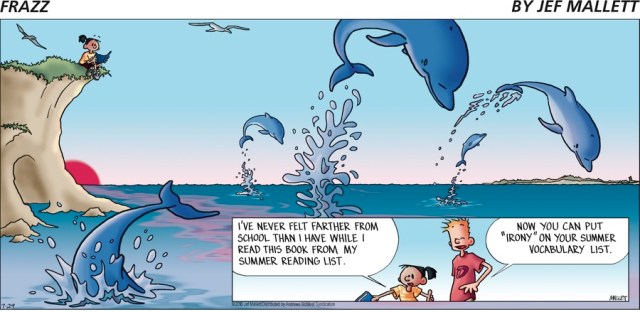
The summer started strong for me reading-wise.  Things have kind of slowed down.  I’m halfway through a re-read of C. S. Lewis’s That Hideous Strength.  I’m almost done with the second book in O’Donovan’s Ethics as Theology series.  Both are, in a way, like the book mentioned in this recent Sunday Frazz strip.

Frazz Summer Reading(image from gocomics.com)

Posted in Books | Leave a comment

Unstuck

The music is wonderful.  The framing, though, of the porch and the house is oddly picturesque.  It’s a nice blend of things, particularly since it’s a great U2 song in general.

Posted in Music | Tagged | Leave a comment

Measuring the Fallout

FalloutIt’s been a week of getting back to work, which has been good.  But it also marks that transition from summer to fall (even though summer isn’t over for a while yet).  That’s just how the calendars we live by often overlap, I suppose.  And with that comes the ins and outs of the summer movie season.  It started early with Avengers: Infinity War.  It’s limped along, really, with a few enjoyable movies that just didn’t “catch fire” like summer movies in the past.  Which makes this weekend’s Mission Impossible: Fallout something like the last cinematic fling for the summer . . . and it works amazingly well.

I opted for an IMAX showing of the movie (mainly since it was the first showing of the night and tomorrow’s a school day).  A number of scenes were shot for IMAX, though.  For the first time, I really noticed a difference with those scenes.  Things go full-screen.  The action goes full-force.  And your heart starts to pound a little more than it did just one cut prior.  McQuarrie does an amazing job directing some incredible action sequences.  Lots of sky shots that seem utterly impossible.  Which is fitting.

Something about an action flick like Mission Impossible feels like a dozen heist movies packed into one.  The planning and possibilities that the characters deal with keep you guessing.  And while trying to figure things out is part of the fun, it’s more fun to see things actually fall apart/fall in place.  And that happens a number of times in this movie.  Just when you think you’ve seen enough car chases or motorcycle chases, you find yourself totally sucked into one more.

Mission Impossible: Fallout is easily the most enjoyable, roller-coaster ride of a movie since Infinity War.  It’s worth the big screen.  It’s good to go to the movies and be amazed at every little thing: the acting, the locations, the tricks, the humor, and the action.  Highly recommended.

(image from heroichollywood.com)

Posted in Movies | Leave a comment

Crashing Again (or Staircase Serenade)

Maybe someone should start a blog recording every time someone records U2 performing “Every Breaking Wave.”  It’s a great song that captures something vital about the human experience that showcases the musical and vocal talents of the band well.  And this recent rendition was shot on the front porch of a house.  Turn up the volume and press play.

I’m a little bummed for the short/video posts so far this week.  Today was the first official day back at school, which means yesterday was the first unofficial full day back at school.  So the days have been packed . . . and probably will be until I get home from Mission Impossible: Fallout Thursday night.  But more on work and fun later.

Posted in Music | Tagged | Leave a comment

Pieces of Glass

There’s a part of me that’s excited to see this and another part of me that simply wants to know as little as possible about the story that’s being told.  But that’s the way it always is for me when M. Night Shyamalan has a new movie releasing.  The ending of Split was probably one of my favorite movie surprises of the last few years (and by probably, I mean definitely).  Such a nice surprise.  So here’s the first official trailer for Glass, which brings the worlds of Unbreakable and Split together completely.  The trailer says a lot, but I’m just not sure how it all fits together.

Yeah.  May not watch it again . . . and definitely will try and stay away from comments and fan theories.  But definitely cool to see some shots of some long boxes.

Posted in Movies | Tagged | Leave a comment

Rest and Reset in a Culture of Constant Content

resetting clockOne of the interesting aspects of my two weeks of mainland travel was a lack of internet access for two different chunks of time. While I was at Laity Lodge, I had nothing.  While traveling beyond Tennessee, I had phone access but no real iPad wifi access.  Beyond that, I decided before traveling that I wasn’t going to carry an external keyboard or laptop while traveling.  So while it wasn’t a total unplug, there were some real moments of a kind of freedom from deeply embedded online practices.

Just over a week beyond Laity Lodge, speaker Alan Jacobs posted some interesting thoughts on his role as a writer/thinker and a sense of meaninglessness that had befallen him in light of his work (most recently with the book How to Think and then next month with The Year of Our Lord 1943).  It had even gotten to the point that he had decided against writing a third book in line with How to Think and an earlier book on reading for pleasure.  For some time now, Jacobs has (publicly) processed multiple attempts at making sense of the digital behemoth, often leaving and returning to Twitter or going back and forth between “dumb” phone and “smart” phone.  And while little was said of that at the retreat, it was interesting to see it appear again in his online work.  From the original post’s conclusion:

There has been one significant consequence of all these moves, and I find it an interesting one. Curiously, though in a way logically, my escape from Twitter’s endless cycles of intermittent reinforcement and its semi-regular tsunamis has made me significantly calmer about my own future as a writer, in large part because it has re-set my mental clock. I have always told myself that I have time to think about what, if anything, I want to write next, but I haven’t really believed it, and I think that’s been due to my immersion in the time-frame of Twitter and other social media. Now that I’ve climbed out of that medium, I can give not merely notional but real assent to the truth that I have time, plenty of time, to think through what I might want to say.

It was Douglas Coupland who first introduced me to the idea of “an accelerated culture” via Generation X.  That’s been a common complaint for each successive generation, and yet perhaps more pertinent for ours than for many that have gone before us.  Jacobs sees that in his own life with “Twitter and other social media.”  (There was one point during the retreat where some gentleman’s name was mentioned that no one seemed to know.  But we knew well his “invention,” the “pull down to refresh” option on phones.  Upon the revelation, I nodded and laughed uncomfortably).  That is, of course, the downside to our culture of constant content.

As I reflect on the ideas of rest and “resetting mental clocks,” I think that such a “resetting” involves more than just our “accelerated” culture, though that is the one that many of us are most prone to fall prey to.  As I traveled, I often found myself at the whim of whatever time-trapped culture I was in.  Whether a culture of leisure or of labor, fast or slow, finding the footing to establish and maintain a good and healthy rhythm can seem impossible.  That was part of my hope for this summer.  For the last year, I had lived a kind of rhythm that could work in the short-term but not in the long.  Now I’m on the edge of repeating that rhythm.  And I’m wondering if I’ve done the work necessary to circumvent the worst parts of that rhythm.  Because here’s the thing: no one is going to do that work for you.  Or if those people exist, they are rare and likely have little say in the rhythms of your life.

You can read all of the Alan Jacobs post here.

(image from credit.com)

Posted in Books, Internet, Teaching | Leave a comment