Sherlock and the Posthumous Game (or There’s Something About Mary)

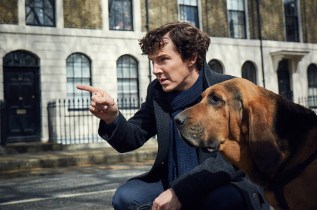
sherlock-bloodhoundLast night saw the premiere of the fourth (and many assume final) series of Sherlock on Masterpiece Mystery.  Perhaps its a repeat of my thoughts on Doctor Who‘s Christmas special, where absence has made the heart grow fonder.  I can’t help but admit, though, that I really enjoyed “The Six Thatchers.”

The Title Mystery.  It took a while for the title’s meaning to work for me.  And while it’s sort of unfortunate that the mystery involved a main member of the cast (always tricky when there are so many other stories to tell), it was enough to keep me guessing.  And while the mystery ultimately transcended Mary, she was its ultimate victim,

The Return of the Tech.  Part of what made the initial premise of Sherlock so interesting was the idea of a detective immersed in the modern world of blogs and tweets and information-on-demand.  While that theme might have always been there, it was once again a pronounced part of the storytelling.  And, for the most part, it worked.  I didn’t totally buy into Sherlock’s use of it as the episode opened, but then things evened out.  I always like the text message overlay, which “The Six Thatchers” used quite well.

Lady Mary.  As good as it was seeing Cumberbatch and Freeman back in the game, Amanda Abbington’s Mary was the real acting high-point for the episode.  She played it so well, the fine line between loving present and violent past.  I quite liked her scene on the airplane and even, yes, at the episode’s end.  It’s a shame that we didn’t see more of Mary on the job.  She plays others well.

Pulling at the Loose Threads.  This episode also reminded us that the show’s main three might work like a well-oiled machine but that they also have nuance and weaknesses.  I particularly liked the scene between Sherlock and Mrs. Hudson when he confessed his arrogance and gave her the power to keep him in check.  It was painful seeing Watson’s dalliance throughout the episode.  I imagine his “you made a vow” cry at the end was as self-directed as anything Sherlock did or did not do.  The question of Moriarty still hangs over the show.  I like how Mary subverted Moriarty’s “miss me.”  Nice touch of self-awareness for the show.  I still imagine that Moffatt and friends have a deeper story to tell.  I’m just not sure that Moriarty is the crux of it.

Here’s the trailer for next week’s episode.  Toby Jones plays villains brilliantly, so I expect to be at least a little creeped out.

(image from metro.co.uk)

Posted in Internet, Television | Tagged | Leave a comment

Checking the Settings

settings_logoYesterday Michael Dougherty of The Week tweeted what I am assuming is his version of a “new year’s resolution,” and I like it a lot.

Process setting. System setting. Ritual setting.

Not goal setting.

Don’t get me wrong.  I have some goals that I’m working on finalizing.  But I like his approach to process, systems, and rituals.  It’s a good echo of Smith and You Are What You Love.

I think a lot of us spent a large amount of 2016 realizing that our settings were off.  Maybe not all of them, maybe not by much, but at least enough to reconsider how to go about moving through the year 2017.  One some level, the process-system-ritual distinction almost feels redundant.  Process, though, is how you do a particular thing.  Example: this is how I make this particular decision.  System, on the other hand, is how your collection of processes work together (or don’t work together, even).  System implies a certain kind of checks-and-balances that keeps total equilibrium in mind.  Ritual feels a little different, the third but ancient jewel in the beautiful ring.  Ritual speaks of action rooted in something deeper, more significant, than  process and system.  Perhaps it even points to greater purpose.

(image from TheConTech.com)

Posted in Internet, The Long Story | Leave a comment

Don’t Get Captured

chainsThis morning’s routine was thrown out of whack because of the holiday.  God bless the good folks at Zippy’s for putting up with people like me early each Sunday.  Instead, I had a quick breakfast at Starbucks before heading to church.

I spent some time writing and thinking about the new year.  I was greatly encouraged by the Epistle reading from the daily office.  From Colossians 2 (ESV):

Therefore, as you received Christ Jesus the Lord, so walk in him, rooted and built up in him and established in the faith, just as you were taught, abounding in thanksgiving.

See to it that no one takes you captive by philosophy and empty deceit, according to human tradition, according to the elemental spirits[a] of the world, and not according to Christ. For in him the whole fullness of deity dwells bodily, and you have been filled in him, who is the head of all rule and authority.  In him also you were circumcised with a circumcision made without hands, by putting off the body of the flesh, by the circumcision of Christ, having been buried with him in baptism, in which you were also raised with him through faith in the powerful working of God, who raised him from the dead.

This passage is, of course, Christmas-y, and points to the incarnation (“for in him the whole fullness of deity swells bodily).  It also points to a fifth-act reality for the Christian: that we “have been filled in him,” which is an odd phrase that the NIV renders “and in Christ you have been brought to fullness,” which reads a little easier.  Along with that, we who have received Him are to “walk in him,” should be “rooted and built up in him and established in the faith.”  “Rooted” and “built up” are two good images to start the new year and to keep in mind during Christmastide.  Paul encouraged the Colossian Christians to do this “as [they] were taught” all the while “abounding in thanksgiving.”

A fifth act life is one of avoiding capture from philosophies and ideas not rooted in the truth of Jesus.  For those on the outside, this might look like a command to ignorance, which isn’t true at all.  It doesn’t mean we cease seeking understanding or stop pursuing engagement with those who think differently.  It does mean, I think, that Christians start with what (and Who) they know.

(image from WFUV.org)

Posted in Faith, Life in the Fifth Act, Scripture | Leave a comment

The Last of 2016

wootton-majorAnd so ends a year that our culture has anthropomorphized for the last couple of months.  Thought I’d end a year in posts with something other than a “best-of” list (though I would like to get around to that at some point).  So here’s my list of “last things” for the year.

Last Novel.  I didn’t read as much fiction as I’d planned in 2016.  The last novel I read this year took me longer than I had expected (not because it was a long novel, mind you).  Francis Spufford’s Golden Hill, released earlier this year in England and later next year in America, tells the story of a mysterious man who shows up in early New York with a bank note beyond the means of many.  The novel takes so many wonderful twists (wonderful might not be the best word) that makes the story utterly unpredictable (to the very end) and also a great Christmas read.

Last Book of Non-Fiction.  I finished Anthony Esolen’s Ten Ways to Destroy the Imagination of Your Child just minutes before landing in Honolulu today.  For a book about the humanities, it sure did make me feel a little guilty and a little sad.  I’ll get more into the book later (and I also mentioned it a couple of days ago).  It’s a great read, one that serves as a reminder of what feels like a long-lost era, even though it was only a handful of years ago.

Last TV Show- Cable.  “The Return of Doctor Mysterio,” which I wrote about here.

Last TV Show- Network.  The season finale and reunion show for this fall’s Survivor: Millennials vs. Generation X, which I wrote about here.

Last Short Story.  Thanks to Anthony Esolen, I finally got around to reading J. R. R. Tolkien’s “Smith of Wootton.”  It reads like a nice companion piece to “Leaf by Niggle,” taking a more magical, faery-like approach to looking at gains and losses and the nature of the world.  Definitely something worth reading once a year.

Last 2016 Movie.  On the final leg of my flight back to Honolulu today, the plane had a full array of movie options.  I tried watching the reboot of Ghostbusters, but stopped about 30 minutes in.  Not a horrible movie; just not something with a real hook for me.  Thanks to the time-period of Golden Hill, I decided to watch Love and Friendship.  It played in Honolulu for a few weeks and had great reviews.  I just didn’t make the time for it.  The movie is an adaptation of a Jane Austen short story.  The most notable cast member was Kate Beckinsale, who played her part perfectly.  Some strange editing choices, but the great one-liners more than make up for any narrative rough spots.

Posted in Books, Movies, Television, Travel | Leave a comment

“The Land of My Sojourn”

At the final Behold the Lamb of God concert this Christmas season, Andrew Peterson added Rich Mullins’ “Land of My Sojourn” to his set list.  It’s the final song on Mullins’ masterpiece, A Liturgy, A Legacy, and a Ragamuffin Band.  Jill Phillips is signing back-up.  It’s worth watching (and then revisiting its source material).

Posted in Faith, Music, Travel | Leave a comment

Time and Voice

cicero-411I have some friends expecting their first child in April.  For Christmas, I bought them a copy of Anthony Esolen’s Ten Ways to Destroy the Imagination of Your Child.  I was so intrigued by the premise that I bought myself a copy.  It reads like The Screwtape Letters for teachers with a bent toward the humanities.  Full of wonderful (and often convicting) quotes from literature of significance, Esolen always finds a way to “turn things” against the wisdom of history to show us how much we are losing as our culture continues to stagnate.
And so the best of literature and history has been on my mind these last few days, which made reading a recent post by Carl Trueman at First Things particularly poignant (particularly when paired with the year we’ve had and the year we’re about to embark on whether we want to or not).  In “Ciceronian Times Call for Ciceronian Voices,” Trueman makes an argument for his own perspective on writing by thinking about one of his heroes: Cicero.

Learned, well-read, a philosopher, an orator, a lawyer (well, nobody’s perfect), and a politician, [Cicero] was the very epitome of the truly engaged thinker, the intellectual man of action. And he was the preeminent dissenting voice as Rome dramatically changed from a republic to an empire, a change in which Cicero himself was eventually a casualty.

And it is from that particular point in history that Trueman sees a parallel of our times (just as we often find parallels in the times of writers and thinkers like Augustine or David Foster Wallace, really).  Trueman continues:

That change from republic to empire was traumatic and transformed Rome (and thereby the West) forever. And it is arguable that a similar thing is happening today. Our republic, and the philosophies and social realities upon which it was built and by which it has been sustained, are giving way to an empire, an empire of desire. Whether one agrees (as I have come to do) with the arguments of thinkers like Patrick Deneen and Michael Hanby, who see the origins of our current situation in the very origins and ambitions of the American experiment, or whether one sees our current society as a disastrous malfunction of the same, there is surely consensus on the fact that things are changing in fundamental and permanent ways. Liberalism is in trouble, as is the republic built upon it. The empire of desire, of which both expressive individualism and populism are symptoms, looks set to triumph. A chaotic and unsustainable triumph, no doubt, but a triumph nonetheless.

Which is where Trueman hopes his voice can come to play.

Ciceronian times require Ciceronian voices: Thoughtful, learned, literate, historically and philosophically astute, cultured in the true sense of the word, and engaged in the public square. To address the present we surely need to avoid the clichéd pieties of political correctness that serve only to bolster special interests. But we must also resist the simplistic populist rhetoric of reaction. We have to address the present by drawing on the history and culture of our past. And we must do so in a public way that calls out those who abuse their power while giving good arguments to those who wish to work for a deeper, greater good than the myopic vision offered by the regnant gospel of immediate gratification.

As I have read through Esolen’s Ten Ways, I have found myself saddened by the acknowledgement that much of what Trueman hopes for might be beyond the scope of the current moment.  I am hopeful, mind you, but I also know that the losses that have made our current situation a reality run deeper than we think.  To be “thoughtful, learned, literate” and all of the other good qualities in Trueman’s list might make one irrelevant in a world that rejects the presuppositions such a voice needs for real reception and consideration.

I am hopeful, though.  And over the next week or two (particularly once I work through those reflections on habit that I mentioned a couple of days ago), I hope to try and articulate my own thoughts on the current moment.

You can read the rest of Trueman’s post here.

(image from foreignaffairs.com)

Posted in Books, Faith, Teaching | Leave a comment

“No Hard Feelings”

After a couple of days staying around home, I’ve spent the last couple of days catching up with friends down the road, down interstate, and one state up.  I’ve been driving a rental without USB hook-up, so I’ve had to scramble for old CDs.  I also finally got around to getting True Sadness, the latest from the Avett Brothers.  I haven’t gotten through the whole album yet, but I have listened to a few tracks a number of times.  That includes “No Hard Feelings,” a song that strikes some powerful notes about life and the living of it.  Here’s a clip of the band performing the songs earlier this year at Red Rocks in Colorado.

The song does what great songs to best: it weaves a good tapestry that catches a solid collection of emotions and experiences even as it catches you by surprise.

Posted in Faith, Music | Tagged | Leave a comment

2016 and Questions of Habit, Routine, and Ritual

I suppose the book that most shaped 2016 for me was James K. A. Smith’s You Are What You Love.  The book, which dropped in the spring, was a recapitulation of Smith’s earlier work on “cultural liturgies” with more practical observations and illustrations thrown in.  It was the book I gave away most often.  I used videos based on/centered on the book’s view of habit, routine, and ritual in meetings that I led with co-workers.  I got to be a part of a small group-talk on the book.  It continues to regularly show up in conversations and planning.  Here’s a clip from Smith talking through just one aspect of his thinking (though not from this year).

Questioning habit and routine and ritual is, in a way, like questioning the Matrix.  You know it’s all around you.  You can tell some kind of programming is going on, even though you cannot totally put your finger on it.  But once you know, you can start some kind of counter-programming.  And with that can come a sense of purpose and freedom (both from and for).

Over the next few days, probably even a day or two into 2017, I’m going to think through the issues of habit, routine, and ritual one more time, this time using another book and a handful of online articles.  The concepts in You Are What You Love aren’t the kind that should get wiped off the slate with the drop of the new year’s ball.  Instead, they are a reminder to think through and fight a deeper and better struggle, one that ultimately transcends the year that you’re in.

Posted in Books, Faith, Teaching | Tagged , , | Leave a comment

Advent’s End, Christmas Eve

mary-and-josephStanley Hauerwas is a theologian who really challenged my thinking this year.  While I find myself disagreeing with some of his conclusions and assertions, I find that he often has a way of pointing to particularly good but hard truths for those trying to live with faithful Christian presence.  His recent thoughts on Christmas in light of the reality of Mary and Joseph is a great example of this.  While reflecting on conservatism and liberalism with Mary as a point of contention in ideologies:

Mary and Joseph are not ideas. They are real people who made decisions on which our faith depends. Christianity is not a timeless set of ideas. Christianity is not some ideal toward which we ought always to strive even though the ideal is out of reach. Christianity is not a series of slogans that sum up our beliefs. Slogans such as “justification by grace through faith” can be useful if you do not forget it is a slogan. But Christianity cannot be so easily “summed up” even by the best of slogans or ideas. It cannot be summed up because our faith depends on a young Jewish mother called Mary.

Mary and Joseph are real people who had to make decisions that determined the destiny of the world. Isaiah had foretold that a Mary would come, but we had no idea what Isaiah’s prophecy meant until Mary became the Mother of God. This is no myth. These are people caught up in God’s care of his people through the faithfulness of the most unlikely people. They are unlikely people with names as common as Mary and Joseph, but because of their faithfulness our salvation now depends on acknowledging those names.

Advent is a time the church has given us in the hope we can learn to wait. To learn to wait is to learn how to recognize we are creatures of time. Time is a gift and a threat. Time is a gift and a threat because we are bodily creatures. We only come into existence through the bodies of others, but that very body destines us to death. We must be born and we must die. Birth and death are the brass tacks of life that make possible and necessary the storied character of our lives. It is never a question whether our lives will be storied, but the only question is which stories will determine our living in and through time.

Stories come in all shape and sizes. Some are quite short, such as the story of a young Texan trying to figure out what it means to believe or not believe in the virgin birth. Other stories are quite long, beginning with “In the beginning.” We are storied by many stories, which is an indication that we cannot escape nor should we want to escape being captured in and by time.

I particularly like Hauerwas’s connection of the biblical story to time, something that has come up a lot this last half of the year (like with Ephraim Radner’s book on mortality).

From there, Hauerwas connects his thinking to that of Charles Taylor, whose tome A Secular Age has been quite influential over the last few years (and “popularized” by the work of James K. A. Smith).

It’s a good piece to end this season of Advent.  It answers some questions while begging others, which is good and fine.  You can read the rest of the article here.

(image from biblestudytools.com)

Posted in Books, Faith | Tagged | Leave a comment

Christmas, Mortality, and More

One of the best books I read this year was Ephraim Radner’s A Time to Keep.  I hope to reflect on it in this space at the beginning of the new year.  Regardless, the book came to mind when reading the Christmas thoughts of Carl R. Trueman over at First Things a few days ago (as both have significant things to say about mortality and the Christian faith).  In his post, gleefully titled “A Merry Pascalian Christmas,” Trueman brings Blaise Pascal’s view of things to bear on contemporary culture, particularly in how we view our bodies and the fact of their frailty.

Above all Christian thinkers, Pascal anticipated and critiqued the spirit of our present age. With his notions of distraction and diversion, he saw both the luxury and the bureaucratic complexity of the French court of his day as driven by a deep psychological need: the desire to avoid facing the reality of mortality. Thus, the French king, who could surely have spent all day merely contemplating his own glory, actually spends every day in busy-ness or occupied with trivial entertainment, for anything is preferable to solitude. Solitude is the context in which our minds move forward to think about our impending deaths.

Death, of course, is not something anyone likes to talk about, even within the horizon of the Christian faith.  Contemporary politics of the body, Trueman asserts, are also made to lead us to believe that our bodies have no final say in things.

If we can pretend that our bodies are of only very subordinate or incidental significance to who we are, then we can pretend that we may ultimately beat their authority. Pascal would no doubt see the psychological turn in our culture as an obvious one: It combines both the therapeutic needs that are met by entertainment and the repudiation of the significance of our bodies.

Yet death is unavoidable and so, when it makes its inevitable appearance, it must be rationalized. This is especially striking with regard to the Immortals of our own day, the celebrities, those High Priests of distraction who serve the most important function of all.

No matter what we declare ourselves to be (or how we view the celebrities around us), though, we can’t get around our mortality.

The metaphysical assumptions of the present age, so perfectly articulated in . . . phrases [like] “You can be whatever you want to be” . . .  are anti-Incarnational at the deepest level. And they are flatly contradicted by our own mortality. Our bodies will have the final word on who we are. No view of reality that denies or marginalizes death can help us to live. That is why Christianity is so important. As Christianity claims, death is overcome not by our pretending it is not there but by God’s going through it. The last temptation of Christ—“If you are the king of the Jews, come down from the cross!”—had to be resisted in favor of the second thief’s prayer, “Lord, remember me when you come into your kingdom!” Christ really had to die that human beings might truly live.

That is why, Trueman suggests, the Incarnation of Jesus and all that it entails for humanity is so significant (and with it, Christmas).  Trueman concludes:

Perhaps the irony of Christmas is that, in its current form, it has become one of the focal points of the culture of distraction, which Pascal so ably critiqued. It is all about consumption, which is just another form of distraction and diversion. It gives us a baby Jesus, helpless and conveniently trapped in a manger, a Christ who is just one more manageable commodity. Ironically, the real message of Christmas is the exact opposite: not to distract us from death but to point us toward death, and then its destruction in Christ. Were death not a reality, Christmas would not be necessary.

The article is a great reflection on the season, particularly as Advent comes to a close and we enter the season of Christmas.  You can read the whole thing here.  Any little thing that can help us remember not just “the reason for the season” but the part that the season plays in the greater story is worth the effort.

Posted in Books, Faith | Tagged | Leave a comment