
A recording of Andrew Peterson performing one of Rich Mullins’ best as part of a soundcheck.
Currently Reading:

Flickr Photos
A recording of Andrew Peterson performing one of Rich Mullins’ best as part of a soundcheck.
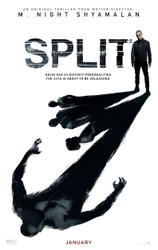 Make no mistake: M. Night Shyamalan’s Split is going to frustrate people on a number of levels (one particular level that I cannot get into here for about another week). The movie’s subject matter is tricky and disturbing (perhaps in a way not seen since some of his earliest work). The script balances converging storylines well (as there are at least three) without feeling bloated. The movie is wonderfully shot, still Shyamalan but without the long cuts. The acting is superb. James McAvoy is brilliant in his ability to change character on a dime. Anya Taylor-Joy, who plays the movie’s female lead, does so much while saying so little. The story is full of palpable tension, which is really what Shyamalan does best (which is why he has always been more suspense than horror to me). Little details unfold in subtle ways. Particular moments in the movie’s climax that could easily derail the story and take the viewer out of the flow were well-managed. And what’s best is that it’s a story that doesn’t need a twist ending.
Whatever else the movie is, it is the kind of movie that I would love to talk to others about. The question of the nature of humanity is front and center in a way that is pertinent to contemporary conversations about the self. It will be interesting to see how Shyamalan defends the movie to its critics, those who find the subject matter offensive or insensitive (regardless of any storytelling intent). If this movie had been made five or ten years ago, the clamor would be less. It’s a testament, particularly in light of the movie’s final scene, to how much culture has changed.
I saw an early showing of the movie. I was surprised at how full the theater ended up being. I was a little worried because the crowd was of the talking kind. As the movie moved past the first scenes (mostly seen in the trailer), the audience quieted and focused. And while one person behind me was asleep in the movie’s final third, the rest of the audience seemed either riveted (lulled by the movie’s uncomfortable sense of humor) or respectful (of the movie’s tense and unsettling conclusion).
To say that the movie ended in a way that I did not see coming would be an understatement. Oh, that final shot! It was the first time in a good while that I left the theater with a genuine smile on my face and some (particular) music in my heart, which probably seems odd considering the subject matter. But for those who trust Shyamalan and understand genre, the smile and the song might be understandable.
Speaking of repartee, that was one aspect of Sherlock that was always fun to watch, particularly when the show hit its comfortable, comedic stride in series three. Here’s Martin Freeman reflecting on that dynamic.
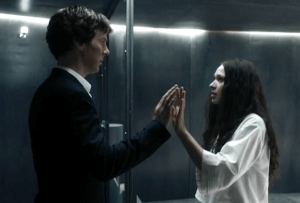 Series four of Masterpiece’s Sherlock came to an end Sunday night. I must admit to having seen it twice now: first on TV and then second tonight at the theater. I’m happy to say that they episode held up well. I am often put off by overly psychological episodes for mysteries (which I feared to be the case last week, too). I’m also not a huge fan of “you have a forgotten sibling” stories (Cobalt Blue, anyone?). Back stories are often tricky, too, particularly when a show has been around for a while.
Perhaps the episode worked so well because of Sian Brooke’s Eurus Holmes. She took the creepiness bar set by Toby Jones to a different level this week. And while her story invoked Moriarty, his presence did not overshadow hers. The episode also worked because it was strung together well and almost relentless in moving forward. The ethical issues set by Eurus were basic but well-played (and also helped us contrast Mycroft and Watson one last time). The scene with Molly Hooper was tragic, of course, with one of the most genuinely emotional parts of the story. The humorous moments with Lestrade and Mrs. Hudson were nice, too.
In fact, it was Lestrade’s comment at the episode’s end, that Sherlock was a good man, that most summed up the episode and series, really. Which is interesting because Moffat’s Doctor (Who) spent at least an entire series asking that question of himself. That was where the character needed to grow in understanding the most, I suppose. This series and this particular episode reflected this through his commitment and sense of responsibility towards others (both friends and family).
Which is another reason to believe that this episode could be the series’ “final bow.” When asked about the show’s end by Deadline (referenced in this article at comicbook.com), Stephen Moffat and Mark Gatiss had this to say (Moffat first):
“If this is the last time — and I’m not planning on it to be, but it might be — it is possible that we could end it. . . We couldn’t have ended it on any of the previous series because there was what have been great cliffhangers.”
(and then Gatiss):
“It may be the final problem, you never know. I think what has actually happened is we have now done the story of how the Sherlock Holmes and Doctor Watson that you’ve always known became those men. It’s actually a backstory and we never intended it to be, but the reason to leave it at that place is that actually if we do come back — and we’d love to come back — then we could have it absolutely start with a knock on the door and Sherlock saying, ‘Do you want to come out and play?’”
Time will tell many things of course, particularly if the show will ever return and how well or poorly it will age. It is definitely the product of a particular place in time. But if the show’s success tells us anything, time is something these characters, actors, and creators can easily transcend.
(image from tvline.com)
One of my other favorite tracks from the most recent Avett Brothers’ most recent project is its title track, “True Sadness.” The cut on the album is a good deal more maudlin than the performance below for 89.3, the Current. Even still (and maybe more so), it’s another song that catches something vital about the human experience, one along the lines of the reminder that at any given moment, all of us are fighting a battle “Peel back a few layers and you will find” isn’t exactly a warning, but it is definitely something worth heeding.
The most improved show this season, hands down, is DC’s Legends of Tomorrow. They changed some of the cast, redirected the plot, and embraced some snappier dialogue. Now they are moving the show to Tuesdays after The Flash, which will be interesting. Here’s the extended trailer for its return episode on the 24th.
Last night’s Agents of SHIELD made the move from supernatural thriller (with Ghost Rider) to technological apocalypse (with the concept of the Life Model Decoy). As many critics have noticed, it was an almost-seamless transition, which is a good thing. Last season, I felt like the first half was full of great set-up and tension that wasn’t resolved as well as I’d hoped in the second half. And while the Ghost Rider storylines was decent (quite well-done for a supernatural/comic book story on TV), I’m hoping that this season’s back-half picks up the pace and pushes things forward. Here’s the trailer for next Tuesday’s episode.
A number of long-term plot threads are moving forward well. That includes the Inhumans thread, which hasn’t paid off as well as I’d hoped. Maybe the revelations about the new SHIELD director will move things forward there.
We’re still a couple of weeks away from the return of the DC television universe. There’s not been much on network TV beyond two episodes of Sherlock and tonight’s return of Marvel’s Agents of SHIELD. Here’s the latest trailer for the next episode of The Flash, “Borrowing Problems from the Future.”
The CW recently renewed all of its super-hero shows, which means we’ll get a fourth season of Barry and friends. I’m hoping that this will help them build some long through-lines that can go beyond the norm. That also means at least one more major crossover with the other shows, hopefully. They also recently announced a “musical” crossover with Supergirl, since the principals on both shows have musical chops (as seen years ago on Glee). Plus we’ll be getting a return of Grodd, which means a trip back to Earth-2.
The second half of this season can’t get here fast enough, I think.
I was afraid that this Sunday’s second episode of Sherlock was going to suffer from being too interior, too cerebral. It happens every now and then (particularly with Doctor Who, really), an episode where nothing much happens that isn’t all mind games. I can’t help but think of the “Hounds of Baskerville” episode from 2012. Too much depended on the psychological for me to really enjoy things.
But “The Lying Detective” came through in a way that moved things forward (and thus to their end) quite well. I was surprised to see Mary being there, but that was fine. It added a nice touch along with a reminder that grief can be a long process.
Here’s the trailer for the final episode of the fourth series, what could be the final episode for Sherlock for a long, long time.
I do feel like this series has been a kind of abbreviated “greatest hits” album of a run. The stories have been intricate. The principal character work has been phenomenal. The cast beyond the main three has been just present enough. So it will be interesting to see how everything weaves together . . . particularly as many members of the crew think that “The Final Problem” is their best episode ever.
One of the more fun and upbeat tracks of the Avett Brothers’ True Sadness is “Smithsonian.” It feels a little slower in this live performance last year in Nashville, but it still shows energetic artistry that is always good to see.


 Space Enough, and Time