
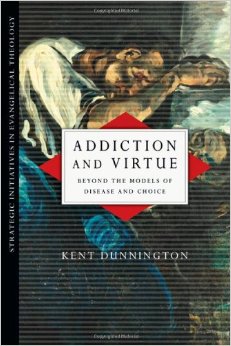
 The best sermon I heard this year made good use of You Are What You Love, the book by James K. A. Smith about the power of habit in the life of faith. The sermon also made connection to one of my favorite books of the New Testament: Hebrews, which speaks of being in the habit of meeting together with one another. The sermon also utilized a book that I read on that pastor’s recommendation, Addiction and Virtue: Beyond the Models of Disease and Choice. I’ve been meaning to write about the book for a while now, but just couldn’t find the right time.
Kent Dunnington, the author of the book, summed up the premise of the book in a recent online interview:
The main argument of the book is that addiction is neither a disease nor a choice, but a complex habit. It’s neither fully determined nor voluntary, but is rather a “second nature” that a person takes on. The power of any habit is correlative to the kinds of things the habit helps an agent achieve, thus a big part of the book is spent showing what it is that addictions help us achieve. Contrary to popular belief, we don’t get addicted for pleasure, though pleasure may be an initial hook. We get addicted because addictions help us attain, though only fleetingly, certain moral and intellectual goods that late-modern capitalist culture makes difficult to attain. And this insight led me to the discovery that addiction is really a counterfeit of the theological virtue of charity or love, in that it promises sustained ecstatic existence and an ordering principle for all of life. So — not surprisingly, really — it turns out that addiction has everything to do with God!
Habit, of course, is a key concept for many at the beginning of a new year. Many people see the fresh start of a new year as an opportunity to rethink hopes and habits, looking for practical ways to “rethink one’s settings.” And when many of us fail to achieve that change, we got back and forth between blaming our (weak) will power and the (strong) influence/habit/routine that seems insurmountable. Few people would admit to the power of some level of addiction to be at work (and, honestly, the word addiction shouldn’t be thrown around carelessly until it has no weight).
In an essay dated to 1992 and titled “The Problem of Tobacco, Wendell Berry asserted that calling out the addiction to tobacco is actually a “red herring.” He goes on to say:
In calling attention to the dangers of one kind of addiction, the tobacco controversy distracts from the much greater danger that we are an addictive society — that our people are rushing from one expensive and dangerous fix to another, from drugs to war to useless merchandise to various commercial thrills, and that our corporate pushers are addicted to our addictions.
And so you could replace the 1992 list with things like work, the internet, cell phones, YouTube, sports, and any of a number of things that we as a culture have settled on as acceptable addictions.
And so habits and addictions here at the beginning of a new year. I’m going to try and articulate a few thoughts on things through the lens of Dunnington’s book, particularly as it pertains to a particularly Christian community.
You can read the rest of the quoted interview with Dunnington here. And you can read Berry’s essay in its entirety here. (special thanks to Alan Jacobs’ reading list for the lead to the Berry essay)
 Seth Godin asked a good question today of contemporary culture and our relationship with curiosity:
 Much digital ink has been spilled over the last year writing about the return of the Star Wars franchise to the big screen, for with Star Wars: The Force Awakens and most recently with Rogue One: A Star Wars Story. A recent article by Marc Barnes at First Things addresses one thing that the new movies have brought a course correction to the much-maligned prequels.
 Last night saw the premiere of the fourth (and many assume final) series of Sherlock on Masterpiece Mystery. Perhaps its a repeat of my thoughts on Doctor Who‘s Christmas special, where absence has made the heart grow fonder. I can’t help but admit, though, that I really enjoyed “The Six Thatchers.”
 Yesterday Michael Dougherty of The Week tweeted what I am assuming is his version of a “new year’s resolution,” and I like it a lot.
 This morning’s routine was thrown out of whack because of the holiday. God bless the good folks at Zippy’s for putting up with people like me early each Sunday. Instead, I had a quick breakfast at Starbucks before heading to church.
 And so ends a year that our culture has anthropomorphized for the last couple of months. Thought I’d end a year in posts with something other than a “best-of” list (though I would like to get around to that at some point). So here’s my list of “last things” for the year.


 Space Enough, and Time