Finding Dory: Into Darkness

doryLike many Americans, I spent a couple of hours in the theater this past weekend catching up with Dory, Marlin, and Nemo.  And by catching up with, I mean swimming far into the murky existential depths of the children’s movie that is Finding Dory.

Confession: I had so much exposure to Finding Nemo when it first came out on DVD that anything that made it special was truly lost on me.  So going into Finding Dory, I was simply hoping for a decent story with some great animation.  I went in assuming that, as children’s fare, the movie would be easy and breezy.  It really wasn’t, which is part of what K. Austin Collins makes note of early in his reflection on the movie at The Ringer:

Surprisingly and not, Finding Dory gets dark. Quite dark, when you think about it, but you have to look beyond the fabricated whimsy of the story toward all the tragic weirdness hovering just outside of it. You have to notice the surroundings: a sunken freighter, with its steel cargo containers crumpled along the seafloor like a kingdom of forgotten junk and the plastic soda rings that briefly ensnare an always-unsuspecting, freckle-faced Dory. You have to consider where Dory comes from: a marine life institute where (the voice of Sigourney Weaver tells us) scientists believe in the three R’s: “rescue, rehabilitation, and release.” Sounds dreamy — until an octopus named Hank (Ed O’Neill) explains he’s missing a tentacle thanks to the throngs of grabby children at said institute, making him, as Dory helpfully points out, a septopus, not an octopus. A septopus with toddler-induced post-traumatic stress disorder.

It’s insightful, darkly funny stuff, this trove of secondary details, all of it hinting at a weirder world of humans and other forces that exceed the eventual story’s needs.

Finding Dory is a great example, at least to me, of a movie that can be safely dangerous (as opposed to dangerously safe).  Dory’s memory issue make the journey that more uncertain.  Her slowly returning memories make the stakes that much higher.  When she ultimately hits “rock bottom,” she stays there for longer than expected.  And because of the nature of the character, achieving the intended goal is never the end of the adventure.

In his Ringer article, Collins asserts that it’s Dory’s “safe bet” status that should’ve allowed the movie to go weird places. For him, the movie might be an example of the dangerously safe.  That makes more sense when Collins reminds us of Dory‘s director’s previous work as writer and/or director on Wall-E, A Bug’s Life, and the Toy Story movies (which had moments very dark and very weird).

Too often, the utopias Pixar imagines for children are so much duller, morally and aesthetically, than the worlds those kids already live in. The pleasure of Finding Dory, for an adult, is its sense of the dangerous wonder of the wider world, as scary as it is irresistible . . .

The central irony of Finding Dory is that Dory is a risk-taker trapped in a movie that, for all its likability, won’t join her on whimsical leaps.

I remember hearing (perhaps reading) somewhere last week that Finding Dory really is the missing piece of the Finding Nemo story, that the idea of Dory finding her home was something that begged for resolution. I’m not sure that I would’ve agreed prior to seeing the sequel. I’m glad they told the story, though.  And I’m kind of glad that it’s dark and more serious than I expected (and much more subtle than a gang of toys trapped in an incinerator).  I also get Collins’ point. Perhaps, in that way, Dory is a missed opportunity.  We’ll see if Pixar dips its toes in the same water for a third time to meet that challenge.

You can read the whole Ringer article about Finding Dory here.

(image from wallpapershome.com)
Posted in Internet, Movies | Leave a comment

A Song for Sinners and Saints

Posted in Faith, Internet, Music | 1 Comment

The Back-Drop for the Age

This past weekend I had the opportunity to sit around a breakfast table and talk about James K. A. Smith’s You Are What You Love.  It was an interesting conversation for me, as I’ve been pretty invested in Smith’s thinking for a good while.  It was interesting to see what concepts and comments people grabbed onto.

One of the things that I take for granted when reading Smith’s newer work is the significance of his thinking on what is now called “our secular age.”  He talked about it a lot through the lens of Charles Taylor’s book, which is named for that age.  And while You Are What You Love stands well on its own (and even hints at Smith’s other work), it’s good to get a solid dose of “thinking about the secular.”  Here’s a recent video of Smith talking at a Q Conference about the back-drop for the age we live in, this secular age.

Posted in Books, Faith, Internet | Leave a comment

“For British Eyes Only”

I’ve got a number of friends traveling abroad this summer.  Two in particular are enjoying a couple of weeks in England.  Weird to think that I was just there a few months ago myself.  A version of Britain (known as Wee Britain) played a role in the third season of Arrested Development.  Here’s a fun little clip from Michael’s first trip to “the British section of the OC.”

Posted in Television, Travel | Leave a comment

Trailer Talk: Batman v Superman Extended

I may be one of the few to admit it, but I regret only seeing Batman V Superman once in the theater.  I feel that regret as soon as I hear the first musical notes in the trailer for the upcoming extended version of the movie.  I’m not expecting the extended version to “fix” anything: the movie is what it is.  And while it’s sensibilities are not mine, I think I get what Snyder was going for.  Here’s the trailer for the movie which “drops” a couple of different ways over the summer.

My two favorite moments from the trailer:  (1) Where Luthor mangles the argument for the problem of evil and God’s existence and (2) where WW comments on how mankind has created a world where it is impossible to stand together. I imagine that most of the rest of the additional material consist of lots of posturing and fighting.

Posted in Internet, Movies | Leave a comment

Klosterman Looks Back on Television

friends tvChuck Klosterman’s new book, But What If We’re Wrong?, dropped this past week.  The premise of the book is to cast thought forward a few hundred years and try and understand what we think we’re getting right now but might ultimately be getting wrong (ah, the time-space continuum).  The folks at The Ringer were kind enough to post the section of the book where Klosterman reflects on television (something of great interest to those of us from the time-before-the-internet).  The article’s opening paragraphs:

Television is an art form where the relationship to technology supersedes everything else about it. It’s one realm of media where the medium is the message, without qualification. TV is not like other forms of consumer entertainment: It’s slippier and more dynamic, even when it’s dumb. We know people will always read, so we can project the future history of reading by considering the evolution of books. (Reading is a static experience.) We know music will always exist, so we can project a future history of rock ’n’ roll by placing it in context with other genres of music. The internal, physiological sensation of hearing a song today is roughly the same as it was in 1901. (The ingestion of sound is a static experience.) The machinery of cinema persistently progresses, but how we watch movies in public — and the communal role cinema occupies, particularly in regard to dating — has remained weirdly unchanged since the fifties. (Sitting in a dark theater with strangers is a static experience.) But this is not the case with television.

Both collectively and individually, the experience of watching TV in 2016 already feels totally disconnected from the experience of watching TV in 1996. I doubt the current structure of television will exist in two hundred fifty years, or even in twenty-five. People will still want cheap escapism, and something will certainly satisfy that desire (in the same way television does now). But whatever that something is won’t be anything like the television of today. It might be immersive and virtual (like a Star Trekian holodeck) or it might be mobile and open-sourced (like a universal YouTube, lodged inside our retinas). But it absolutely won’t be small groups of people, sitting together in the living room, staring at a two-dimensional thirty-one-inch rectangle for thirty consecutive minutes, consuming linear content packaged by a cable company.

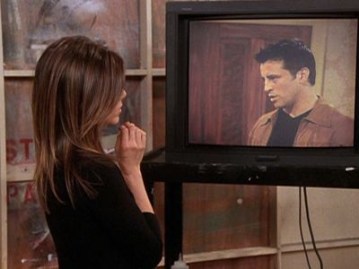
Much like the thinker Klosterman alludes to (McLuhan and the medium being the message), Klosterman has a good grasp of the particularly unique (and passing) place of television in culture.  Time changes things, and quickly.  I remember a couple of years ago watching the entire run of Friends and being surprised at how “present” the television was in the first two seasons.  If it wasn’t being used as a plot device, it was on in the background reminding viewers, if only in a meta way, of what was actually going on between viewer and television.

And so Klosterman sets out to determine “What is the realest fake thing we’ve ever made on purpose?” as it relates to television, which is an interesting task.  And while I might not agree with Klosterman’s conclusion, I can at least respect it.

You can read the whole article here.  And if you want to know why I refer to the “essay” as an “article” . . . you’ll need to read the book.

(image from quora.com)

Posted in Books, Internet, Television | Leave a comment

Some Songs Say So Much

One of the most interesting reads of the past week was an article at FiveThirtyEight from Leah Libresco about the language of contemporary Christian music as compared to the language of shape note hymns.  She did a survey and came up with this chart:

libresco-christianrock-1

The survey inspired other short articles like this reflection on great CCM music from the 90s and this reflection on the idea of “winter Christians” and “songs of exile.”  I think it’s a good and necessary conversation to have, especially when you think about the worship habits and rituals of younger Christians (or what we think they expect, even).

What’s interesting to me (and what shows my disconnect from CCM in general) is that I have found myself gravitating and revisiting artists who are Christian and who deal with the sadder, sober side of life.  Case in point: the music of Andrew Peterson.  Here’s a recording of a recent performance of the first track (“The Dark Before the Dawn”) from his latest album (The Burning Edge of Dawn).  It’s music like this that helps ground me in both the sorrow and joy of a fallible life in a fallen world.  It might not always employ particular words and concepts all the time, but it’s something, even to call it “the pain before the balm.”

Posted in Faith, Internet, Music | Tagged | Leave a comment

“The Traveling Wilburys of Pain”

One of my favorite episodes of Community is “Paradigms of Human Memory,” which aired late in the show’s second season.  It’s basically a clip shows of stories that were not told previously (and yet here we have footage of those adventures).  It’s a nod to the conventionality of the sitcom, of course, and to one of the staples of this particular show: Jeff Winger’s grand speeches.  Such a great (and meta) way to approach a tried, true, (and sometimes tired) television genre.

Posted in Internet, Television | Leave a comment

The Perfect Space

Last night was good and rainy, great weather for listening to the Avett Brothers.  A few of their songs from I and Love and You really stick with me.  Last night, it was “The Perfect Space.” (The other is “Head Full of Doubt/Road Full of Promise,” but we’ll get to that some other time.)

I really like the sentiment of the song: the idea of security in a volatile space, the idea of those you can trust, the refusal of the wrong kind of pride.  I feel like I’ve been wrapping up this school year for a few weeks now.  And while I’ve been fortunate to have lots of time and space to get things done, the list seems a little longer than usual.  Part of it is that weird space between the old and the new, that overlap that holds you in an odd place for a while.  Songs like this kind of help me maneuver well.

I also really like the “second act” of the song, even though it’s a little jarring.  But then they weave back into the main tempo and melody seamlessly, which is a nice life challenge, too.

Posted in Internet, Music | Leave a comment

Trailer Talk: A Matter of Loyalty

Another new trailer that played before The Lobster was the latest from Meryl Streep.  She plays the title role in Florence Foster Jenkins, the real-life story of a woman with the desire to sing but not the talent.  On one level, this looks like clear Oscar material.  My favorite line comes at the 1:00 mark.

Virtue talk is tricky these days.  You’ll often read of “virtue signaling” when discussion social justice warriors and corporations making stands on certain topics.  In theory, virtue talk is prevalent in schools where character development is expected.  I’m not so sure of that, though, as we tend to feel like a virtueless culture.  Regardless, the assertion that “without loyalty, there’s nothing” is pretty challenging and at least a little damning for many of us.

Florence Foster Jenkins premieres August 12.

Posted in Internet, Movies | Leave a comment