Prefacing Scary Close: Intersections

I remember well when my friend Cathy introduced me to Blue Like Jazz and the work of Donald Miller. It was early in my time in Hawaii, and it felt like I was finally settling into some kind of routine. I had become a big reader of contemporary fiction (Eggers et al), but hadn’t expanded much in Christian-living stuff.

I read Blue Like Jazz and loved it, not so much because I needed a salve for contemporary Christian bitterness but because Miller was such a great writer. I tracked down a copy of Prayer and the Art of Volkswagen Maintenance and loved it, too. Here was a guy, a writer, who had no preaching license or ordination certificate but still had vital things to say about Jesus and His church.

I eventually made my way to Portland, Miller’s “home base.” Twice. The first time was for an education conference. I got to visit Imago Dei (a bit too “emerging” for my tastes) and fell madly in love with Powell’s (where that new love of contemporary fiction made every aisle more exciting than the last). One of my co-worker’s family lived in the neighborhood that Miller wrote about in BLJ, and getting to walk through it and read in it and watch people throwing frisbee and enjoying the lake was a real moment for me.

My second time in Portland was to try and meet Miller himself. I had been a supporter of the Blue Like Jazz movie on KickStarter and had the opportunity to see the movie if I attended Miller’s Storyline conference. It was a great weekend: I caught up with some graduates, enjoyed a day on the coast of Oregon, and spent time watching Miller talk about story (along with guests like Bob Goff, who has become a presence in his own right).

All of this to say that Donald Miller’s writings and thinking have been a big part of my growth since moving to Hawaii. I share his ideas on “letting story guide you” each year with my juniors. His talk on story coupled with N. T. Wright’s idea of “the Bible as a five-act play” really helped get my upper-level Bible curriculum sorted. His A Million Miles in a Thousand Years has become a book I often give to graduates. For a number of years his blog gave me good things to share with co-workers and friends. So yes: five years has been a long time to wait for a new book from the guy.

For all that time, though, life has been crissing and crossing, Miller’s writing often a helpful stitch for some wound from daily living. I haven’t known quite what to make of him over the last few years, as he has become something of a “guru” for companies and lifeplans, so I started Scary Close with some uncertainty. And then I read it in just over 24 hours. It was a kind of comfort food and a great challenge for healing. But before I get to that, I want to share a couple of quotes from my other favorite Miller book. That’s for tomorrow.

Posted in Books, Faith, Teaching, The Long Story, Travel | Tagged , | Leave a comment

The Unfinished Line

This past November I spoke at an area church for the beginning of Advent. While I liked the general content of my sermon (and will surely reuse it somewhere down the road), I have to admit that something felt missing to me. As I reflected on the sermon throughout the rest of that afternoon, one word kept coming to mind: unfinished. It wasn’t, though, that the sermon wasn’t well-polished. . . at least not entirely. It also had something to do with my uneasiness to call people to a particular action, a kind of obedience in a particular moment. And that saddened me, because I think all words that come from God should lead to some kind of response.

And so I ended the year with the word unfinished in my head, and in my head it has remained. It has become something of a rabbit hole, a forest trail that I want to pursue this year.¹  The Apostle Paul talked about it in terms of “not that I have already achieved it yet,” which is something all people of faith must struggle with. Truth be told, an awful lot of me feels unfinished, and instead of getting to work on it, I’ve been puttering around like a hobbit knowing he has a journey to make but just can’t bring himself to step out the door. So if it seems like I’m grasping at straws here for the next few weeks, it’s because I’m trying to get things in order, pack the bare necessities, and run. I’ve been saving up a lot of thoughts, waiting for a “right time” to commit to them. I’m thinking the time is now. And by now I mean tomorrow, when I post the first in a series about Scary Close, Donald Miller’s first book in five years.

_____________________________________________________________

¹ A “word of the year” reminds me of my dear friend Beth, who chooses a word each year to focus on.  This year her word is brave, which God gave her before being given a serious medical diagnosis.  You can check out her blog here.


Posted in Faith, The Long Story | Leave a comment

Get On Your Feet, Leslie Knope

In honor of the final season of Parks & Recreation (Tuesday nights on NBC), I’ve taken to revisiting some of my favorite earlier episodes.  I especially like the episode where Leslie, ever the optimist, relies on her friends to help kick-off her campaign after the professional campaigners walk out.  What happens when the team walks out the door, heads held high, is a great example of so many things (optimism, reality, and the awkwardness of peeing, three-legged dogs).  Get on your feet, Leslie Knope.  Make it happen.

Posted in Internet, Television | Tagged | Leave a comment

A Common Confession

Yesterday I rambled on a bit about The Pilgrim’s Progress and starting from a common place (as seen in the story with the Wicket Gate).  How good it is, I think, for us to sing about that which is common amongst us: the core belief we have of who Jesus is and what He has done and is doing still.  I’ve had Andrew Peterson’s After All These Years collection playing for the last few months, and his “The Good Confession” is a great example of singing about the journey and the One who guides us on it.

All I know is that I was blind but now I see that though I kick and scream, Love is leading me. And every step of the way his grace is making me; With every breath I breathe, he is saving me. And I believe.

Posted in Faith, Internet, Music | Leave a comment

How the Way Becomes Common

Christian at the Wicket Gate from a 1778 English edition.  (Thanks, Wikipedia)

Christian at the Wicket Gate from a 1778 English edition. (Thanks, Wikipedia)

There’s one particular idea from Bunyan’s The Pilgrim’s Progress that has stuck with me since I reread it last semester.  Early in the story, Christian is told to go to the wicket gate, that he will receive further instructions there.  After much struggle, he arrives there and receives what is necessary: it is the beginning point of the Narrow Way, the King’s Highway.  Later on, he meets a man named Ignorance, who has decided to go his own way.  Their conversation:

“You may have some difficulty there getting in the Gate.”

“As other good people do,” answered Ignorance.

“But what rolled certificate do you have to show at the [Celestial] Gate?”

“I know my Lord’s will,” replied Ignorance.  “I have lived a good life.  I pay my debts.  I pray, fast, pay tithes, give alms.  And I have left my country for the Celestial City.”

“But you didn’t come in at the wicket gate that is at the head of the way,” worried Christian.  “I fear you will not get into the City.  Instead you will be charged ‘a thief and a robber.'”

“Gentlemen, you are utter strangers to me.  I don’t know you.  Be content to follow the religion of your country, and I will follow the religion of mine.  I hope all will be well, and as for the wicket gate that you talk of, all the world knows it is a great way off.  I cannot think that any men in all our parts do so much as know the way to it.  Nor need it matter whether they do or not, since we have, as you see, a fine pleasant green lane that comes down from our country the way into it.”

For all intents and purposes of Bunyan’s story, you could come from anywhere in the wide world, from any far-off location, to make your way to the road to the heavenly City.  But your journey in earnest had to start at the Wicket Gate.  And while that is true of salvation, it is true of other things for believers by implication.  In our attempts to accommodate the diversity of faith journeys in our Christian communities, we can easily forget the need to reiterate the assertion that for all of our different places of departure, we come by the Narrow Way, the way to and of the Cross, and that’s more than just a devotional truth.  At some point our journeys have joined, the road has become a shared one, and because of that the journey is different.  What we see and how we see are different.  We cringe at the thought of any kind of lock-step faith, as if it destroys our sacred sense of individuality.  But if the way is narrow and we are changed, then so be it and thank God.  Rather we learn to walk it together now than to be astonished when we arrive at our destination but are not allowed entrance because we chose instead to go our own ways (like Ignorance, who was anything but).  That is true of faith and church, in our institutions and our relationships.  All of them (and our work in them) begin in earnest when we start “at the head of the way.”

____________________________________________________

Text from the 2010 Barbour Publishing edition.

Posted in Books, Faith | Leave a comment

Parks, Recreation, and “Corporate Culture”

Leslie and Ron from Hitflix.comLast night’s Parks & Recreation double-header gave me a great example for something I’ve been mulling over for some time: the connections between culture, community, and relationships.

Culture and community, of course, are buzzwords in corporate-speak.  It’s definitely true in education, where you can easily find and read books about “learning communities” and cultures of “insert cool term here.”  Culture and community are good words; I know because I have thought a lot about them myself.  Culture, in my mind, is the broadest of the terms.  And while it can include artifacts created by individual, the most resilient signs of culture are artifacts created by collaboration.  Quality collaboration comes from quality community.  And what is community?  It is easy to think of individuals as the building block of community, but I think it’s not that simple.  The root reality of community is relationships, the interplay of those with common beliefs, goals, and actions, people who both like and love one another.  Real relationships bubble up into real community, which bubbles up into real culture.  Anything else is window-dressing and fleeting fad.

Last night’s Parks double-header was a picture of what happens when relationship is inadvertently abandoned and what that can do to those “left behind.”  How wonderfully strange that this was the cause of Ron Swanson’s anger towards Leslie!  What a great use of subtle flashbacks to things we didn’t get to see but that really mattered in the long run!  And what a real struggle for all of us caught up in trying to “make things happen.”  I’ve been there and done that, and I’m ashamed of it, feel my complicity in the building of weaker things.  But I cannot, do not want to, stay there.

Do we want real culture?  Do we want real community?  We can start by striving for real relationships.  It’s probably one of the hardest thing we’ll ever do, the thing we’ll fail at the most.  But we can try.

_________________________________________________________

For more on culture, check out J. D. Hunter’s To Change the World.  Even reading just a few pages of it might help you think more clearly about culture and the world around us.

Posted in Television | Leave a comment

Let the Took Decide

From The Hobbit by JRR Tolkien:

As they sang the hobbit felt the love of beautiful things  made by hands and by cunning and by magic moving through him, a fierce and a jealous love, the desire of the hearts of dwarves.  Then something Tookish woke up inside him, and he wished to go and see the great mountains, and hear the pine-trees and the waterfalls, and explore the caves, and wear a sword instead of a walking-stick.  He looked out of the window.  The stars were out in a dark sky above the trees.  He thought of the jewels of the dwarves shining in dark caverns.  Suddenly in the wood beyond The Water a flame leapt up– probably somebody lighting a wood-fire– and he thought of plundering dragons settling on his quiet Hill and kindling it all to flames.  He shuddered; and very quickly he was plain Mr. Baggins of Bag-End, Under-Hill, again.

But then later:

“Go back?” he thought.  “No good at all!  Go sideways? Impossible! Go forward?  Only thing to do!  On we go!”  So up he got, trotted along with his little sword held in front of him and one hand feeling the wall, and his heart all of a patter and a pitter.

Happy birthday, Mr. Tolkien.  Much obliged to you.

Bag-End in Early Winter

Posted in Books, Commonplace Book, Travel | Tagged , | Leave a comment

Forgetting, Losing, and Finding Ourselves

One last selection from Bonhoeffer’s Life Together concerning reading the Bible together:

Consecutive reading of Biblical books forces everyone who wants to hear to put himself, or to allow himself to be found, where God has acted once and for all for the salvation of men.  We become a part of what once took place for our salvation.  Forgetting and losing ourselves, we, too, pass through the Red Sea, through the desert, across the Jordan into the promised land.  With Israel we fall into doubt and unbelief and through punishment and repentance experience again God’s help and faithfulness.  All of this is not mere reverie but holy, godly reality.  We are torn out of our own existence and set down in the midst of the holy history of God on earth.  There God dealt with us, and there He still deals with us, our needs and our sins, in judgment and grace.  It is not that God is the spectator and sharer of our present life, however important that is; but rather that we are the reverent listeners and participants in God’s action in the sacred story, the history of the Christ on earth.  And only in so far as we are there, is God with us today also.

A complete reversal occurs.  It is not in our life that God’s help and presence must still be proved, but rather God’s presence and help have been demonstrated for us in the life of Jesus Christ.  It is in fact more important for us to know what God did to Israel, to His Son Jesus Christ, than to seek what God intends for us today.  The fact that Jesus Christ died is more important than the fact that I shall die, and the fact that Jesus Christ rose from the dead is the sole ground of my hope that I, too, shall be raised on the Last Day.  Our salvation is “external to ourselves.”  I find no salvation in my own life history, but only in the history of Jesus Christ.  Only he who allows himself to be found in Jesus Christ, in his incarnation, his Cross, and his resurrection, is with God and God with him.

Posted in Books, Commonplace Book, Faith | Leave a comment

The Story Under Your Skin

The author I read most this past year had to be James K. A. Smith.  His How (Not) to be Secular: Reading Charles Taylor is probably the best book about a book I’ve ever read.  After that, I moved on to his recent books on postmodernism and relativism.  I often find myself coming back to his thinking on social imaginaries (as presented in his Cultural Liturgies series) and am glad when I find nice snippets of his thinking to share.  Here’s a presentation given by Smith for a Q conference.  Q focuses on Christian work for the common good.  It’s a video worth 18 minutes of your time.  I especially like what he has to say around the fifteen-minute mark.  A real challenge for us all.


Posted in Books, Faith, Internet, Teaching | Leave a comment

Cynicism and “Come and See”

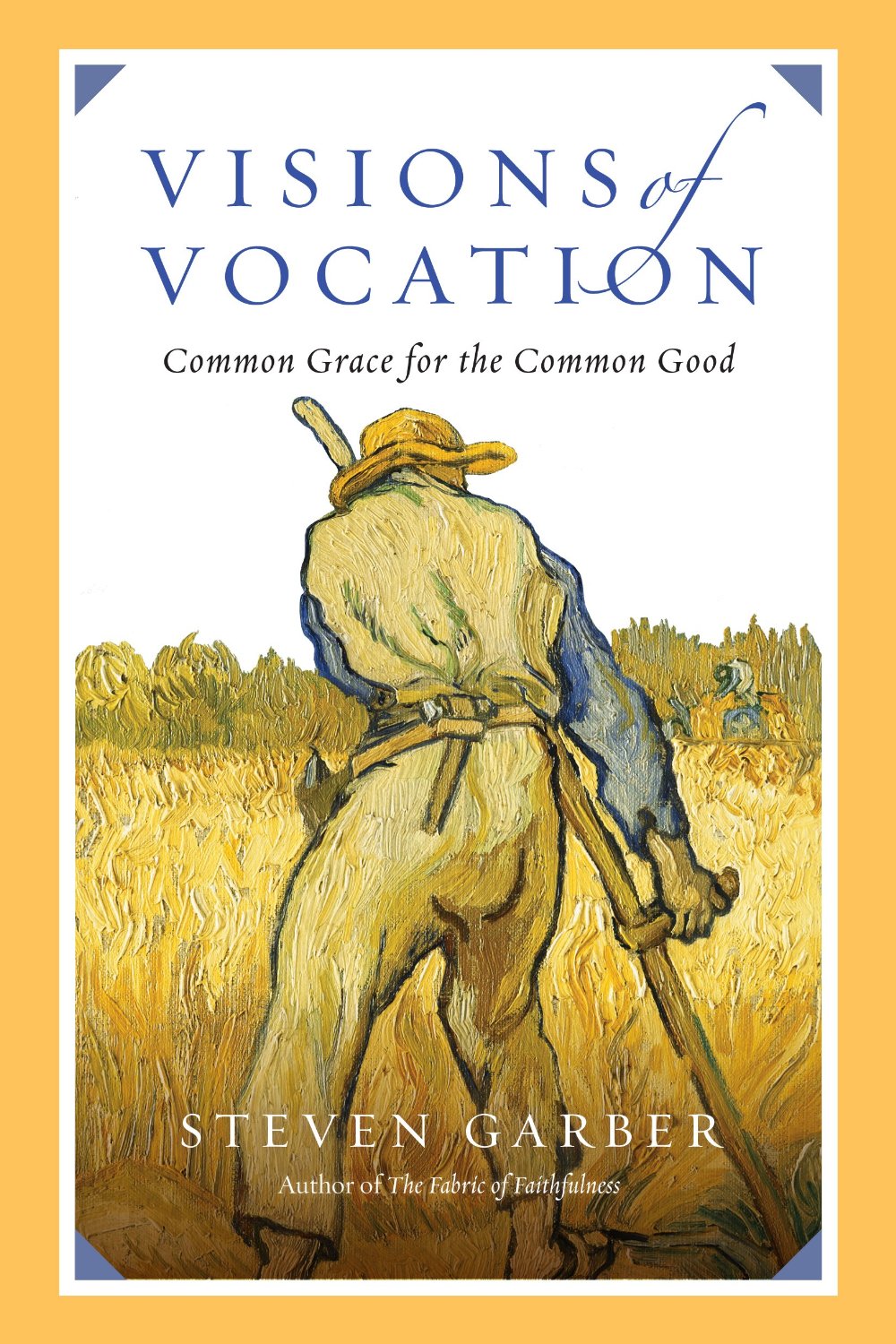
Visions of VocationIf I gave an award for “Book Bought Most in 2014,” it would definitely be Steven Garber’s Visions of Vocation.  It dropped in late spring, and I was so moved by it that I had to pass it on to anyone I knew who was working hard at understanding calling and mission in 21st century America.  The key question Garber asks has stuck with me all year: knowing what I now know of the world, can I still love it?

Christianity Today recently saw fit to recognize Garber’s book with an “award of merit” in their year-end consideration of books.  They posted a section of the book to their website titled “Overcoming Cynicism, Even After You’ve Seen How the Sausage is Made.”  You can read it all here.  Some of my favorite lines:

In the strange calculus of history and the human heart, the subtle temptation of cynicism confounds our best efforts at working toward a common good. Sometimes all we can do is name the problem, cancerous as it is to a good life and a good society. Some, of course, do not see it as a problem, instead embracing it as the reality of realities. . .

Whether conscious or not, intentional or not, the temptation to cynicism is always a way of keeping one’s heart from being wounded, again. . .

There is much to be cynical about—and it is a good answer if there has not been an incarnation. But if that has happened, if the Word did become flesh, and if there are men and women who in and through their own vocations imitate the vocation of God, then sometimes and in some places the world becomes something more like the way it ought to be.

Some of the book was also released at Patheos earlier in the year through a dedicated blog.  Tying into the incarnation and vocation and using Jesus’ challenge to “come and see” to his first disciples:

The Abrahamic religions have several central truths in common, but at this point of God becoming flesh there are deep divisions. “Not for a moment,” Judaism protests, arguing instead that God is one— even as they still hope for a Messiah, someday and sometime. And while Islam believes that there was a great prophet named Jesus, it is incensed at the idea of incarnation. Pushing the boundaries into the pluralizing world at large, those who call themselves atheists and pantheists do not believe that an incarnation of God happened in history. And yet it is the heart of mere Christianity. But if that is the central reality of Christian faith, come and see is profoundly instructive. We do not learn the deepest lessons any other way. Moral meaning is always learned in apprenticeship, in seeing over-the-shoulder and through-the -heart of those who have gone before us, of those who have something to teach us. Theologian Stanley Hauerwas maintains that we learn brick laying only through apprenticeship, just as we learn to hope only through apprenticeship—and he is right. We do not learn anything that matters any other way.

You can read more of that excerpt here.

Most days it’s challenge enough just to see rightly.  Acting on what you see takes a different and deeper kind of strength.  I’m thankful that this year brought a new book by Garber to help me better understand that reality. Give the book a chance if you’re looking for a challenging read.  And if you do read it, let me know what you think.

Posted in Books, Faith, Internet, Teaching | Tagged | Leave a comment