Parks, Recreation, and “Corporate Culture”

Leslie and Ron from Hitflix.comLast night’s Parks & Recreation double-header gave me a great example for something I’ve been mulling over for some time: the connections between culture, community, and relationships.

Culture and community, of course, are buzzwords in corporate-speak.  It’s definitely true in education, where you can easily find and read books about “learning communities” and cultures of “insert cool term here.”  Culture and community are good words; I know because I have thought a lot about them myself.  Culture, in my mind, is the broadest of the terms.  And while it can include artifacts created by individual, the most resilient signs of culture are artifacts created by collaboration.  Quality collaboration comes from quality community.  And what is community?  It is easy to think of individuals as the building block of community, but I think it’s not that simple.  The root reality of community is relationships, the interplay of those with common beliefs, goals, and actions, people who both like and love one another.  Real relationships bubble up into real community, which bubbles up into real culture.  Anything else is window-dressing and fleeting fad.

Last night’s Parks double-header was a picture of what happens when relationship is inadvertently abandoned and what that can do to those “left behind.”  How wonderfully strange that this was the cause of Ron Swanson’s anger towards Leslie!  What a great use of subtle flashbacks to things we didn’t get to see but that really mattered in the long run!  And what a real struggle for all of us caught up in trying to “make things happen.”  I’ve been there and done that, and I’m ashamed of it, feel my complicity in the building of weaker things.  But I cannot, do not want to, stay there.

Do we want real culture?  Do we want real community?  We can start by striving for real relationships.  It’s probably one of the hardest thing we’ll ever do, the thing we’ll fail at the most.  But we can try.

_________________________________________________________

For more on culture, check out J. D. Hunter’s To Change the World.  Even reading just a few pages of it might help you think more clearly about culture and the world around us.

Posted in Television | Leave a comment

Let the Took Decide

From The Hobbit by JRR Tolkien:

As they sang the hobbit felt the love of beautiful things  made by hands and by cunning and by magic moving through him, a fierce and a jealous love, the desire of the hearts of dwarves.  Then something Tookish woke up inside him, and he wished to go and see the great mountains, and hear the pine-trees and the waterfalls, and explore the caves, and wear a sword instead of a walking-stick.  He looked out of the window.  The stars were out in a dark sky above the trees.  He thought of the jewels of the dwarves shining in dark caverns.  Suddenly in the wood beyond The Water a flame leapt up– probably somebody lighting a wood-fire– and he thought of plundering dragons settling on his quiet Hill and kindling it all to flames.  He shuddered; and very quickly he was plain Mr. Baggins of Bag-End, Under-Hill, again.

But then later:

“Go back?” he thought.  “No good at all!  Go sideways? Impossible! Go forward?  Only thing to do!  On we go!”  So up he got, trotted along with his little sword held in front of him and one hand feeling the wall, and his heart all of a patter and a pitter.

Happy birthday, Mr. Tolkien.  Much obliged to you.

Bag-End in Early Winter

Posted in Books, Commonplace Book, Travel | Tagged , | Leave a comment

Forgetting, Losing, and Finding Ourselves

One last selection from Bonhoeffer’s Life Together concerning reading the Bible together:

Consecutive reading of Biblical books forces everyone who wants to hear to put himself, or to allow himself to be found, where God has acted once and for all for the salvation of men.  We become a part of what once took place for our salvation.  Forgetting and losing ourselves, we, too, pass through the Red Sea, through the desert, across the Jordan into the promised land.  With Israel we fall into doubt and unbelief and through punishment and repentance experience again God’s help and faithfulness.  All of this is not mere reverie but holy, godly reality.  We are torn out of our own existence and set down in the midst of the holy history of God on earth.  There God dealt with us, and there He still deals with us, our needs and our sins, in judgment and grace.  It is not that God is the spectator and sharer of our present life, however important that is; but rather that we are the reverent listeners and participants in God’s action in the sacred story, the history of the Christ on earth.  And only in so far as we are there, is God with us today also.

A complete reversal occurs.  It is not in our life that God’s help and presence must still be proved, but rather God’s presence and help have been demonstrated for us in the life of Jesus Christ.  It is in fact more important for us to know what God did to Israel, to His Son Jesus Christ, than to seek what God intends for us today.  The fact that Jesus Christ died is more important than the fact that I shall die, and the fact that Jesus Christ rose from the dead is the sole ground of my hope that I, too, shall be raised on the Last Day.  Our salvation is “external to ourselves.”  I find no salvation in my own life history, but only in the history of Jesus Christ.  Only he who allows himself to be found in Jesus Christ, in his incarnation, his Cross, and his resurrection, is with God and God with him.

Posted in Books, Commonplace Book, Faith | Leave a comment

The Story Under Your Skin

The author I read most this past year had to be James K. A. Smith.  His How (Not) to be Secular: Reading Charles Taylor is probably the best book about a book I’ve ever read.  After that, I moved on to his recent books on postmodernism and relativism.  I often find myself coming back to his thinking on social imaginaries (as presented in his Cultural Liturgies series) and am glad when I find nice snippets of his thinking to share.  Here’s a presentation given by Smith for a Q conference.  Q focuses on Christian work for the common good.  It’s a video worth 18 minutes of your time.  I especially like what he has to say around the fifteen-minute mark.  A real challenge for us all.


Posted in Books, Faith, Internet, Teaching | Leave a comment

Cynicism and “Come and See”

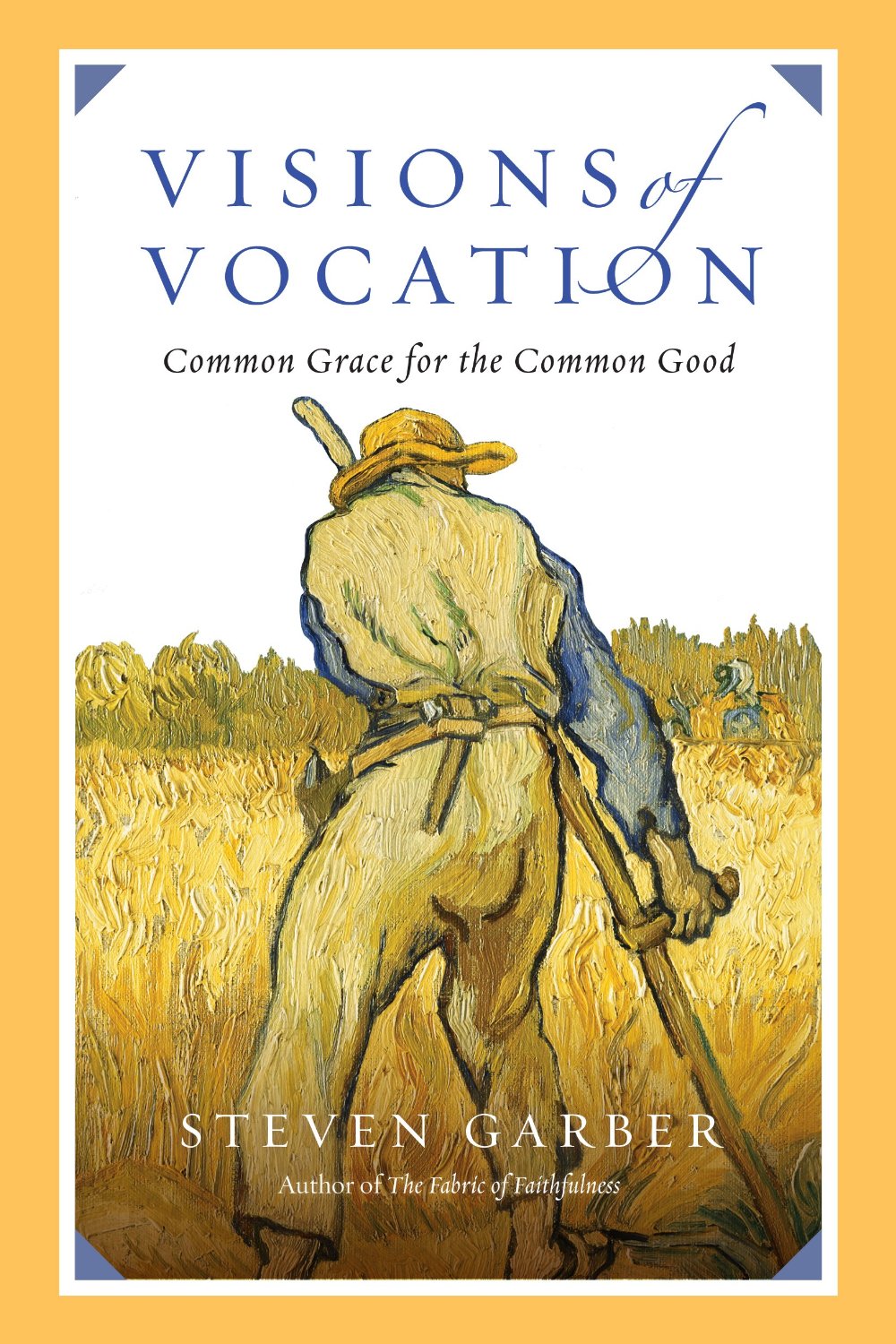
Visions of VocationIf I gave an award for “Book Bought Most in 2014,” it would definitely be Steven Garber’s Visions of Vocation.  It dropped in late spring, and I was so moved by it that I had to pass it on to anyone I knew who was working hard at understanding calling and mission in 21st century America.  The key question Garber asks has stuck with me all year: knowing what I now know of the world, can I still love it?

Christianity Today recently saw fit to recognize Garber’s book with an “award of merit” in their year-end consideration of books.  They posted a section of the book to their website titled “Overcoming Cynicism, Even After You’ve Seen How the Sausage is Made.”  You can read it all here.  Some of my favorite lines:

In the strange calculus of history and the human heart, the subtle temptation of cynicism confounds our best efforts at working toward a common good. Sometimes all we can do is name the problem, cancerous as it is to a good life and a good society. Some, of course, do not see it as a problem, instead embracing it as the reality of realities. . .

Whether conscious or not, intentional or not, the temptation to cynicism is always a way of keeping one’s heart from being wounded, again. . .

There is much to be cynical about—and it is a good answer if there has not been an incarnation. But if that has happened, if the Word did become flesh, and if there are men and women who in and through their own vocations imitate the vocation of God, then sometimes and in some places the world becomes something more like the way it ought to be.

Some of the book was also released at Patheos earlier in the year through a dedicated blog.  Tying into the incarnation and vocation and using Jesus’ challenge to “come and see” to his first disciples:

The Abrahamic religions have several central truths in common, but at this point of God becoming flesh there are deep divisions. “Not for a moment,” Judaism protests, arguing instead that God is one— even as they still hope for a Messiah, someday and sometime. And while Islam believes that there was a great prophet named Jesus, it is incensed at the idea of incarnation. Pushing the boundaries into the pluralizing world at large, those who call themselves atheists and pantheists do not believe that an incarnation of God happened in history. And yet it is the heart of mere Christianity. But if that is the central reality of Christian faith, come and see is profoundly instructive. We do not learn the deepest lessons any other way. Moral meaning is always learned in apprenticeship, in seeing over-the-shoulder and through-the -heart of those who have gone before us, of those who have something to teach us. Theologian Stanley Hauerwas maintains that we learn brick laying only through apprenticeship, just as we learn to hope only through apprenticeship—and he is right. We do not learn anything that matters any other way.

You can read more of that excerpt here.

Most days it’s challenge enough just to see rightly.  Acting on what you see takes a different and deeper kind of strength.  I’m thankful that this year brought a new book by Garber to help me better understand that reality. Give the book a chance if you’re looking for a challenging read.  And if you do read it, let me know what you think.

Posted in Books, Faith, Internet, Teaching | Tagged | Leave a comment

Christmas Party with Chris Rice

I spent last Christmas wondering whatever happened to Chris Rice, whose music played a big part in my college experience.  Finally found him on Twitter, which led me to this new song written for the Christmas season, “Christmas Party.”  Always good to hear a new Chris Rice song.

Posted in Internet, Music | Tagged | Leave a comment

Last Christmas This Christmas with the Doctor

This looks to have the right blend of intense and absurd.  Ho ho ho- two weeks to go!

Posted in Internet, Television | Tagged | Leave a comment

“Too Profane a Purpose”

Again from Bonhoeffer’s Life Together:

Do not object that the purpose of common devotions is profounder than to learn the contents of the Scriptures, that this is too profane a purpose, something which must be achieved apart from worship . . . A child hears and learns the Bible for the first time in family worship; the adult Christian learns it repeatedly and better, and he will never finish acquiring knowledge of its story.

Because the Scripture is a corpus, a living whole, the so-called lectio continua or consecutive reading must be adopted for Scripture reading in the family fellowship. Historical books, prophets, Gospels, Epistles, and Revelation are read and heard as God’s Word in their context. They set the listening fellowship in the midst of the wonderful world of revelation of the people of Israel with its prophets, judges, kings, and priests, its wars, festivals, sacrifices, and sufferings. The fellowship of believers is woven into the Christmas story, the baptism, the miracles and teaching, the suffering, dying, and rising again of Jesus Christ. It participates in the very events that occurred on this earth for the salvation of the world, and in doing so receives salvation in Jesus Christ.

Posted in Books, Commonplace Book, Faith | Tagged | Leave a comment

“More Than Light for Today”

From Bonhoeffer’s Life Together:

Almost all of us have grown up with the idea that the Scripture reading is only a matter of hearing the Word of God for this particular day. That is why for many the Scripture reading consists of only a few, brief, selected verses which are to form the guiding thought of the day . . . But there can be equally little doubt that brief verses cannot and should not take the place of reading the Scripture as a whole. The verse for the day is still not the Holy Scripture which will remain throughout all time until the Last Day. Holy Scripture is more than a watchword. It is also more than “light for today.” It is God’s revealed Word for all men, for all times. Holy Scripture does not consist of individual passages; it is a unit and is intended to be used as such.

As a whole the Scriptures are God’s revealing Word. Only in the infiniteness of its inner relationships, in the connections of Old and New Testaments, of promise and fulfillment, sacrifice and law, law and gospel, cross and resurrection, faith and obedience, having and hoping, will the full witness of Jesus Christ the Lord are perceived. This is why common devotions will include, besides the prayer of the psalms, a longer reading from the Old and the New Testament.   

Posted in Books, Commonplace Book, Faith | Tagged | Leave a comment

A Cappella in the High Countries

My Faith & Literature class is reading C. S. Lewis’ The Great Divorce as our final major work of the course.  It’s a brilliant book, one that I’ve bought multiple copies of.  Caedmons Call recorded a Sandra McCracken-written song based on the book called “The High Countries.”  And here’s Living Water, an a cappella group from Yale, performing the song last Christmas.

Posted in Books, Faith, Internet, Music, Teaching | Tagged , | Leave a comment