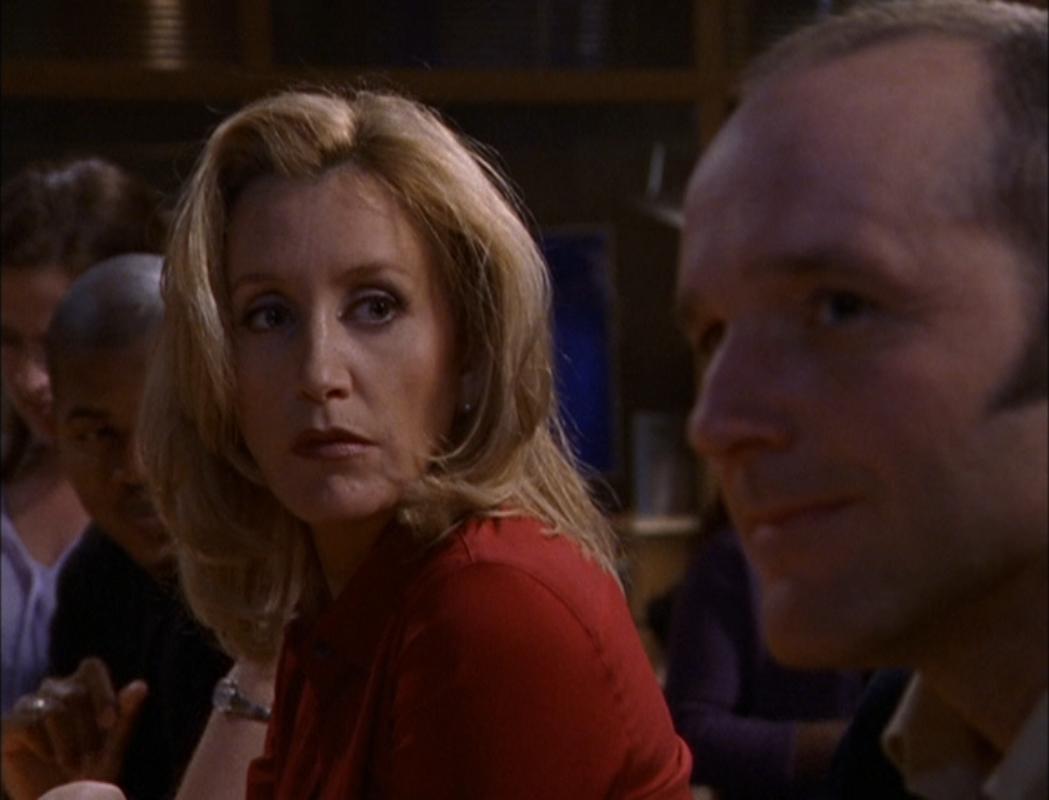
No Joe Like “Yo Joe!”

Community, the show that no one seems to watch, just did an episode based on the 80s G.I. Joe cartoon.  The episode played the way I imagine most adult-satire shows do these days, which means it was equal parts funny and disturbing.  Two of the best parts of the episode? First, the opening sequence:


Second, one of the commercials made for the “toys” from the show:


Childhood was never quite like that.

Community has had a good season whose run ends with a two-part finale starting next Thursday.  Six seasons and a movie, though, right?


Posted in Internet, Television | Tagged , | Leave a comment

Save the Day in Outer Space

I suppose well-made and funny videos are a dime a dozen these days.  Even a twelve second vid like this kid with a lightsaber is a nice, simple daydream come to life.

I kind of like this one though.  I enjoyed Gravity for what it was: a simple story of a woman in the fight for her life.  The twist is great, a nice nod to another great character.  Check it out.


Posted in Internet, Movies | Leave a comment

Being Mosby: Unending Story

Final MotherA series finale can be a tricky thing. Do you take the approach of The Sopranos, cutting to an ambiguous black screen? Do you wrap things up neatly in bow like Everwood? Do you end on a sad note like Friends, leaving the audience to speculate about everything beyond that one last cup of coffee? Maybe you have to go the Smallville route, bound your “no flight, no tights” rule until the finale. And there’s always the LOST option: go for emotional resonance without answering any viewer’s nagging questions. Series finales are tricky, which is why I’m willing to give Carter and Bays the benefit of the doubt with How I Met Your Mother.

As I see it, there are two characters from the show with strong narrative impulses as the series comes to an end. The first, of course, is Ted. He wants love, real love. And he waits what seems like forever to get it (and her name is Tracy). And then there’s Lily. What she wants the most (and you’ve seen this in her throughout the series) is for the group-of-five to be together forever. So viewers want Ted to be happy, want Lily to be happy. But you kind of know there’s a good chance that won’t happen. And if it does, it won’t last forever.

In fact, if there’s one thing How I Met Your Mother has taught me (insomuch as a television show can teach you something), it’s that the story never really ends. You get milestones. You get markers. And then life happens. It moves forward, falls in on itself, picks itself up, and goes on. That’s part of the beautiful frustration of it.

In the end, How I Met Your Mother is a lot like The Matrix series. It’s about a worthwhile and necessary battle. And there’s a reason for all of it, the good and the bad. But it’s like the Matrix within the Matrix, a kind of full circle device that both moves you forward and starts you over simultaneously. There’s a glimmer of more hope with HIMYM, though, with Ted older and wiser. But there are no guarantees.

The folks at Grantland posted a pretty solid reflection on the series. I don’t agree with everything the writer says (the same goes for the comments the article inspired). The writer does say that the theme of the series is failure as much as it is hope, and I can sort of see that. You can read the article here.

I suppose one sign of success for a series finale is how much it teases you to go back to the beginning to watch it all again. On that account, I think the finale works. For one, it does make me want to watch all of the final season over at a faster pace. And the last scene, of course, is a call-back to a key moment from the pilot, which is always a nice touch.

And so it turns out that there’s a bigger story being told than just “this is how I met your mother.” It’s a sobering thought, maybe even a painful one. But if there’s one thing we’ve learned from Ted Mosby, it’s that it doesn’t have to be defeating.

______________________________________________________________________

This is, I must admit, a horribly weak review for a wonderful show.  It was a show about five people and their quirks and how those five people somehow transcended those quirks, if only for brief moments.  The show did so many things right.  It does make me wonder about how different life looks when viewed with a microscope (seasons one through nine) as opposed to a telescope (which the finale does).  If anything, the finale had a real jarring effect that other time-distorting episodes didn’t.  It is much easier to take when you look at the finale as two separate episodes.

I really liked the “end credits” of the main cast.  A nice touch.  Just had to say that.

Posted in Internet, Television, The Importance of Being Mosby | Tagged | Leave a comment

Being Mosby: The Best Thing We Do

Big night tonight.  After nine seasons, Ted finally meets his match.  Lots of fun little “retrospectives” for a show that many thought wouldn’t make it past two or three seasons have been popping up.  Here’s TV Guide‘s article looking inside and back.  Here’s Entertainment Weekly‘s top fifty episodes.  And below is a great clip from last week’s episode that hits an important nail on the head.

I’m not sure what to expect tonight.  Lots of viewers are concerned about the final fate of the mother (that didn’t even cross my mind until I read about it online a couple of weeks ago).  I’m hopeful, but that’s a big part of why I’ve followed the show for so nine years.  I’m sure I’ll have something more intelligent to say tomorrow.  But for now this: love is the best thing we do.

Posted in Internet, Television, The Importance of Being Mosby | Tagged | Leave a comment

Quo Vadis?

clark gregg sports nightLong before he helped bring the cinematic Avengers together as Agent Coulson, Clark Gregg played Calvin Trager, a mysterious entrepreneur who held the fate of Sports Night in his hands.  “Where are we going?” he would ask Dana, the fictional show’s producer. It wasn’t until a co-worker told her the Latin rendering of the question, “Quo Vadimus?” that Dana realized that the show had been saved and that she and her crew actually had somewhere to go beyond the unemployment line.

Christian tradition suggests that Peter asked the same question to the resurrected Jesus.  As the story goes, Peter was fleeing for his life from Rome when he sees Jesus on the road.  “Where are you going?” Peter asks the Messiah.  “Quo Vadis?”  Jesus’ reply: “To go to Rome to die again.” In a moment of clarity, Peter repents, returning to Rome to lose his life for the sake of the Gospel.

Inquiring about destination is a potent and tricky thing, especially for a group or organization. If Peter’s story is any indication, it’s a conversation you can’t afford to dismiss.  We’ve gotten so used to “the joy is in the journey” and “it’s not the destination, it’s the journey” talk that we’ve minimized, become uncertain of, the ultimate reason for why we do what we do.  Starting strong is vital, as is traveling well. But having the right destination? That gives you the reason for everything, not the least of which is  your reason for leaving in the first place.

(photo from formidnight.blogspot.com)

Posted in Faith, Internet, Television, The Long Story | Tagged | Leave a comment

Berry and the Interlocking World

I really like how N. T. Wright thinks of heaven and earth as a kind of “interlocking reality.”  Both are important, essential in the way things are made.  And I especially like how Wendell Berry catches something like it in the first poem in his 2006 “Sabbaths” collection.

If there are a “chosen few”
then I am not one of them,
if an “elect,” well then
I have not been elected.

I am one who is knocking
at the door. I am one whose foot
is on the bottom rung.
But I know that Heaven’s
bottom rung is Heaven
though the ladder is standing
on the earth where I work
by day and at night sleep
with my head on a stone.

You can read more of Berry’s “Sabbaths 2006” here.

Posted in Books, Faith | Tagged | Leave a comment

February Finished (All These Things)

Four weeks full of posts: not bad.  They weren’t all classics, but that’s okay.  Showing up and persisting, those are good things.  And so a “classic” from the Killers to commemorate the end of February and the start of March.

Posted in Music, The Long Story | Tagged | Leave a comment

Waiting for Muppets Most Wanted

2011’s The Muppets was a real “shot in the arm” for a significant but flagging pop culture franchise.  It balanced sweet and edgy, nostalgia and new, well.  We’re just under a month away from seeing the sequel, which is unfortunately Amy Adams and Jason Segel-less.  Hopes are high, but concern is there. Thanks to this “UK music trailer,” we get a better glimpse at what to expect.

Good music.  A healthy dose of self-awareness.  I do wonder how much the human actors will sing in this one.  That was definitely one of the nice touches in The Muppets.  Muppets Most Wanted Drops March 21.

Posted in Internet, Movies, Music | Tagged | Leave a comment

Mal Reynolds and the First Rule of Flying

I found the complete series of Firefly on sale for $10 at Wal-Mart a week ago.  I hadn’t watch the series in some time, since I found my original discs had gotten scratched up some.  So I’ve spent the last few days rewatching a series that didn’t connect at all with me when I saw a few episodes upon their original airing.  The story wraps up in the feature length movie, Serenity.  It’s a doozy, but it’s a doozy with heart.  Here’s the last scene from the movie.  It doesn’t give much away plot-wise, but it says something important really well.

In the end, Mal sounds a lot like the Apostle Paul.  Heh.

Posted in Internet, Movies | Tagged | Leave a comment

Changing Minds

Been thinking a lot about thinking for a few years now.  It’s something built into some of my curriculum, and it’s something that I see happening (and not happening) all the time.  A key part of thinking well is communicating well.  It seems more and more we’ve become a culture that communicates without connecting, that speaks at one another instead of speaking to.  Over the last 24 hours I’ve seen it in print and in person.  And so some thoughts from James K. A. Smith on “the lost art of persuasion.”

Persuasion is not necessarily the same as proving or merely demonstrating. Persuasion is as much art as science, as much a matter of aesthetics as logic. You can win an argument without necessarily persuading your interlocutor. It’s not justwhat we say; it’s also how we say it. In a little known tract called The Art of Persuasion, Blaise Pascal notes that, while demonstration is important, in fact most of us are persuaded in regions of consciousness that operate below the intellect. “For every man,” he observes, “is almost always led to believe not through proof, but through that which is attractive.” This is why “the art of persuasion consists as much in pleasing as it does in convincing.”

This is not a brief for telling people what they want to hear, as if one would be “persuasive” by just being a mushy flatterer. To the contrary: to engage in the art of persuasion is to have a persuasion in the second sense of the term: a conviction, a settled assurance, a commitment to a particular vision. Only if you have a persuasion can you then take up the task of persuading others. Persuasion will be characterized by what Richard Mouw describes as “convicted civility.” So when Pascal talks about persuasion being “pleasing,” he means that successful persuasion will be logical and beautiful, coherent and convicting, well-thought andwinsome. The art of persuasion appeals as much to the gut as it does to the head. To be persuaded is to not only be convinced; it is to be moved. See how beautiful are the feet of those who bring such good news.

I’m sure there’s a lot more that goes into working together and communicating well than simple persuasion.  But it’s “guts and heads” for everyone.  We ought to be careful of winning the head and losing the heart.

You can read the rest of Smith’s editorial from Comment Magazine here.

Posted in Faith, Internet, Teaching | Leave a comment