Espionage in the Days of Disco

Today has been a day!  It started before the crack of dawn with the second Zoom meeting for my summer audit class, Pastoral Ministry in the Modern Novel.  Today we discussed what we had learned from Cry, the Beloved Country by Alan Paton.  I’ve known of the novel’s existence for a long time but had never given it a read.  I really enjoyed it . . . it read much faster than Gilead while also being a good bit heavier content-wise.  The conversation this morning was good.  I’m obviously one of the oldest people in the class.  Many of them are involved in regular pastoral ministry, so it’s refreshing to hear young pastors articulate their concerns, fears, and joys.

Beyond that, today was a work day at school for me.  I’ve mostly gotten my classroom ready for social distancing in August.   I also had some work to do to get ready for opening things up in July with faculty and staff.  Called some family and friends.  Did some yard work.  Spent some time with the neighbors.  And now I’m catching up on this week’s Agents of SHIELD (which I’ve been writing about way too much lately).

SHIELD has been jumping up the time stream on a quest to keep things on course, which means they’ve been messing up in bits and pieces along the way.  But the show has been having some fun with things, including how they do opening credits and title sequence.  This week’s episode was a great nod to the 70s.

And here’s the preview for next week’s episode.  Looks like they’ll be in the seventies at least a little while longer.

And that’s enough TV talk for a few days, I hope.  This weekend should bring something with a bit more substance . . . or at least a comic strip or two.

Posted in Teaching, Television | Tagged | Leave a comment

“Turn, Turn, Turn” Again

The local ABC affiliate decided to preempt this week’s Marvel’s Agents of SHIELD, which left me with some time to watch the first big turning point in the series’ seven season run.  So after a nice walk down the hill and back, I settled in for “Turn, Turn, Turn,” the episode of SHIELD where the events of Captain America: The Winter Soldier totally changed the set-up for the fledgling show.  And it wasn’t enough that the system of SHIELD was compromised by HYDRA.  It was also the fact that one of Coulson’s own agents was a plant the whole time.

I hadn’t really intended to start a SHIELD re-watch.  But it was on my mind after watching a couple of Captain American movies and two seasons of Agent Carter.  I’ve seen every episode of the show, but I’d never really thought of it as one to watch a second time through.  I remember feeling like the first season was disjointed and sorely lacking in real Marvel Cinematic Universe connections.  It holds up surprisingly well, though.  Granted, six seasons later we have a sense of how little the show will connect to the MCU, but we also know that it does a good job of creating its own complicated little world.  It’s also nice to revisit so many long-standing characters during their earliest year.  And even though it took a while for the show to adopt its “three short seasons in one” approach, the first season “binges” nicely with some great twists and turns.

Here’s the scene where Coulson figures it out.  Most of the first season was spent trying to make sense of a character known as the Clairvoyant.  I’ll have to admit that I had forgotten who it was (just like I had forgotten that Skye almost dies and Coulson has a difficult time trusting Agent May).

The episode afterwards, of course, is where the team starts to pick up the pieces.  It’s an odd one: lots of threads are in knots and Coulson leads the remaining team on a wild goose chase.  A chase that comes to an end when he throws that badge into the air.  Here’s Coulson’s big speech, which sums things up nicely, just before the fatal throw (which brings its own twisty reveal or two).

Posted in Television | Tagged | Leave a comment

From the Mountain to the Sea

Tolkien's WorldsEarlier this month the folks at Princeton University Press released a book by John Garth detailing the locations that likely inspired different aspects of JRR Tolkien’s imagination and writings.  Sometimes it feels like about-Tolkien books are a dime a dozen, so I’ve waited to move on this one until some reviews came in.  A recent article on the UnHerd platform by Niall Gooch helped me hit the “purchase” button.  Here are a couple of my favorite selections from the essay (no real quotes from the book, just about Tolkien’s life and writing).  The first concerns hobbits in light of Tolkien’s posthumously published Roverandom:
In this respect it foreshadows the creation of hobbits, who closely resemble rural Englishmen and women of Tolkien’s early life. They are extremely insular in a good-natured way, fond of ale and soil, and enjoy a peaceful, complacent existence under the barely-necessary authority of sheriffs and mayors. And yet, the Shire is a little enclave of quiet normality in a vast and dangerous world of magic and mystery.

Everywhere the hobbits move in Middle Earth, they are moving through the ruins of an ancient and decayed civilisation, inhabited by all kinds of dark creatures. It is stressed several times in The Lord Of The Rings that the hobbits’ lifestyle is maintained only by the vigilance and sacrifice of others outside their borders. Even the hobbits’ own history hints that their bucolic idyll is brought at a high price and is part of a much wilder and harder world — it tells of attacks by goblins and wolves. As Aragorn says to the landlord of The Prancing Pony in nearby Bree, there are enemies within a day’s march who would chill their blood.

And then on the gap in England’s mythical history:

Tolkien saw a gap in England’s pre-history. There is English folklore. However, this tends to be local and on a rather small scale. There are Hengist and Horsa, the legendary first Anglo-Saxons to lead an expedition to our shores, but nothing with the grandeur and drama of the sagas mentioned above. Tolkien planned to fill in the gaps before Hengist and Horsa with a highly-developed imaginary world that harked back to a time of elves and fairies.

Some early versions of the Middle Earth stories use a framing device of a traveller to an enchanted land, which turns out to be an antique and otherworldly Britain inhabited by the Elves who were the predecessors to the human inhabitants. Indeed, a great deal of the Tolkienian fiction not linked to Middle Earth has a similar setting: a kind of uncanny fantasy England, where people are called Tom and Bob and have village greens and summer fetes, but where dragons are in the offing and towering mountain ranges full of bizarre creatures loom on the horizon. Smith of Wootton Major, Leaf By Niggle and Farmer Giles Of Ham all have this kind of atmosphere.

One of the things I like about The Silmarillion and things like Tolkien’s letters is that you get a sense of the bigger picture.  I’m looking forward to that here, too.  Plus it looks like it has lots of maps!

Posted in Books, Travel | Tagged | Leave a comment

Diagnosing Decadence

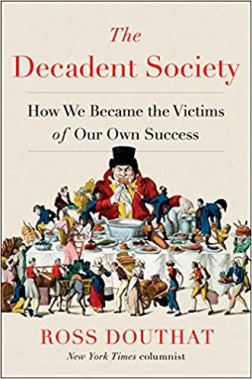
Decadent SocietyEarlier this week I posted a classic Calvin and Hobbes Sunday strip having to do with perspective, particularly what happens Calvin tries to “engage” his dad in some kind of “minor debate.”  It’s a visually brilliant strip that points to some bigger truths.  Because perspective is difficult.  And there are different ways of getting it and different ways of understanding it.  And that requires a particular kind of humility.

Earlier this year, Ross Douthat (columnist at the New York Times) released The Decadent Society: How We Became the Victims of Our Own Success.  I got a few chapters into it before Covidtide came along.  At that point, it seems like I gave up most books in order to follow Twitter and read longer pieces online.  One thing my summer online class has done for me is it has forced me back into my books.  So I’ve spent the last couple of days finishing the first section of Douthat’s work.  He’s a great writer, I think, super-easy to read and often saying hard truths in interesting ways.

The premise of the book is that America has entered a period of decadence, which he defines as “economic stagnation, institutional decay, and cultural and intellectual exhaustion at a high level of material prosperity and technological development.”  From there, he introduces what he calls the “four horsemen” that signify this state of being:

It describes a situation in which repetition is more the norm than innovation; in which sclerosis afflicts public institutions and private enterprises alike; in which intellectual life seems to go in circles; in which new developments in science, new exploratory projects, underdeliver compared with what people recently expected.  And, crucially, the stagnation and decay are often a direct consequence of previous development.

It is important for Douthat to help the reader to see “decadence as something more specific than just any social or moral trend that you dislike.”  And then he wants the reader to see that decadence doesn’t necessarily bring things to a swift death and rebirth; instead, decadence can last for a long time.

All to say that I find Douthat’s argument substantive and sobering, particularly in light of the last three months.  All of the facets of Our Current Moment have been apocalyptic in the sense that they are showing, really pointing out, how much of Douthat’s basic assertions hold weight.  And those four horsemen (stagnation, sterility, sclerosis, and repetition) make an interesting and beneficial framework for understanding specific institutions and ideas as they ground a survey of things in the history of something and not just in a particular moment.

I mention all of this because this is both the stew and the pot for me.  It’s both content and content holder.  Any handle we can have to understand things more fully, to gain perspective, is a good thing.

Posted in Books, Notes for a World's End | Tagged | 1 Comment

Mountains Again

Appropriate for today for many reasons, I think.

Posted in Books, Movies | Tagged , | Leave a comment

SHIELD’s Own Endgame?

Things with Marvel’s Agents of SHIELD took an interesting turn this week.  It looks like we’re spending roughly two episodes in each time period, and each time period is revealing more of the thread that entwines SHIELD and Hydra.  So even though there are no Infinity Stones involved, Coulson’s team is on its own kind of “Endgame” travel through history to some key moments.  And, unlike the first story of the season, this story saw the team changing the time stream in a significant way: saving Agent Sousa and bringing him onto the team, at least for a while.  Here’s the preview for next week’s episode.  It looks to a lot of fun.

Posted in Television | Tagged | Leave a comment

Wednesday Evening Song

A little music from the Avett Brothers to close out the middle of the week.

Posted in Music | Tagged | Leave a comment

Turing Test in Reverse?

This week’s new Agents of SHIELD took us to Area 51 in the 1950s.  There was some nice humor mixed in with this week’s hunt for the evil robots from the future.  Plus there was the arrival of Agent Sousa (from Agent Carter) to set up.  Here’s a clip.

The team has faced some interesting ethical dilemmas as they tour the past.  Next week’s looks particularly difficult.

Posted in Television | Tagged | Leave a comment

Ministry is Friendship

I’m just  few hours away from the first live Zoom meeting of the course that I’m auditing this summer through my old university.  I am cautiously optimistic about the opportunity.  Last night I sat down to write my reflection of Gilead.  I’m maybe 75% happy with it?  I had hoped to frame it a little differently, but the given prompts didn’t quite line up like that (which is fine).

The thing is, I’m almost desperate for a place to talk about/reflect on ministry.  These last, mostly-three years of working with our Christian Ministries program along with my regular responsibilities teaching Bible have left me producing a lot of content that I believe in, but it’s also crowded out some other things that I think should be necessary when talking about the implications and realities of the Gospel.  Beyond that, I’ve learned that leadership often means everything BUT “getting your own way.”  Voices come at you from every direction, and a big part of leadership seems to involve harmonizing those different voices as much as possible, even if it means that you don’t get to sing what you would like.

I’ve had a few ideas percolating over the last few months that I’ve wanted to get down somewhere.  A lot of what I’ve been thinking about is a mix of personal experience blended in with the thoughts of people like Jamie Smith or Andrew Root or Ephraim Radner.  (Maybe I’ll reflect on each of their influences later).  I often find that much communication about what I say or do through class or chapel or camps is evaluative: good job, great approach, well-done type stuff that is fine but not very helpful on a heart level.  But you can’t respond with that because then you’re looking down on something intended to encourage.  But since it looks like I’m up for another year of doing what I’ve been doing temporarily, I need to get some things down and out.  And so here’s where I want to start:

Ministry is friendship.  And friendship is ministry.

Anything less than friendship in ministry is likely to be mutual manipulation, even at its best.

Don’t get me wrong: ministry is many things.  There are lots of ways to approach ministry, and some are better than others.  But in the big picture, in the “long obedience,” I think the thing most needed and least defined in ministry is friendship.

Ministry often starts with an imbalance: I’ve got something you don’t have that I want you to have and I want to help you get it.  And rightly so.  The Gospel must be preached.  Faith comes by hearing.  But what does that look like over time?  How do we best understand the kingdom of God around us?

At some point, the Good News of Jesus is a reality experienced amongst equals.  The New Covenant as mentioned in Jeremiah 31 hints at this:

“This is the covenant I will make with the people of Israel
    after that time,” declares the Lord.
“I will put my law in their minds
    and write it on their hearts.
I will be their God,
    and they will be my people.
No longer will they teach their neighbor,
    or say to one another, ‘Know the Lord,’
because they will all know me,
    from the least of them to the greatest,”
declares the Lord.

I think that’s a big part of the ontological reality of being considered brothers and sisters in Christ.  At some point, the connections between people has to go from a distributionist/top-down model to a form of brothers-and-sisters model.  Sure: there will be moments when one has what the other needs (particularly if there is a brother in crisis), but more often the communal life amongst followers of Jesus will be about bringing common things to share at the table (as brothers and sister in Christ).  The difficulty with programmatic Christianity, with a kind of hierarchical Christianity, with a kind of Christianity that is not keyed towards growth in Christ towards Christ-likeness, is that an unfortunate approach to community and unity is adopted that might actually do more damage in the long run because of how it sets up a potential mutual manipulation based on the needs of the program or the institution that may ultimately have little to do with the person right in from of you who is seeking to become more like Jesus in ways that the tyranny of the urgent just doesn’t allow for.

Ministry is friendship.  And friendship is ministry.

Anything less than friendship in ministry is likely to be mutual manipulation, even at its best.

That’s a start.

Posted in Faith, Teaching | Leave a comment

Strange Summer Day

Today didn’t go as I had planned at all.

Last night I noticed something stuck in my right front tire: turned out to be a screw.  No real leak, but you can’t be too careful.  So my day started with a trip to Goodyear to get that taken care of.  While my car was in the shop, I made my way back to school only to find that I had not actually signed up to be on campus.  So there went my morning pans.  Spent some time with the neighbors before going to pick up the car.  Decided to grab lunch from Teddy’s Bigger Burgers, which was a nice treat.  I found out later that Matthew Crawford’s new book had dropped, which led to a quick trip to Barnes and Noble (which is now open for business).  And tonight was spent writing a kind of reflection on Marilynne Robinson’s Gilead for Thursday’s class.

So what I had hoped to write today will have to wait until tomorrow.  In the waiting, though, is a quote from Gilead that I quite like but that didn’t make it into this week’s reflection.  From the letter of Reverend John Ames to his son:

I feel sometimes as if I were a child who opens its eyes on the world once and sees amazing things it will never know any names for and then has to close its eyes again.  I know this is all mere apparition compared to what awaits us, but it is only lovelier for that.  There is a human beauty in it.  And I can’t believe that, when we have all been changed and put on incorruptibility, we will forget our fantastic condition of mortality and impermanence, the great bright dream of procreating and perishing that meant the whole world to us.  In eternity this world will be Troy, I believe, and all that has passed here will be the epic of the universe, the ballad they sing in the streets.  Because I don’t imagine any reality putting this one in the shade entirely, and I think piety forbids me to try.

Posted in Books, Faith | Leave a comment