
It’s been a long day of travel, walking, and eating. Here’s a quick picture of one of my favorite places in Victoria: Russell’s Books. And I only bought two books today.
 And this isn’t even my favorite section of the store . . .
It’s been a long day of travel, walking, and eating. Here’s a quick picture of one of my favorite places in Victoria: Russell’s Books. And I only bought two books today.
And this isn’t even my favorite section of the store . . .
I haven’t seen much in Awaiting the King (by James K. A. Smith) that deals with Rod Dreher’s “Benedict Option” aside from one or two “so-called Benedict Option” lines. So I was a little surprised to see a longer mention of it in this recently-released video that serves as a kind of “promo” for the book.
It’s an interesting juxtaposition, for sure: cozying up to political power on one end and running from it in fear on the other. I’m glad to see Smith acknowledging the close connection between his approach and Dreher’s. And while I do have a better sense now of where Smith’s frustration with the Option comes from, I can’t help but think that there’s a difference between fear and facing reality. I think Dreher’s assumption is that most Christian communities are no where near ready for the kind of engagement Smith thinks is possible. We need some rehabilitation to get there. And, ironically enough, Smith’s work is one way of helping that rehabilitation along.
I’m slowly making my way through James K. A. Smith’s Awaiting the King, hoping to have it read through once before Thanksgiving. It’s a good read that brings a lot of threads together (along with some nice nods to pop culture, which is always appreciated). One thing that Smith does early on is address the question of the “social imaginary” of politics. Social imaginaries were a big part of the first Cultural Liturgies book, so I’m glad to see that thread brought back here. In this video, Smith talks about “space” and the liturgical reality of our political and public lives.
 Joshua Gibbs, who teaches at a classical Christian school in Virginia, recently recounted what happened when he challenged his sophomore students to consider the “rule” of St. Francis in the context of adopting their own “rule” for living for one week.
“Rule,” of course, is a tricky word for many of us, one rife with opportunity for equivocation and miscommunication. Most of us hate rules. But most of us also understand our need for rules. And then, when you add the monastic concept of “rule” into the mix? Well, that doesn’t happen as often as it should. Gibbs reflects:
What do American Christians think of rules? Christians are suitably concerned that this nation should have the right rules governing marriage and immigration and abortion. But when a Christian leaves earthly concerns behind and begins to dwell on working out his salvation with fear and trembling, he is often tempted to turn up his nose at the rules, dismissing them as legalism.
And legalism, definitely, is something we are constantly challenged to avoid.
If legalism is a disease, the cure is worse. Christians in this country have heard “Doing X does not make you a Christian” for so long, they do not know what Christians do. Many are offended at the idea that Christians should do anything, for salvation is a state of being, and being transcends acting. The less we do, the greater our faith.
Gibbs has much to say in the article concerning temptation, which is pointed and refreshing. Even recently reflecting on the Christian year (starting soon with Advent), I was reminded of how the series of moments from Advent to Pentecost, too often clothed in party garb, is really corrective and medicine. Gibbs adds:
If Christians would fight temptation, they must have not only the desire to win, but a strategy for obedience that respects the prowess of their enemy.
For Gibbs, a “rule” in the monastic vein isn’t simply about things Christians already know they should do. Some of this students mentioned things like gossip and kindness, things explicitly mentioned in Scripture. Things like bed times and tech use? not so much. And that’s where a “rule” comes into place.
I’ve been thinking about rules for some time, definitely since moving to Hawaii a decade-and-a-half ago. Some of that stems from the practical reality of living alone, which can make the rhythm of life inconsistently difficult (and assumes, rightly or wrongly, that families and households have it better). Some of that stems from a felt frustration with church life, with Christian community: how do you maintain a proper disposition of faithfulness when church life looks more like programs and parties? How, even, do you talk about the Christian life without a language to support it (and the language of programs and parties is definitely deficient here)?
Scripture, perhaps, asserts that “this is the way the world moves.” A “rule,” then, is a way for us to move through it and with it.
As we move closer to the beginning of the church year with Advent, I can’t help but feel some hope for the return of a kind of rhythm that has disappeared during these months of “ordinary time,” when it has felt like “anything goes” and that whatever happens happens. Not only that, but simply being pushed back and forth amongst different calendars (be it from Hallmark or the school hallway) makes you want to find good root in something deeper.
You can read more of Gibbs’s article here.
(image from meteora.com)
 I finished the second season of Stranger Things Tuesday night. Or rather I should say “we,” as I was grateful to get to watch the season with friends (the same from season one). That kind of thing seems only appropriate for a show rooted in friendship, in a kind of adventure that eludes most of us now that we are deeper into adulthood.
It was a good season. Odd, really, because of the show’s comfortability. Really, I suppose, it’s our comfortability with the characters. The show, really, is anything but comfortable. At moments, it felt like an after-school version of Broadchurch, with everyone struggling to make sense of something both foreign and right before their eyes. To summarize the thoughts of others: the season was part Aliens, part Goonies, and part the Exorcist (and that doesn’t even include Eleven’s X-Men like turn in episode seven). I suppose that, on some level, it was easier to take certain thematic elements for granted now that we have two seasons of Hawkins goodness.
Nick Olson recently posted an article at Image Journal that gets at something about the show and its allure (hat-tip to Twitter for the find). Olson asserts:
My mind is first drawn to the context of watching Stranger Things before the show itself. This is instructive for how the show has become a pop cultural phenomenon: Its attention to the past isn’t reducible to its 1980s setting. I was born in 1985, but I am a child of the 90s. I miss more of the show’s references than I recognize, yet its nostalgic spell affects me.
If nostalgia is the ache of homesickness, then the longing that animates Stranger Things isn’t reducible to the desire for Phil Collins and mullets and Dungeons and Dragons. The show’s sense of nostalgia is deeper and wider—perhaps the powerful subtext that some critics have been looking for.
Stranger Things recognizes the profound ways that we are estranged from home, enfolding the resultant nostalgia into the show’s every layer.
Nostalgia compounds “homecoming” and “pain.” I’m intrigued by how the show’s nostalgic sensibility is situated in horror and science fiction. The scares are fundamentally about homesickness, and science fiction, even when set in the past, orients us to the future—to where our scientific discovery and technological application can lead us.
Stranger Things combines these—nostalgia, horror, and science fiction—into a potent brew for us to binge until we are familiar again with what ails us.
I’m not quite sure most are willing to do much more “with what ails us” than by being reminded of it, but something like Stranger Things is at least good for that if not more.
I think the thing that stood out the most to me this time around was how utterly fearless most of these characters were written to be: jumping into underground tunnels, driving into the lions-den of demadogs, wielding gnarly bats and drug-soaked needles. The single-synapse reactions were a good and refreshing challenge for those of us who take way to much time to decide to do what is good and right.
There’s a part of me, of course, that wants there to be a third season. Another part of me, though, feels like this was a good and appropriate ending to the story (at least on the personal level, not so much on the narrative of the Upside-Down invasion). In that way, it’s like Broadchurch season two, too. Even still, I’ll enjoy the third season when it comes, hopefully with friends.
You can read the rest of Olson’s article here. The last three paragraphs are quite good.
(image from heroichollywood.com)
 Thanks to the kind folks at Hearts and Minds Books, I was able to get my copy of James K. A Smith’s Awaiting the King a few days before the actual release day. And so I waited for Thor:Ragnarok by reading through the preface and introduction to the third volume in Smith’s “Cultural Liturgies” series.
There’s something very comfortable for me about reading Smith. In some ways, he reads a lot like Steve Garber: a consistent blend of pop culture references with ancient texts and everyday concerns that sheds real light on things too easily taken for granted. It definitely makes you want to take your time with the book. When necessary, Smith writes with a good kind of density, too. Good footnotes and interesting asides abound (and really, do I want to see the oft-maligned The Postman now? maybe a little).
From the outset, it is clear to me why Smith looks askance at Rod Dreher’s “Benedict Option.” It has something to do with hope, I believe. He (perhaps incorrectly) interprets Dreher’s proposal as a kind of giving-up-hope, which defeats a key part of Smith’s purposes in the book. Reading Smith excites me, but Dreher’s work connects more with lived experience and concern, I think.
Thirty pages in, one of the things that I am appreciating most about Awaiting the King is the constant reminder of the significance of the telos, the end point of the design, that to which things point. I feel the tension of the lack-of-telos often, really. It is a refusal to see (or be reminded of) a viable big picture. And so we are too often left with our own little “scenes” and our own individual “purposes” when something more clear and true is available. That ought not be, particularly when it comes to church and to education, to areas of life where telos should be “baked in” to the composition of things.
Smith asserts something basic and easily forgotten in the introduction that Christians today would do well to remember. Smith asserts:
There is something political at stake in our worship and something religious at stake in our politics.
That’s true across the board, whether or not you believe that a good God has involved Himself intimately in the unfolding of creation. I’m looking forward to seeing how Smith unpacks that thought particularly while using the work of Augustine and O’Donavan for framing the big picture of what is at stake.
(image from bakerpublishinggroup.com)
 My friends and I are just under halfway through the second season of Netflix’s Stranger Things. The end of episode three was so good that the fourth episode kind of begged to be watched.
It’s odd to reflect on the slow build of the first season . . . and then to remember the intensity of how it all came together in the end. Like so many “second” acts of a story, this second season has all of the main characters, all of those who shared the experience of season one, on their own trajectories. And so as they make questionable decisions, you find yourself doubly frustrated because you know they know better. And yet, because that’s the way both life and TV are, they don’t. And so season two brings with it a slow reweaving with a couple or three new strands added into the mix.
The theme of friendship is present, of course. As I saw from a quick glance of my Twitter feed a few days ago, there’s also something going on with processing trauma. That’s one big “meta” way that the show seems to be working this time around, which kind of makes it a science fiction version of Broadchurch, where things move forward at a deceptive, almost seeming retrograde, pace. With that sense of loss and devotion and trauma comes a cast of characters acting out, grasping for some way forward, even if it has the potential to cause more damage.
It’s fun having little real sense of where the story will end. The thing about franchises based on preexisting properties is that there’s a predictability to them that is both comforting and constraining. That’s not the case with newer, “smaller” shows that get to play by their own rules. I look forward to seeing what happens in the second half of the season.
(image from denofgeek.com)
A few days before Halloween, New York Times columnist Ross Douthat posted an op-ed that hit at something I’ve been thinking about for a while, particularly as it relates to Christian faith & practice and the seeming inability of Christians to talk well about what’s actually happening in life. Douthat calls is “the misery filter,” something rooted in the practice of screening out all of the negative aspects of life when using social media. By the end of the op-ed, he pins the problem on education. From the piece:
Because this seems to me to be the signal failing of modern education — visible among my own peers, now entering the time of life when suffering is more the weather than a lightning strike, but especially among the generation younger than us, who seem to be struggling with the contrast between what social media and meritocracy tell them they should feel and what they actually experience.
In America we have education for success, but no education for suffering. There is instead the filter, the well-meaning deception, that teaches neither religious hope nor stoicism, and when suffering arrives encourages group hysteria, private shame and a growing contagion of despair.
How to educate for suffering is a question for a different column. Here I’ll just stress its necessity: Because what cannot be cured must be endured, and how to endure is, even now, the hardest challenge every one of us will face.
And while that really is the most quotable chunk of the piece, there’s something earlier in Ross’s thinking that stood out to me, that gets me each time I read it:
We tend to be aware of other people’s suffering when it first descends or when they bottom out — with a grim diagnosis, a sudden realization of addiction, a disastrous public episode. But otherwise a curtain tends to fall, because there isn’t a way to integrate private struggle into the realm of health and normalcy.
Because we don’t have “a way to integrate private struggle into the realm of health and normalcy.” He’s right. He’s right. He’s right. And because we don’t, we don’t really know what to do when the curtain falls or the diagnosis comes or things altogether fall apart. And so it festers (something Lewis hints at in The Great Divorce).
One of the comments made by those saying good and wise things about the disastrous end results of the sexual revolution of the late 20th-century get this, I think. They know the collapse is coming. And some of them are trying to “shore things up” so maybe there can be some recovery from the fall. But if we don’t learn the language now, if we don’t find a way to make normal the day-to-day struggle that is life itself (and glossed over by our digital veneer), we will have failed long before the bottom falls out.
You can read all of Douthat’s op-ed here. If you’re like me, you can send it to some people. Hopefully they’ll find a way to respond.
Part of me thinks the stakes are quite high for James K. A. Smith’s Awaiting the King. That’s partly because of the cultural and political climate in which we find ourselves. Attached to that is the seeming “attack approach” that Smith has taken to Rod Dreher’s Benedict Option (which is unfortunate because I’m pretty sure they’re closer to one another than Smith would admit). Beyond that, Smith has gained some real credibility with those outside of academic circles through You Are What You Love, a book I’ve been outspoken about for sure.
In this recent video, Smith makes some sense of how Awaiting the King developed as the third book in his Cultural Liturgies series.
And here, Smith draws some lines of connection between You Are What You Love and Awaiting the King.
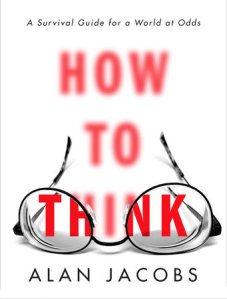 This morning I started my my quick second-reading of Alan Jacobs’s recent release, How to Think. Over the last two years, Jacobs’ voice has become one that I both enjoy and heed. While he doesn’t blog as much as I would like (and beggars can’t be choosers), I do find that what he does blog is always a good challenge.
In a lot of ways, How to Think reminds me of The Tech-Wise Family. Both are smaller books, quick reads, that present some very practical concepts and actions. Thinking, of course, is a broad and winding thing, so there are some differences. Jacobs, wisely so, begins with a quick definition-of-sorts for thinking:
This is what thinking is: not the decision itself but what goes into the decision, the consideration, the assessment. It’s testing your own responses and weighing the available evidence; it’s grasping, as best you can and with all available and relevant senses, what is, and it’s also speculating, as carefully and responsibly as you can, about what might be. And it’s knowing when not to go it alone, and whom you should ask for help.
Even in teaching circles, we often speak of thinking without necessarily defining it. And because we deal so often with propositional truth and “obvious” facts, thinking can come across as something like an unnecessary skill. But it is a process, one that too often occurs below the surface. And we would be wise to pay attention to how we have learned to do it.
The book’s introduction alone is full of nice gems. One other that stands out to me has to do with the academic environment, something close to Jacobs’s heart as a college professor for three decades. Jacobs asserts:
So, again, no: academic life doesn’t do much to help one think, at least not in the sense in which I am commending thinking. It helps one to amass a body of knowledge and to learn and deploy certain approved rhetorical strategies, which requires a good memory, intellectual agility, and the like. But little about the academic life demands that you question your impulsive reactions—
Once again, learning as an engagement with obvious facts is nothing like what Jacobs seems to hope for his readers and students. Knowledge is necessary for good thinking, the first step out of the door, really.
You can purchase your own copy of How to Think here or get it wherever great books are sold (though you may have to ask where to find it . . . at the local Barnes & Noble, it was placed in the “brainpower” section, which I didn’t even know existed).


 Space Enough, and Time