“The Days are Just Packed” No More?

empty playgroundOne of my favorite Calvin and Hobbes Sunday strips (and collections) involves a long summer day with Calvin’s final comment of how “the days are just packed.”  I think most of us feel that way . . . and most of the time, really.  And because of our weird substitute of leisure for rest, even our time off feels like work.  What, then, does it mean for a day to be packed “well”?

Andy Crouch has a lot to say about daily life in The Tech-Wise Family.  As with so many other gems, his comment on the necessity of sleep alone is worth the admission price (and hints at one big reason why lots of contemporary approaches to education are possibly failures at the most important things).

One of the most interesting assertions that Crouch makes (particularly in the chapter “Learning and Working”) has to do with how the “easy-everywhere” mentality of technology can short-circuit things for children as they mature.  Crouch asserts that “the best and richest experiences of learning, it turns out, are embodied ones.”  He continues:

We are made to live and learn in a physical world. And no human beings are more exuberantly and fundamentally rooted in the body than children. As children, our bodies are full of energy and primed for physical learning. We are designed to explore our world and learn through all our senses.

From there, Crouch articulates how technology can make things “dangerously easy.”  He says:

The last thing you need when you are learning, at any age but especially in childhood, is to have things made too easy. Difficulty and resistance, as long as they are age appropriate and not too discouraging, are actually what press our brains and bodies to adapt and learn. From the earliest games of peekaboo to the challenge of mastering a sport or a musical instrument, we are designed to thrive on complex, embodied tasks that require the engagement of many senses at once, and not just our senses but our muscles, from the tiny adjustments possible in the human hand or voice to the gross motor movements of legs and arms . . .

But now, very early on in our lives and learning, we are substituting a single kind of activity, a dangerously easy and simple one, for the difficult, multidimensional kinds of activity that the real world offers us.

One concept prevalent in education is “the gradual release of responsibility.”  I wonder if we have lost site of “the gradual increase of difficulty” in relation to things that really matter, things that might give the impression of being easily solved.  It’s difficult to have an deeper, intricate conversation with those who see no need to understand something intimately because the only answers worth seeing are the easy ones.

You can order your own copy of Crouch’s The Tech-Wise Family here.  I highly recommend it.

(image from shutterstock.com)

Posted in Books, Teaching | Tagged | Leave a comment

Work and Rest, Toil and Leisure

leisureOnce you get past the prolegomena of The Tech-Wise Family (which I mentioned here), Andy Crouch walks readers through ten “commitments” classified in three groups: key decisions, daily life, and what matters most.  The first section, of key decisions, picks apart contemporary ideas of character, space, and time, primarily in relation to the family.  Having said that, one of the most beautifully rendered parts of the book is Crouch’s consideration of church-as-first-family.  (I imagine I’ll come back around to that section of the book at some other time in another framework.)
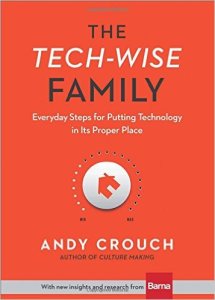
Crouch has a lot of good thing to say to people contemplating technology as it relates to character formation and use of space.  But it’s his approach to the question of time that I find most convicting in the current moment.  Crouch begins with imagery from Exodus concerning the Sabbath.  Crouch writes:

We are meant to work, but we are also meant to rest. “Six days you shall labor and do all your work. But the seventh day is a sabbath to the LORD your God; you shall not do any work— you, your son or your daughter, your male or female slave, your livestock, or the alien resident in your towns” (Exod. 20: 9– 10). One day out of seven— and, even more radically, one year out of seven (Exod. 23: 10– 11)— the people of God, anyone who depended on them or lived among them, and even their livestock were to cease from work and enjoy rest, restoration, and worship. They were called, you might say, to ceasing and feasting: setting aside daily labor and bringing out the best fruits of that work, stored up in the course of the week and the year, for everyone to enjoy.

I have come to appreciate the idea of “ceasing and feasting,” particularly through time spent with my Anglican friends (who often think of it in terms of “fasting and feasting”). The question, of course, is how do you live well into such an idea?  Crouch asserts:

Instead of work and rest, we have ended up with toil and leisure– and neither one is an improvement.

I like the distinction between rest and leisure, particularly as it plays out in lived experience.  Having time off does not guarantee actual rest, and that’s true even in light of taking work home with you.  What can you do that constitutes real rest?  It’s a little like my view of recreation.  Surely it has something to do with being refreshed, being brought back to life, a spending of life for new life and not just a purposeless wasting away.  Crouch’s concern, of course, is the role that technology has played in such shifts.

If technology has failed to deliver us from toil, it has done a great deal to replace rest with leisure— at least for those who can afford it.

If toil is fruitless labor, you could think of leisure as fruitless escape from labor. It’s a kind of rest that doesn’t really restore our souls, doesn’t restore our relationships with others or God. And crucially, it is the kind of rest that doesn’t give others the chance to rest. Leisure is purchased from other people who have to work to provide us our experiences of entertainment and rejuvenation.

A game of pickup football in the backyard can be real rest (as long as the competitive spirit doesn’t get out of hand!). But watching football on TV is leisure, and not just because we’re not burning many calories. It is leisure because we are watching others work, or indeed toil, for our enjoyment. It doesn’t really matter whether the workers are well paid, like professional football players, or paid minimally and indirectly, like college athletes. From the point of view of the Sabbath commandment, it’s still work.

You can read more of Crouch’s take on “character, space, and time” here.  It’s one of most thoughtful-and-practical books that I’ve read in a good while.

(image from gamingandleisurenews.com)

Posted in Books | Tagged | Leave a comment

Life by the Right Rule

tech-wisePerhaps the most wonderfully frustrating thing about Andy Crouch’s The Tech-Wise Family is its reminder that daily life matters.  It is in the day-in and day-out, Crouch asserts, that something like character is formed. For Crouch, the family is key to proper formation.  And proper formation is tactile, physical.  Too often in contemporary life, the stuff that shapes us is abstracted, diffuse and indifferent.  That’s especially true for those of us living the single life far from day-to-day family.  This realization, Crouch’s basic assertion of a rule for contemporary life, is enough to make the book special.
The most powerful choices we will make in our lives are not about specific decisions but about patterns of life: the nudges and disciplines that will shape all our other choices.  This is especially true with technology.  Technology comes with a powerful set of nudges– the default settings of our “easy-everywhere” culture.

Crouch presents some real wisdom within the 200 little pages of The Tech-Wise Family. He understands the stakes, though, and that the stakes are high.  Also from the introduction:

We are continually being nudged by our devices toward a set of choices.  The question is whether those choices are leading us to the life we actually want.  I want a life of conversation and friendship, not distraction and entertainment; but every day, many times a day, I’m nudged in the wrong direction.

Crouch’s book helps “nudge” us back into a better direction and way of life.  Over the next three days, I’m going to mention three personal highlights from the book.  I cannot recommend the book enough, particularly if you have a young family or work with students and their parents.

You can purchase the book here or (hopefully) at your local bookseller.

Posted in Books, Teaching | Tagged | Leave a comment

Like Leaving the Piano in Ohio

pianoDouglas Coupland prefaces Bit Rot, his most recent collection of essays and stories, with this:

When the pioneers crossed North America from east to west, the first thing to be thrown off the family Conestoga wagon was the piano, somewhere around Ohio.  Then, somewhere near the Mississippi River, went the bookcase, and by Nebraska off went the books . . . and by Wyoming, everything else.  The pioneers arrived in the Promised Land owning only the wagon and the clothing on their backs.  They may have missed their pianos, but in the hard work of homesteading, they didn’t have the time or energy to be nostalgic.

This image, Coupland asserts, is one way of understanding the person journey he has been on since the dawn of the 21st century as he “shed[s] older and weaker neurons and connections and create and enhance new and unexpected ones.”

I understand the feeling.  In another recent post, I expressed a feeling of having to deal with baggage, with the accumulation of things.  And so the imagery of “leaving it all behind,” even bit by bit, has its appeal.  I don’t think, though, that I’m at a place anywhere near Coupland, who adds:

By 2007 I realized that the future that was once this far-off thing on the horizon was coming closer quite quickly, and then somewhere around 2011 or 2012, the future and the present merged and became the same thing– and it’s now always going to be this way, and we are now always going to be living in the future. (Coupland’s emphasis)

There is something healthy, I think, about this.  And yet to write off pianos and books and the shelves that hold them as simple nostalgia seems a bit much.  I think we are all going through some version of this triage, though, trying to figure out what stays and what goes as we move to whatever seems to be next in contemporary American culture.  As always, that makes me grateful for a thinker and writer like Coupland.

I’m looking forward to reading Bit Rot over the course of the summer.  Over 60 pieces in just over 400 pages makes it a piece that will hopefully be as much a joy as Jonathan Lethem’s The Ecstasy of Influence.  You can order your own copy of Bit Rot here, or you can purchase it at your local bookstore.

(image from mulpix.com)

Posted in 2017, Books, The Long Story | Leave a comment

Temporary Vocational Stretch

Moleskine ProfessionalBecause of changes and restructuring at work, I’ll be taking a temporary vocational stretch in the fall.  The conversation has been mostly in-house at this point, which is fine by me.  It will require me to work on some of my weaknesses, for sure.  I’ve been blessed over the last few years with being able to set good things in place that don’t need much tweaking.  That won’t be the case for the next semester.  I’ll still spend a majority of my time in the classroom, but there will be a lot more meeting and planning with things beyond my comfort zone.  (I think my year-end meeting count has doubled, if not tripled.)  This weekend I even bought a paper planner.  One that has multiple sections for each page (and each page represents one day).  This is no small thing for me!

There are moments where I get a little panicky.  Well, panicky isn’t the right word.  I just feel the weight of it, I suppose.  I am hopeful.  But I also feel saddled with stuff.  I am very aware of the build-up of stuff over time, like plaque on your teeth, and the care needed to remove the build-up and bring some kind of healing.  That kind of accumulation is often my greatest complaint with any given system.  Systems, often, don’t know how to take care of those build-ups as they happen.

So here’s to praying and planning and striving to understand and act in good and healthy ways.  I imagine that I’ll share more about it as the summer progresses.  I have the feeling that I’ll be learning a lot.

(image from officesupplygeek.com)

Posted in Teaching, The Long Story | Leave a comment

The Echo of Voices (where the streets have no name)

While it’s great seeing U2 perform live, it’s really the audience-as-choir that gets to me.  Got to me when I saw the in concert over a decade ago.  Gets to me in this recording of “Where the Streets Have No Name” from a recent concert in Houston.

Posted in Music | Leave a comment

A Song of Lament and Praise

What a last couple of weeks it has been!  The highs and lows of life can be so tightly woven together that they bleed together in weird and subtle ways, where every praise is also a prayer request.  Here’s a just-posted classic from Andrew Peterson.  I like the honesty of the introduction, but I love the way the lyrics and music build in the song itself. “Hosanna,” indeed.

Posted in Faith, Music, The Long Story | Leave a comment

Finish Line Flashpoint

After a pretty interesting conclusion, this ending came out of no where.

This could easily be a way of returning Barry to the proper, pre-Flashpoint, timeline.  We’ll have to wait all summer to find out.

Posted in Television | Leave a comment

Cloning Time

We’re less than a month away from the final season premiere of Orphan Black on BBC America.  Season four was a solid course correction after two seasons of wandering.  I’m hopeful that this season will bring everything together nicely.  Here’s the official trailer.  (And yes: all the mains are played by the same actor.)

Posted in Television | Leave a comment

From a Flash to a Crawl

Much of this season of The Flash has been about Barry’s (always thwarted) attempt at saving Iris, the love of his life.  Last week’s penultimate episode ended with one last failure, this one seemingly final.  The extended trailer to Tuesday’s finale is fittingly subdued.  Because of that, though, there are lots of things left unsaid and open.

“Finish Line” is also the end of basic network scripted television for the summer for me.  Still finales of Survivor and The Amazing Race to air.  Cable keeps Doctor Who and Fargo in play, at least until Orphan Black jumps into its final season mid-June.  I imagine I’ll get around to recapping the “year” at some point in early June.

Posted in Television | Leave a comment