Lectures and Lessons

Michael_Ondaatje_Tulane_Lecturn_2010A couple of weeks ago, Molly Worthen of UNC-Chapel Hill posted an op-ed piece to the New York Times that got a nice bit of traction in some education circles.  “Lecture Me. Really.” was a reminder of the significance of the lecture as a means to an education.  Anyone who spends anytime in the classroom or keeping up with teacher talk knows that the lecture format is a highly-debated thing (who wants bored students?). From the essay:

In many quarters, the active learning craze is only the latest development in a long tradition of complaining about boring professors, flavored with a dash of that other great American pastime, populist resentment of experts. But there is an ominous note in the most recent chorus of calls to replace the “sage on the stage” with student-led discussion. These criticisms intersect with a broader crisis of confidence in the humanities. They are an attempt to further assimilate history, philosophy, literature and their sister disciplines to the goals and methods of the hard sciences — fields whose stars are rising in the eyes of administrators, politicians and higher-education entrepreneurs.

I like what Worthen has to say about “lecture as argument.”  She goes on to say:

Those who want to abolish the lecture course do not understand what a lecture is. A lecture is not the declamation of an encyclopedia article. In the humanities, a lecture “places a premium on the connections between individual facts,” Monessa Cummins, the chairwoman of the classics department and a popular lecturer at Grinnell College, told me. “It is not a recitation of facts, but the building of an argument.”

Absorbing a long, complex argument is hard work, requiring students to synthesize, organize and react as they listen. In our time, when any reading assignment longer than a Facebook post seems ponderous, students have little experience doing this. Some research suggests that minority and low-income students struggle even more. But if we abandon the lecture format because students may find it difficult, we do them a disservice. Moreover, we capitulate to the worst features of the customer-service mentality that has seeped into the university from the business world. The solution, instead, is to teach those students how to gain all a great lecture course has to give them.

The Week‘s Damon Linker liked the essay but felt like Worthen didn’t go far enough.  He suggests that something more should be added (but that it’s something that humanities professors are ill-at-east to do):

A more powerful and compelling defense of the humanities lecture course would have to proceed differently — into terrain that professors of history, philosophy, and literature often find exceedingly uncomfortable these days. Such a defense would require that they confidently assert that professors in the humanities possess knowledge, that this knowledge is valuable, and that the most effective way of conveying it to unknowledgeable students is to explain it to them in a lecture format.

He goes on to list reasons why this can be a difficult stand to take (thanks, post-modernism, verifiability, and certain aspects of democracy).  But then:

Why do students of history need teachers who will stand at the front of a classroom and lecture? Because history is hard. It presupposes the knowledge of thousands of facts (names, dates, events) and how they fit together into an enormously complicated, multi-dimensional causal sequence. Until the students absorb those facts and grasp that causal sequence, “group work” and other forms of interactive learning are premature.

That’s why lecture-based courses that do the introductory work of explaining the past must come first — and why such courses are typically followed by smaller, more advanced seminars that foster conversation and debate and raise questions of historiography (competing and conflicting interpretive traditions about the past). By that point, students have learned enough — they know enough — to begin participating more actively in their own education.

That’s not easy for many to read or hear: we’ve become a culture of academic instant gratification.  But Linker is definitely on to something.  You should read the rest of the article here.  The question of “best practices” is a real and powerful conversation taking place in schools all over the country.  Because lecturing well isn’t something that everyone can do, it’s much easier to promote a “coach from the side” mentality.  It’s to our loss, though.  And in the long run, to the loss of our children.

Posted in Internet, Teaching | Tagged | Leave a comment

Our Final Word

I have often wondered if Steven Curtis Chapman would get around to making a “worship album.”  When the trend hit years and years ago, I was dismayed.  I’m one of that rare breed that sees the praise and worship movement as “that which killed CCM.”  So as each major recording artist put together collections of popular worship hits and personal additions to the mix, I cringed a bit and backed off.  But SCC seemed to mostly stay away.

Turns out that he has a worship album dropping in the spring and that the first song from the album, “Amen,” is already available online.  And I have to admit: it’s pretty good.  Why?  Because it’s simple and obviously and consistently scriptural.  I’ll be curious to see what he does with the rest of the album.  I’m hoping to pleasantly surprised.

Posted in Faith, Internet, Music | Tagged | Leave a comment

Categories of Conversations

Fence TalkI’m about a week into Sherry Turkle’s Reclaiming Conversation: The Power of Talk in a Digital Age.  As is often the case when reading about a given topic, you start to notice it everywhere once it’s on your radar.  So while I’ll get back to Turkle’s book later, I thought I’d share a snippet from a recent interview with Wendell Berry from The Modern Farmer.  As I’ve mentioned before, something about Berry’s non-fiction resonates with me in a way that his fiction hasn’t.  I think it’s way of giving us a brilliant picture of a particular way of life that doesn’t over-romanticize it.

In the interview, Berry speaks some of farming.  Then, at the interview’s end, he reflects on the connections made by farmers and what is being lost the more that that way of life fades.  His response when asked if he sees that kind of connection being rebuilt:

Our neighbor with a CSA was telling Tanya about his little boy who wanted to pick the cherry tomatoes, and did. To have your heart thus warmed is part of a farm’s income. Neighbors working together have an income that’s never booked.

The old way of neighborly work-swapping here involved much talk. Neighbors worked together, a matter of utmost practicality, with a needed economic result, but the day’s work was also a social occasion. Is this a “spiritual” connection between neighbors, and between the neighborhood and its land? I suppose so, but only by being also a connection that is practical, economic, social, and pleasant. And affectionate.

That whole thing of looking somebody straight in the eye and saying something—my goodness. “I love you,” right into somebody’s face, right into their eyes, what a fine thing. Who would want to miss it?

People who talk only to communicate are different from people who talk for pleasure. People who talk for pleasure, as opposed to people who talk to communicate, become wonderful talkers over the years. They have eloquence.

One of the things that has surprised me most about teaching is its particularly solitary nature.  Granted, you’re in front of dozens of students a day.  But it’s possible to go the entire day and never really connect with another adult.  And while it’s not the same as farming, there’s still something to be said for work conversation that transcends “talking only to communicate.”

Posted in Books, Internet, Teaching | Tagged , | Leave a comment

Songs about the Falling Rain

In a recent post at First Things, Leah Libresco shared three simple ways the church (in her case, Catholic) could strengthen the sense of congregational community without embracing unhealthy practice.  Her second suggestion was to bring in more things to connect with “winter Christians.”  She explains:

Winter Christians are both intensely engaged with their faith, but also intensely stymied by spiritual dryness, doubts, a persistent sin, or some other difficulty. (They’re unlike “Summer Christians” who are joyfully drawn to the faith, and completely unlike people who like or dislike the church, but don’t yearn for it).

Community and worship done wrong often result in a short-circuited life of faith.  You can’t ignore the rain when it’s falling (and sometimes you don’t get to go out and dance in it, too).  A recent song from Andrew Peterson’s, “The Rain Keeps Falling,” lines up well with the “Winter Christian” concept, I think.  Here’s a performance of the song at the “launch party” of Peterson’s latest album.

One of my fears moving forward in life is being unable to articulate well the place of pain in the Christian life.  Something about how we have set up our explanations for evil and pain has created an unnecessary and dangerous disconnect with life the way God seems to see it in the Bible.  We ought not ignore the rain, but we shouldn’t be defeated  by it either.

Posted in Faith, Internet, Music | Leave a comment

Concerning Joy

Shots from the Eagle and Child, October 2015.

Shots from the Eagle and Child, October 2015.

I recently took part in a quick work discussion about the place of joy, whether or not one can expect it or in some way legislate it.  Joy, of course, was what C. S. Lewis was surprised by.  It became a kind of lifelong pursuit for him.  I’d be curious to hear what Lewis would say about James K. A. Smith’s recent take on the topic in his essay, “The State of Joy.”

In the essay, Smith points to personal experience, the thoughts of Pascal, and the writings of David Foster Wallace to get a better grasp on the way joy might work in the modern world.  I found his section on “the conditions of joy” well-rendered:

First, it seems to me that, while joy can by crystallized into discrete “experiences”—that is, joy can have episodic “highlights” that bring it to the surface of realization—nonetheless such experiences of joy actually relate to a more baseline, steady-state posture of receptivity, bound up with gratitude, as the condition of possibility for such epiphanic moments. Such “moments” of joy tend to be revelations and recognitions of the giftedness of one’s world—which, in those moments, is recognized to be a reality even during the routine and everyday moments when one isn’t necessarily aware of it. Perhaps we could say that joy is intimately linked to a sense of blessing, a sense of grace.

Second, it seems that such joy is relational: not only is it shared with others, and occasioned by relationships, but it also wells up from a sense of having received a gift from someone (Someone?). In a relational context, joy emerges from a sense of resting on someone who gives; in such a context, having received—being a recipient—is not experienced as a debt but as the basis for joy. So the stance of receptivity that seems integral to joy points to another—a giver or givers (or Giver). Perhaps one could say that joy is a mode of enjoying gratitude. That is, joy is the enjoyment of being a recipient, where receiving a gift fosters not resentment at being indebted but an open welcome of such gift-ing. It presupposes recognition of one’s “indebtedness” as a good feature of a blessed creaturely life. (One wonders, then, if only those creatures who can be resentful can also be joyful.)

I certainly like the connection of joy with a sense of recipient gratitude.  Perhaps joy is hard for many of us to come by because gratitude exists beyond our grasps.

By the essay’s end, Smith asserts that joy should be at the heart of the Christian mission in this period of late modernity: “What if both the cultural mandate and the Great Commission were reconciled as sharing the good news of a great joy, not just telling, but showing?”  It’s a noble and necessary part of our task.  If we take that part seriously, God just might surprise us.

Posted in Faith, Internet, Teaching | Tagged , , | Leave a comment

Brief England Debrief

As I mentioned a few posts ago, I had the opportunity to take a gaggle of students and a handful of chaperons to England for about a week.  We spent much of that time in places of interest to fans of literature: the Lake District, Stratford-upon-Avon, Haworth, Bath, and Oxford.  We ended our trip with a couple of days in London.  It was my second time taking this particular tour; it was my first time actually leading it.  Many lessons were learned.  Some examples:

Lesson One: Misspeaking is such an easy thing to do.  Even saying the wrong thing one time (especially the first time) can set things off.  When you can, write it down.  Read from the script you make.  Granted, there’s no guarantee that anyone will hang on every word you say because  . . .

Lesson Two: Mishearing is such an easy thing to do.  Even when you actually say the right things correctly multiple times, there is no guarantee that what you say will sink in (even if those listening nod their heads in approval or “understanding”).

Lesson Three: “Taking the same trip” doesn’t mean you’ll actually be taking the same trip.  So many things boil down to the weather of the moment, the time of day, and the day of the week.  A good bit of my trip was learning to check my expectations and make the most of any given moment.  A place of chaos on the last trip (sunny, crowded weekend in the city) was almost quaint on this one (rainy, empty Monday morning in the same city).  Self-guided tours are nothing like guided tours (even if you’ve been on the tour before).  I think the only thing that was truly the same between my two times in England was the coronation chicken sandwiches I had for lunch in Bath.  Really.  That’s about it.

Lesson Four: Rely on those around you (and surround yourself with reliable people).  I was fortunate to have a great tour director and a great group of chaperons.  Everyone contributed in an essential way.  Egos seemed to stay out of the picture (my director’s words, not mine).  Flexibility and reliability go well together.

Lesson Five: Jersey Boys is more enjoyable the second time around.

Lesson Six: Sometimes you just don’t get your Cornetto.  Oh well.

Posted in Teaching, Travel | Leave a comment

Shakespeare’s Hint

Last night we stayed in Stratford-upon-Avon. In our hotel, many of the room’s were named for people and places from the Bard’s many tales. This was my room. Not quite sure what Shakespeare might be trying to say. . .  

Posted in Uncategorized | Leave a comment

Ambleside Ramble

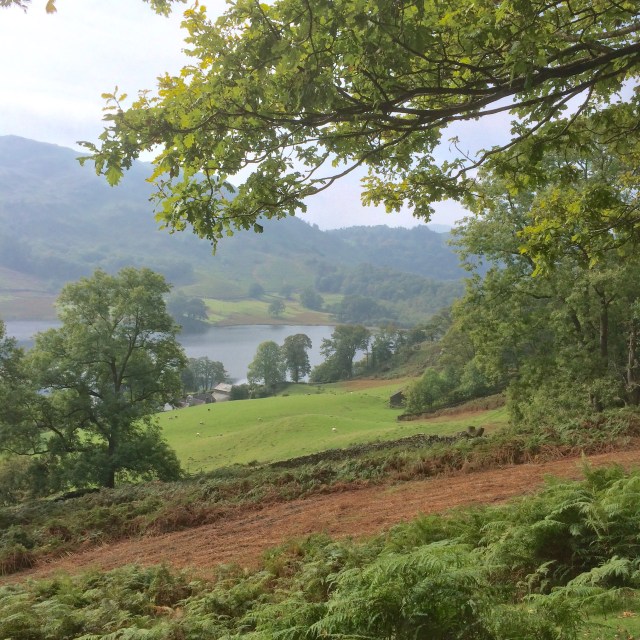
The last two days have been spent in the Lake District, ye olde stomping grounds of Wordsworth and Beatrix Potter. The weather has been great, even if the fog kept us off Lake Windermere until the afternoon. We did get to go for a two-mile ramble in the country-side, which was great.

Two things I’m learning: the struggle of focus and expectation management. It’s no small thing to try and focus the attention of others when there are a dozen comments to make and a million things to see. “I’d like to direct your attention” is such a quaint 20th century notion, really. Corral would be a better word, perhaps. Having been to this area before, it’s also interesting to handle my own expectations of what we can and cannot do: what gets added to the itinerary and what gets cut. Every side street tells a story, which means there are a million good things you’ll  ever hear.

Still and all, this land with its lakes and little lambs is beautiful. Now it’s on to a castle and some Sunday roast.

I’ve added some pics from the area to my Flickr stream. You can check them out by clicking on the three bars in the top right corner of the page.

IMG_0124

Posted in Uncategorized | Leave a comment

Big Sky over Texas

So I’m on my way to England with a gaggle of students and chaperones.  Our first layover is in Dallas-Fort Worth. Was nice flying over the Ballpark at Arlington and Six Flags. Good times. And now the promise of some Cousins BBQ and sweet tea while we wait.

Posted in Uncategorized | Leave a comment

Final Prep for the Doctor

Doctor Who series nine premieres this weekend.  Earlier this week, the BBC released a “prelude” to the season that takes us back to an interesting location and gives us some interestingly vague dialogue.  Love the line at the end about friends.

Posted in Television | Leave a comment