
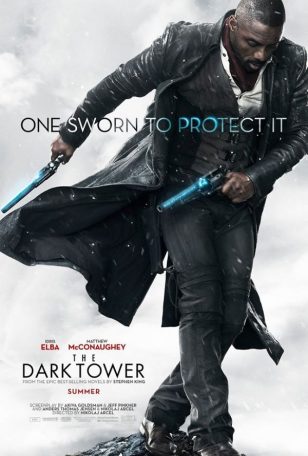
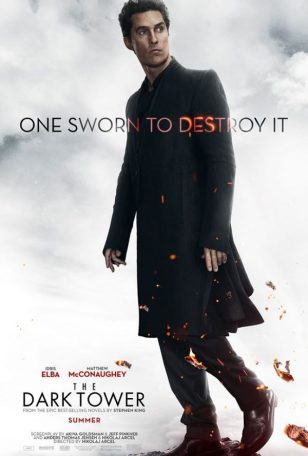
Trailer sometime tomorrow. Hoping that this movie is as amazing as it deserves to be.
Trailer sometime tomorrow. Hoping that this movie is as amazing as it deserves to be.
The posting of a new recording of Andrew Peterson performing is always a good thing. Here’s a recent rendition of “Rejoice” from The Burning Edge of Dawn.
This week The Flash spent most of the episode in “the darkest timeline,” with long-haired Barry Allen and all. It was, perhaps, one of the better episodes in more recent memory. In an attempt to learn the identity of big bad Savitar (and thus get the upper hand), Barry traveled into the future only to find Team Flash utterly fallen apart. The “getting the band back together” vibe worked well for the episode, even reminding the audience of what has often been best about the characters’ interactions.
The episode’s big tease, of course, was the almost-reveal of Savitar’s identity. Obviously it’s someone that evil Killer Frost has no problem following. Lots of viewers are thinking Ronnie Raymond. Maybe. Or maybe it’s a version of Hunter Solomon or even (a version of) Jay Garrick.
Here’s the extended trailer for next week’s episode, where the identity of Savitar is revealed.
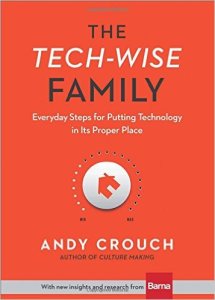 One of the introductory thoughts in Andy Crouch’s The Tech-Wise Family concerns “the proper place” for technology. The benefit of that phrase is in the acknowledgment that technology, screens and all, has a place. Wisdom, though, is key in determining that place. Early in the book, Crouch lays out how to triangulate that proper place. Crouch writes:
- Technology is in its proper place when it helps us bond with the real people we have been given to love. It’s out of its proper place when we end up bonding with people at a distance, like celebrities, whom we will never meet.
- Technology is in its proper place when it starts great conversations. It’s out of its proper place when it prevents us from talking with and listening to one another.
- Technology is in its proper place when it helps us take care of the fragile bodies we inhabit. It’s out of its proper place when it promises to help us escape the limits and vulnerabilities of those bodies altogether.
- Technology is in its proper place when it helps us acquire skill and mastery of domains that are the glory of human culture (sports, music, the arts, cooking, writing, accounting; the list could go on and on). When we let technology replace the development of skill with passive consumption, something has gone wrong.
- Technology is in its proper place when it helps us cultivate awe for the created world we are part of and responsible for stewarding (our family spent some joyful and awefilled hours when our children were in middle school watching the beautifully produced BBC series Planet Earth). It’s out of its proper place when it keeps us from engaging the wild and wonderful natural world with all our senses.
- Technology is in its proper place only when we use it with intention and care. If there’s one thing I’ve discovered about technology, it’s that it doesn’t stay in its proper place on its own; much like my children’s toys and stuffed creatures and minor treasures, it finds its way underfoot all over the house and all over our lives. If we aren’t intentional and careful, we’ll end up with a quite extraordinary mess.
It’s a solid beginning to what could easily be an important book for many families (and singles, even) trying to understand and manage a healthy relationship with technology.
You can purchase Andy Crouch’s The Tech-Wise Family here.
 Writer and professor Alan Jacobs recently returned from his Lenten break from online life. His first post back at Text Patterns concerned something Jacobs calls “Anthropocene theology.” This theology is nuanced because of the strange contemporary mindset that we live in a fully human and yet post-human framework. “Ours; not-ours,” he suggests. How should extending a world totally ours and yet beyond us affect the way we think and do theology?
To this claim there may be the immediate response, especially from orthodox Christians, that theology need not be different in this age than in any other, for human nature does not change: it remains true now as it has been since the angels with their flaming swords were posted at the gates of Eden that we are made in the image of God and yet have defaced that image, and that what theologians call “the Christ event” — the incarnation, preaching, healing, death, resurrection, ascension, and ultimate return of the second person of the Trinity — is the means by which that image will be restored and the wounds we have inflicted on the Creation healed. And indeed all that does, I believe, remain true. Yet it does not follow from such foundational salvation history that “theology need not be different in this age than any other.”
One does not need fancy anthropological words to ask this question, of course. A few weeks ago I spent a little bit of time thinking about coining the phrase “student theology,” the idea being that working with high school students calls for a certain kind of approach to theological truth. And yet “theology need not be different” for a senior in high school or for a senior adult. True? Jacobs continues:
We may indeed believe in some universal human nature and nevertheless believe that certain frequencies on the human spectrum of possibility become more audible at times; indeed, the dominance of certain frequencies in one era can render others unheard, and only when that era passes and a new one replaces it may we realize that there were all along transmissions that we couldn’t hear because they were drowned out, overwhelmed. The moral and spiritual soundscape of the world is in constant flux, and calls forth, if we have ears to hear and a willingness to respond, new theological reflections that do not erase the truthfulness or even significance of former theological articulations but have a responsibility to add to them. In this sense at least there must be “development of doctrine.”
I like his use of “frequencies” and “soundscape.” You get something like that in N. T. Wright’s How God Became King. In that book, Wright asserts that the Gospel is connected to four “sound speakers” that theologians have tended to adjust volumes for throughout the course of history. Turn two speakers up and two speakers down for too long and you lose things of significance for the expressed truths of the Gospel.
I do think that Jacobs is onto something. And for those with ears to hear, it is a message of good challenge. It is a challenge similar to those of Paul in his missionary journeys or of missionaries today attempting to articulate Christian truth to different (or indifferent) cultures. It doesn’t mean situational ethics. It does mean subtle thinking and clear communication.
You can read the rest of “Anthropocene Theology” here.
(image from level7.co)
The Flash on the CW begins its final sprint to its third-season finish line tomorrow night. The folks at the CW were kind enough to put together a simple “recap” video to refresh viewers’ memories.
Seems to me that you’ve got three things going on here. (1) Savitar and the predicted death of Iris West. (2) Killer Frost on the loose. (3) Abra Kadabra, who I think has a much larger role to play, particularly when it comes to “HG.” The thing not referenced in the recap: the Flashpoint timeline.
Word on the street is that the season will end with a cliffhanger. I hope it doesn’t involve the fate of Iris. It would be nice for it to be something bigger, something cosmic, yet something that doesn’t necessarily involve a villainous speedster. Looks like we’ll find out soon enough.
One of these days, I hope to procure a copy of the first Guild collection from Caedmon’s Call. Here’s a song from that album, a live version of “I Waited” by Bill Batstone.
It’s important to forget, I think, that Dave Eggers’ The Circle is first and foremost a thriller. The trailers for the soon-dropping flick build well, which means you’re more likely to go in expecting sharp turns. The book, the overall story, allows for some slow buy-in, a kind of patience that leads to pity. You get a sense of a slow, human build in this clip with Emma Watson and Nate Corddry (of Studio 60 on the Sunset Strip).
In the end, Watson has to do the hard sale. I think she’s up for it, but it will require some real willing suspension of disbelief (particularly for those of us who see her primarily as Hermione). Perhaps that’s where the thriller part of the story will carry us all away.
Here’s hoping that The Circle will catch us by surprise in a couple of weeks.
This one gets me every time.
It’s been an interesting Holy Saturday. Here a few hours out from the turn of Saturday into Sunday, I’m mindful of the strange silence of the day in the biblical story. On Thursday, before the break of Good Friday, my classes read through the passion narrative in Luke’s gospel from daybreak Friday morning to the quickened burial of Jesus. And as I listened to my students read, I was reminded of the sense of irreversible loss that Jesus’ disciples must have felt from midnight Friday on, how they probably forgot the three-day promise of Jesus in the midst of the chaos. And so a day of silence, one repeated a thousand different ways by a thousand different people each and every day. Even still . . .


 Space Enough, and Time